Mapping Industry Growth Trends
Welcome to the Course
Now that you have built a solid understanding of your strengths, values, and work style preferences, it is time to turn your attention outward. In this course, Career Exploration and Market Research, you will systematically investigate the professional landscape to discover where your unique profile fits best. The self-assessment you completed was your compass—this course is the map.
Throughout this course, you will learn how to research industries and evaluate their growth trajectories, decode job descriptions to understand what roles actually demand, and assess company cultures for alignment with your values. By the end, you will have a structured, evidence-based view of the career landscape that pairs with the personal profile you have already created. Let's start by learning how to classify industries and read the signals that tell you where the professional world is heading.
Frameworks for Career Classification and Industry Functions
Before you can evaluate where you want to go, you need a shared language for describing the terrain. The North American Industry Classification System (NAICS) is a widely used framework that organizes economic activity into sectors like "Healthcare", "Information Technology", and "Finance". While these labels help with benchmarking, focusing on industry functions—the core activities like operations, marketing, or product development—reveals transferable opportunities that labels might obscure.
A practical tool is the Industry Map. Start with three to five sectors that interest you, then list the primary functions within each. You might discover that experience in "Manufacturing" has direct parallels to roles in "Logistics" or "Operations". This shifts your focus from being locked into one sector to seeing your skills as portable assets. As you build this map, also consider organizational scale; a role at a 50-person startup functions differently than the same title at a 10,000-person corporation. The following diagram illustrates how the same skill sets may apply to different industry roles:
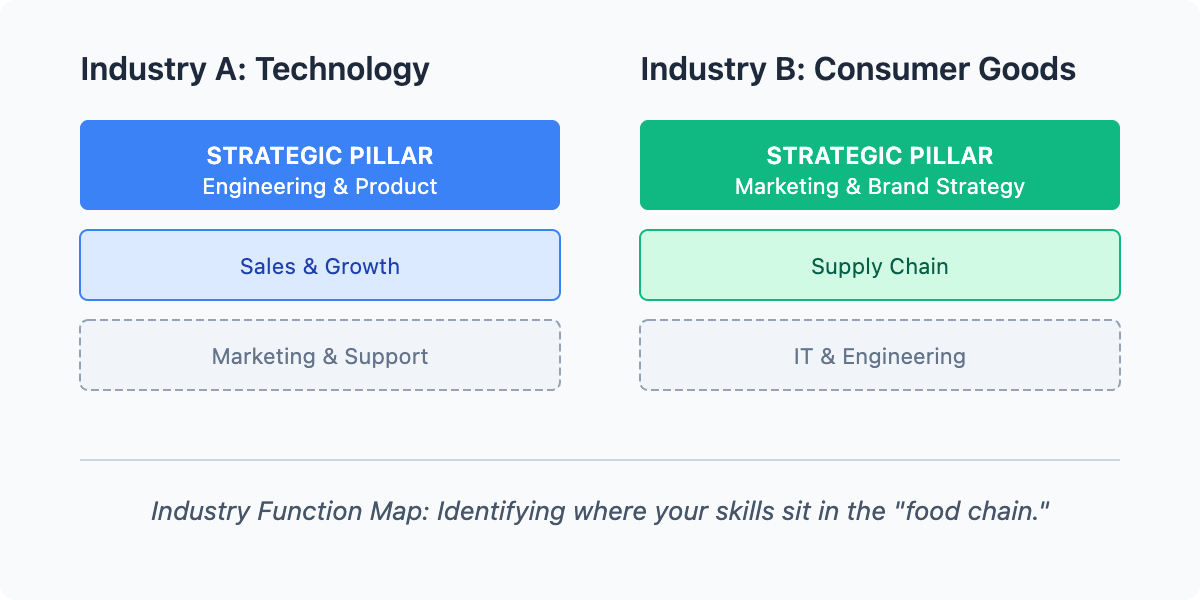
To see how this plays out in practice, consider this conversation between two professionals exploring their options:
- Nova: I've been in healthcare HR for eight years, and I feel like I'm stuck. I want to explore something new, but I don't know where my skills would even apply.
- Ryan: Have you tried mapping your core functions instead of just looking at industry labels? When I did that, I realized my experience managing large teams in retail translated directly into logistics and operations.
- Nova: That's interesting. I guess talent acquisition and employee engagement aren't really healthcare-specific skills—they're universal.
- Ryan: Exactly. Once I stopped thinking of myself as a "retail HR person" and started thinking of myself as someone who builds high-performing teams at scale, my options opened up significantly.
- Nova: So the industry is just the context, but the function is what actually transfers.
- Ryan: Right. Map the functions first, then see which industries need what you already do well.
Notice how Ryan's shift from an industry-first mindset to a function-first mindset unlocked career paths he had never considered. This is exactly the kind of reframing that an Industry Map is designed to produce—it moves you from feeling locked into one sector to seeing your skills as portable assets across multiple industries.
Interpreting Employment Projections and Market Health
Once you can classify industries, the next step is evaluating their health. Employment projections, such as those from the Bureau of Labor Statistics (BLS), offer data on projected growth rates and median salaries. While a high growth rate (e.g., 28% over a decade) signals robust demand, you must also consider absolute volume. A niche field growing at 40% may offer fewer total opportunities than a stable industry growing at 10% that employs millions.
Beyond government data, look at market health indicators like venture capital investment, merger activity, and technological disruption. For instance, high levels of funding in "AI-driven technology" signal where new roles will emerge. The key is to pair quantitative projections with qualitative context so you are not just chasing a headline number but understanding the full story behind the demand.
Identifying Emerging Sectors and Stability Indicators
Emerging sectors—like "Climate Technology" or "Remote Work Infrastructure"—often offer accelerated growth because they are scaling fast and need talent to build their foundations. To identify these, watch for a convergence of signals: government policy investment, talent migration patterns (professionals leaving established firms for new spaces), and new job titles appearing on job boards that did not exist a few years ago.
However, emerging sectors require checking stability indicators. Evaluate a sector's funding diversity, regulatory environment, and revenue model maturity before pivoting. A sector like "Cybersecurity" is stable because it meets an enduring need, whereas a sector built around a single platform carries more risk. The smartest approach is to balance aspiration with pragmatism—targeting growth while maintaining transferable skills that keep you employable across the broader market.
Up next, you will put these concepts into practice in a role-play session where you will defend an industry choice using real growth data and market reasoning.
