Reframing Everyday Conflict
Welcome to the Course
Welcome to Building Confidence in Everyday Conflict. You’re about to embark on a journey that will help you transform how you approach workplace disagreements. In this unit, you’ll discover how to see conflict not as a threat, but as a powerful opportunity for growth, collaboration, and stronger relationships. You’ll also learn to spot early warning signs of tension, understand the impact of your own responses, and take practical steps to resolve issues before they escalate. By the end, you’ll be equipped to handle tough conversations with more clarity, empathy, and confidence—skills that will serve you throughout your career.
Reframing Conflict: From Threat to Opportunity
It’s natural to feel uneasy when conflict arises, but what if you could view these moments as chances to learn and improve? Reframing conflict means shifting your mindset from defensiveness to curiosity. For example, instead of thinking "They’re challenging my idea because they don’t respect me," you might try, "They see something I might have missed—what can I learn from their perspective?" This approach helps you stay open, reduces tension, and often leads to better solutions for everyone involved.
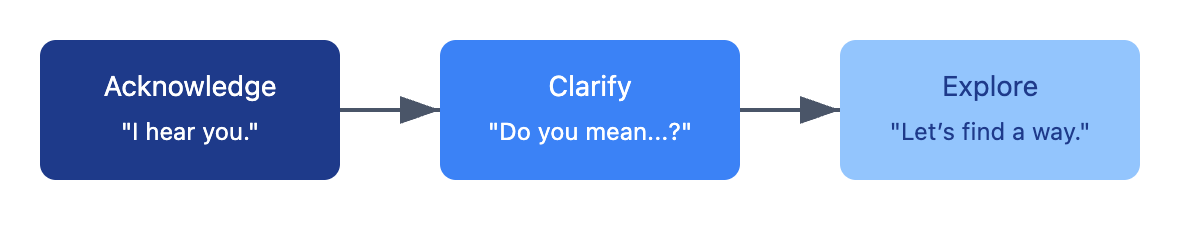
To help you put these ideas into practice, try using the ACE Framework whenever you encounter conflict:
- Acknowledge: Recognize the other person’s feelings or concerns. This shows you’re listening and that their perspective matters.
- Clarify: Ask questions or restate what you’ve heard to make sure you understand the issue. This helps prevent misunderstandings and shows your intent to collaborate.
- Explore: Invite the other person to work with you on a solution. Focus on shared goals and next steps
Practicing Empathy and Clarity in Tense Moments
When emotions run high, it’s easy to react defensively or shut down. However, showing empathy and focusing on shared goals can quickly change the tone of a conversation. Imagine receiving a blunt email from a coworker. Rather than matching their tone, you could use the ACE Framework:
- Acknowledge: “I can see this issue is important to you.”
- Clarify: “Can you tell me more about what’s not working?”
- Explore: “Let’s see how we can move forward together.”
Here’s a short dialogue that demonstrates how the ACE Framework might look in action:
- Chris: Jake, I’m frustrated that you changed the project plan without talking to me first. It feels like my input doesn’t matter.
- Jake: I hear you, Chris. That wasn’t my intention. I made the change because of a tight deadline, but I should have checked in with you. Can we talk about what’s most important to you for the next steps?
- Chris: I appreciate you saying that. I just want to make sure we’re both on the same page before things move forward.
- Jake: Absolutely. Let’s set up a quick sync so we can align and avoid surprises.
In this exchange, Jake uses the ACE Framework: he acknowledges Chris’s feelings, clarifies the situation, and explores a way forward together. Notice how this approach lowers tension and opens the door to a more productive conversation.
You’re now ready to put the ACE Framework into action. In the upcoming role-play session, you’ll have the chance to practice reframing conflict and responding with empathy in real-world scenarios.
