Delivering Candor with Care
Delivering Candor with Care
Clear expectations tell people what "done" looks like. Feedback is how you keep them pointed at it once the work is moving. The trouble is that most managers either soften the message until it disappears or sharpen it until it stings, and both failures quietly erode trust. This unit is about the third path: saying the hard thing in a way that actually lands, whether you're correcting a direct report or renegotiating a commitment upward with your own manager.
Map Where Your Feedback Actually Lands
Kim Scott's Radical Candor framework, from her book of the same name, puts two things on separate axes: how much you Care Personally and how much you Challenge Directly. Get both high and you're in radical candor: you tell the truth because you're invested in the person. Get neither, usually feedback given through a third party or a backhanded comment, and you're in Manipulative Insincerity.
The two failure modes in between are the ones to watch. Care without challenge is Ruinous Empathy, the most common manager failure: you're so worried about the relationship that you withhold the feedback, and the person stays stuck. Challenge without care is Obnoxious Aggression: you're blunt but cold, so the message bounces off defensiveness.
The trap to watch for is Ruinous Empathy, because it feels kind in the moment. Letting a missed deadline slide, praising work you privately think is mediocre, hinting instead of naming: these read as warmth but they tell the person their growth doesn't matter enough for you to be straight. The fix is not to crank up the challenge and slide into aggression. It's to keep the care visible while you raise the bar.
![ A 2x2 grid showing the Radical Candor framework. The vertical axis "Care Personally" is labeled at the top, and the horizontal axis "Challenge Directly" is labeled at the right.]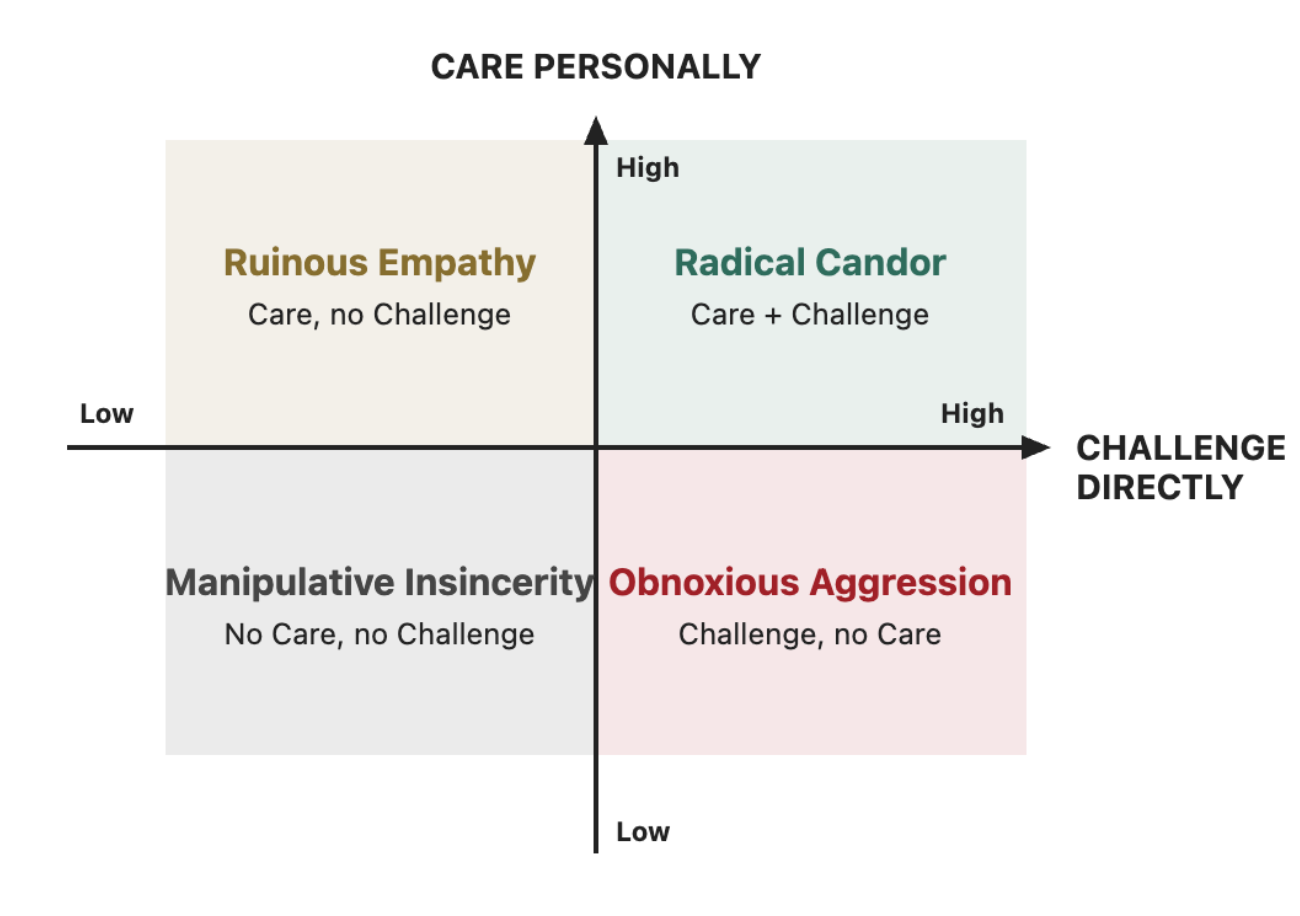
Make It Specific with SBI
Caring directness needs structure, or it collapses into character judgment ("you're not detail-oriented"). Use SBI: name the Situation (when and where), describe the observable Behavior (what they actually did, not what kind of person they are), then state the Impact (the effect on people or the work). SBI keeps you on facts the person can't argue with, which is exactly what cuts through defensiveness. After the impact lands, coach toward one concrete next action rather than a lecture of fixes.
- Ryan: Quick feedback on the forecast deck. You sent it straight to the VP on Tuesday before we'd reconciled the Q3 numbers, and two figures came out wrong.
- Jake: I figured speed mattered most, you'd said she wanted it fast.
- Ryan: Speed did matter, and the impact is she flagged the errors in the thread, which puts our team's credibility on the line. Going forward, run anything exec-facing past me for a ten-minute reconciliation check first. Workable?
- Jake: Yeah, that's fair.
Notice Ryan never says "you're careless." He names the moment, the action, and the cost, then lands on a single behavior Jake can repeat. When a report gets defensive or counter-flags someone else, you don't escalate and you don't retreat; you return to the specific situation, behavior, and impact until the substance is what's left to discuss.
Take Candor Upward Before the Deadline Slips
The same skill points up the chain. When a commitment to your manager is starting to slip, candor with care means raising it early, while there's still room to renegotiate, rather than confessing at ninety percent slipped. Name the situation plainly: the deliverable is at risk, here's the specific cause, and you're flagging it now on purpose. Don't surprise-dump ("just a heads-up, might be late") and don't over-promise recovery ("I'll catch up over the weekend"). Instead, bring options, a reduced scope, a one-week extension, a phased delivery, and recommend one. Managers trust the person who gives early signal far more than the one who delivers flawlessly but goes silent until it's too late.
The throughline of this unit is one move: tell the truth early and specifically, and keep the person in view while you do it. That's what separates candor that builds trust from candor that burns it.
This is where it gets concrete. You'll first spot-check the four quadrants by classifying real manager-to-report exchanges, then take SBI into a live feedback conversation with a defensive top performer, and finally practice renegotiating an at-risk commitment with your manager before it slips. Each one tests whether you can stay both direct and caring when the other person makes it hard.
