Understanding Prime Factorisation
Introduction
Welcome to Breaking Numbers Into Primes, the third course in our learning path! In the first two courses, we built a strong foundation with factors, multiples, prime and composite numbers, and handy divisibility shortcuts. Now it is time to put all of that knowledge to work in a powerful new way.
In this first lesson, we will explore what it means to break a number into its prime factors. We will see why every whole number greater than 1 can be written as a product of primes, learn how to verify that a factorisation is correct, and practise decomposing small numbers by inspection. Let's get started!
Primes: The Atoms of Numbers
As you may recall from earlier courses, a prime number is a whole number greater than 1 whose only factors are 1 and itself. Numbers like , , , , and are prime. A composite number, on the other hand, has additional factors and can be broken into smaller pieces.
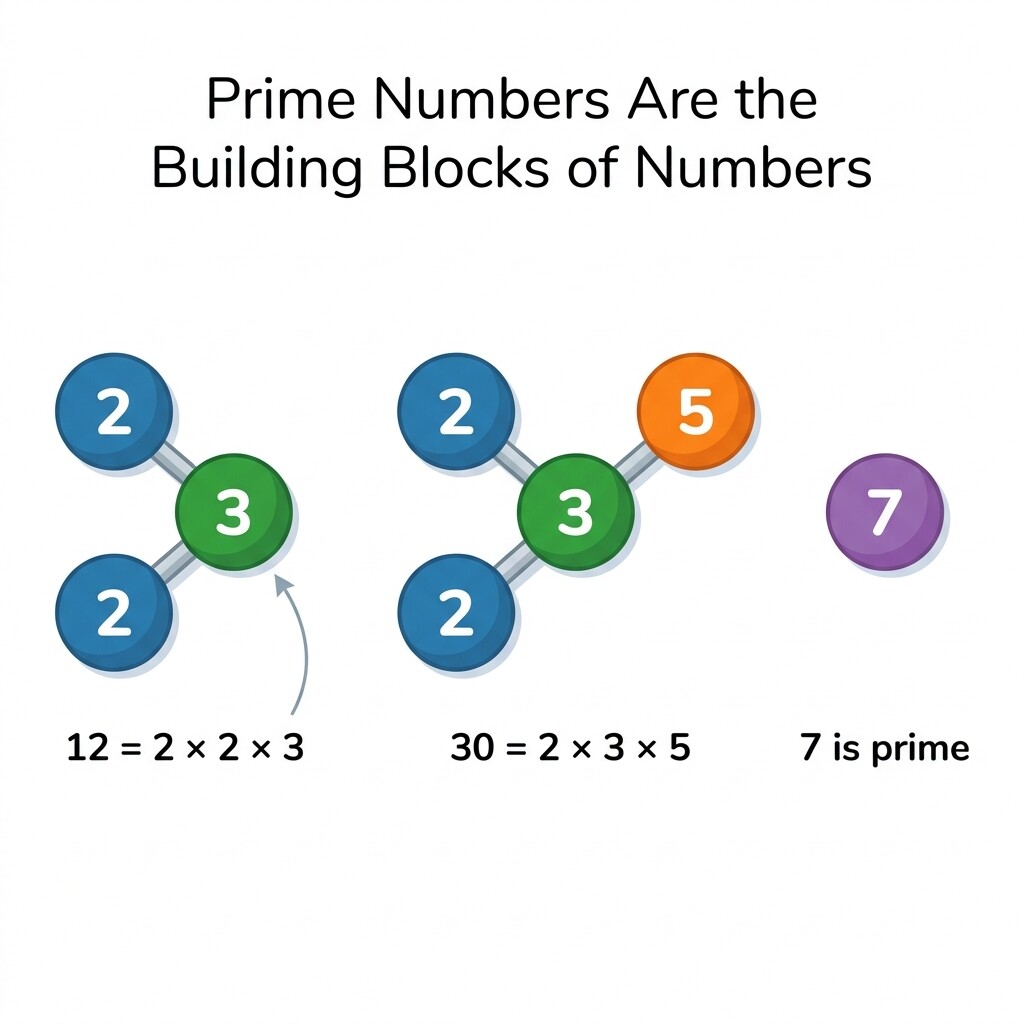
Think of primes as atoms in chemistry. Just as every substance is built from atoms, every composite number is built from primes. No matter how large a number is, we can always split it into prime "building blocks." That idea is the heart of this entire course.
What Prime Factorisation Means
Prime factorisation is the process of writing a whole number as a product of prime numbers. For example:
Every factor on the right side is prime, and when we multiply them together we get back to . That expanded product, , is the prime factorisation of . Because 1 is not a prime number, it is never included in a prime factorisation.
Here are a few more examples to build the pattern:
| Number | Prime Factorisation |
|---|---|
Notice that every factor listed is prime. If even one factor in our product is composite, we have not finished factorising. For instance, writing is not a prime factorisation because is composite — we would need to break down further into .
The Uniqueness Guarantee
One of the most important facts in all of mathematics is the Fundamental Theorem of Arithmetic. It states that every integer greater than 1 is either a prime itself or can be represented as a product of primes. Furthermore, every whole number greater than 1 has exactly one prime factorisation, apart from the order in which we write the factors.
In mathematics, a single prime number is considered a "product" of one prime. It’s similar to how a single brick is still considered a "building block," even if it hasn't been stacked with others yet. For a number that is already prime (like ), its prime factorisation is just .
What does "apart from order" mean? Consider again. We could write , or , or . These are all the same collection of prime factors, just rearranged. No matter how we choose to break apart, we will always end up with two s and one — there is no alternative set of primes that multiplies to .
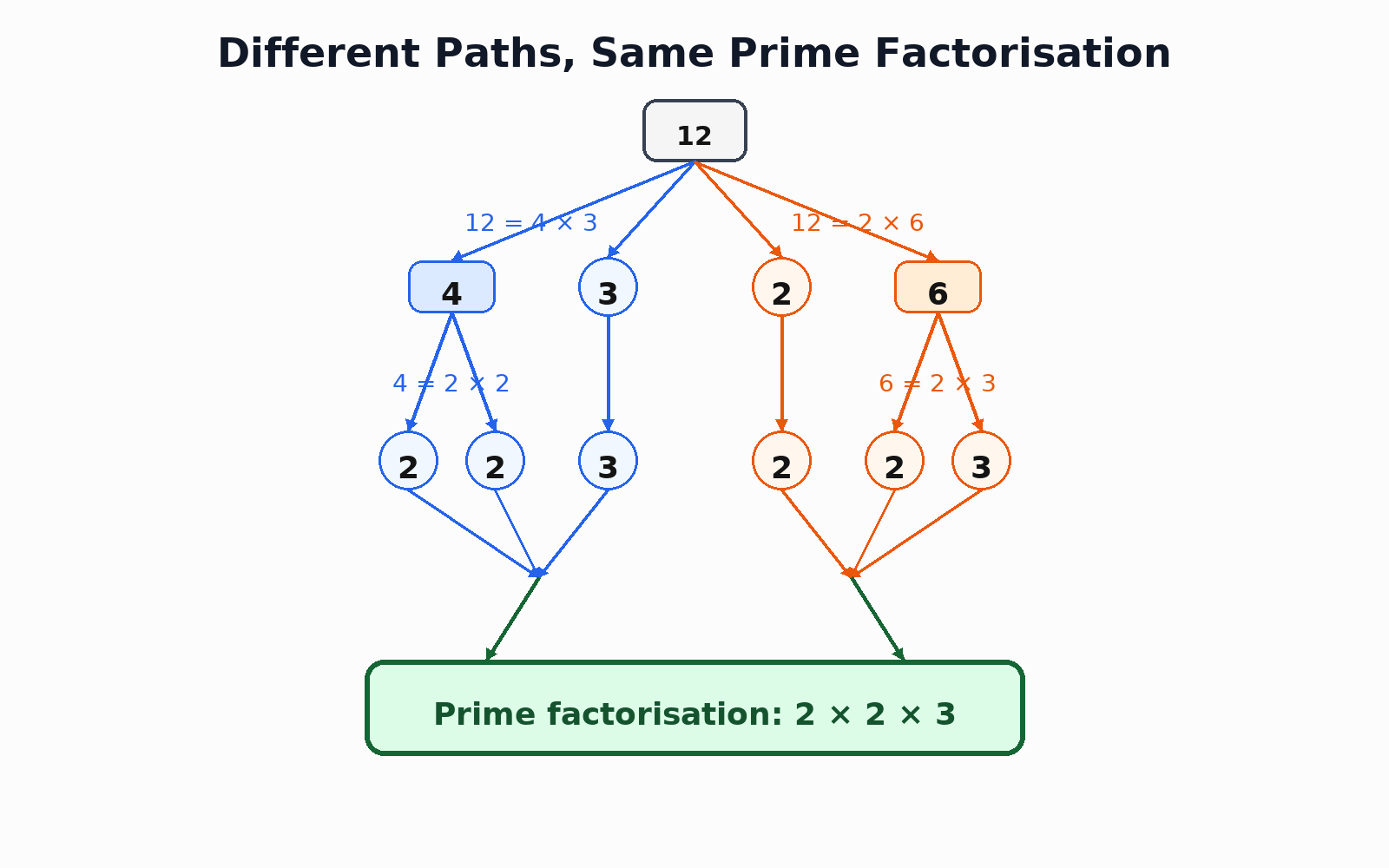
This uniqueness is what makes prime factorisation so useful. It gives every number a kind of fingerprint that never changes, and later in this learning path we will use these fingerprints to find highest common factors and lowest common multiples efficiently.
Verifying a Prime Factorisation
Before we start building factorisations from scratch, let's practise a critical skill: checking whether a claimed factorisation is correct. To verify, we confirm two things:
- Every factor in the product is prime. If any factor is composite, the factorisation is incomplete.
- The factors multiply back to the original number. If the product is wrong, the factorisation does not match.
Example 1 — Correct factorisation: Is a valid prime factorisation of ? All three factors (, , ) are prime ✓, and ✓. Yes, this is correct.
Example 2 — Composite factor present: Is a valid prime factorisation of ? The factor is not prime (), so this fails immediately. Even though , the factorisation is not complete because a composite factor remains.
Example 3 — Wrong product: Is a valid prime factorisation of ? Every factor is prime ✓, but ✗. The factors do not multiply to the target number. Always multiply back to be sure!
Decomposing Small Numbers by Inspection
For small numbers, we can find the prime factorisation simply by thinking through what we already know about factors. The approach is straightforward:
- Start with the smallest prime, . If it divides the number, pull it out and work with what remains.
- Keep dividing by until it no longer goes in evenly, then move to , then , and so on.
- Stop when the remaining number is itself prime — that last prime is your final factor.
Let's walk through using this approach. We begin by dividing: , so we pull out a . Now is not divisible by , so we try : since , we pull out a , and the remaining is already prime. Collecting everything gives us . A quick check confirms it: ✓.
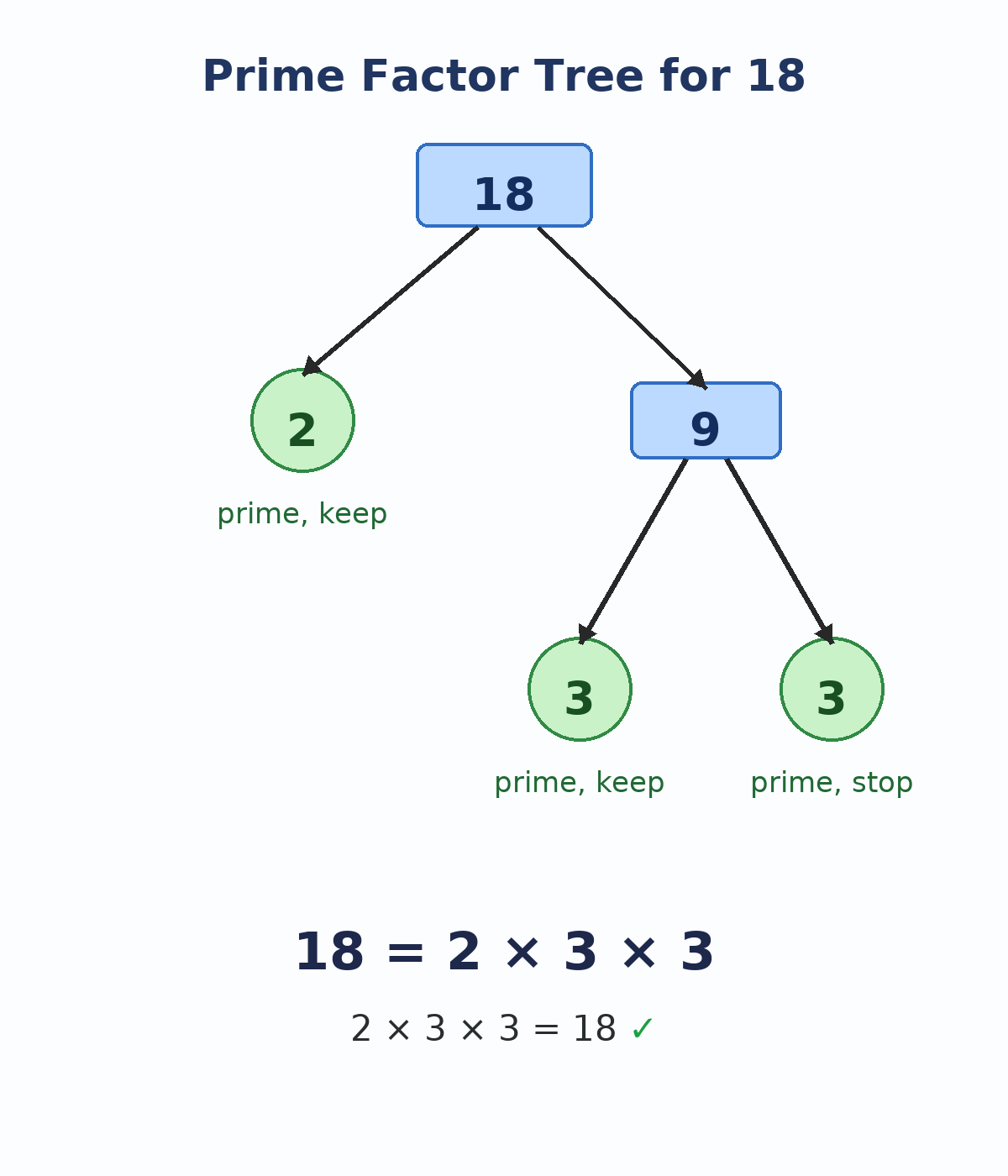
Now try . Dividing by gives , then , and is prime, so we stop. The result is , confirmed by multiplying back: ✓. With a little practice, you will be able to do this almost instantly for numbers under .
Conclusion and Next Steps
Let's recap the key ideas from this lesson. Prime factorisation means expressing a number as a product where every factor is prime. The Fundamental Theorem of Arithmetic guarantees that every number greater than 1 is either prime or has a unique prime factorisation — no matter how you break a number apart, you always arrive at the same set of prime factors. To verify any claimed factorisation, simply check that every factor is prime and that the product equals the original number.
Up next, you will put these ideas into action with a set of hands-on practice tasks. You will verify given factorisations, compute products of primes, decompose small composites on your own, and explore firsthand why different splitting paths always lead to the same prime factors.
