Everyday Bayesian Thinking
Introduction
Welcome back to Bayesian Reasoning in the Real World! This is lesson three of seven, placing us nearly at the midpoint of the course. So far, we have used Bayes' theorem in fairly structured settings: a spam filter that multiplied likelihood ratios across flagged words, and a courtroom scenario where ignoring the base rate produced the prosecutor's fallacy. Both of those situations came with concrete numbers ready to plug into the formula.
Today we step away from exact calculations and into the kind of uncertain thinking we all do every day. Should we trust that five-star review? Does a new weather forecast change our picnic plans? What does an unexpected headache really mean? These questions don't come with neat probabilities attached, but the Bayesian framework still provides a reliable way to think them through. By the end of this lesson, you will be able to look at any new piece of evidence and reason clearly about whether it should shift your belief and by roughly how much.
From Formulas to Everyday Intuition
In earlier courses and lessons, we practiced computing posteriors with precise priors and likelihoods. Real life rarely hands us those numbers. We don't know the exact probability that a great restaurant receives a one-star review, and we certainly don't have a reliable base rate for how many restaurants in our city are "great."
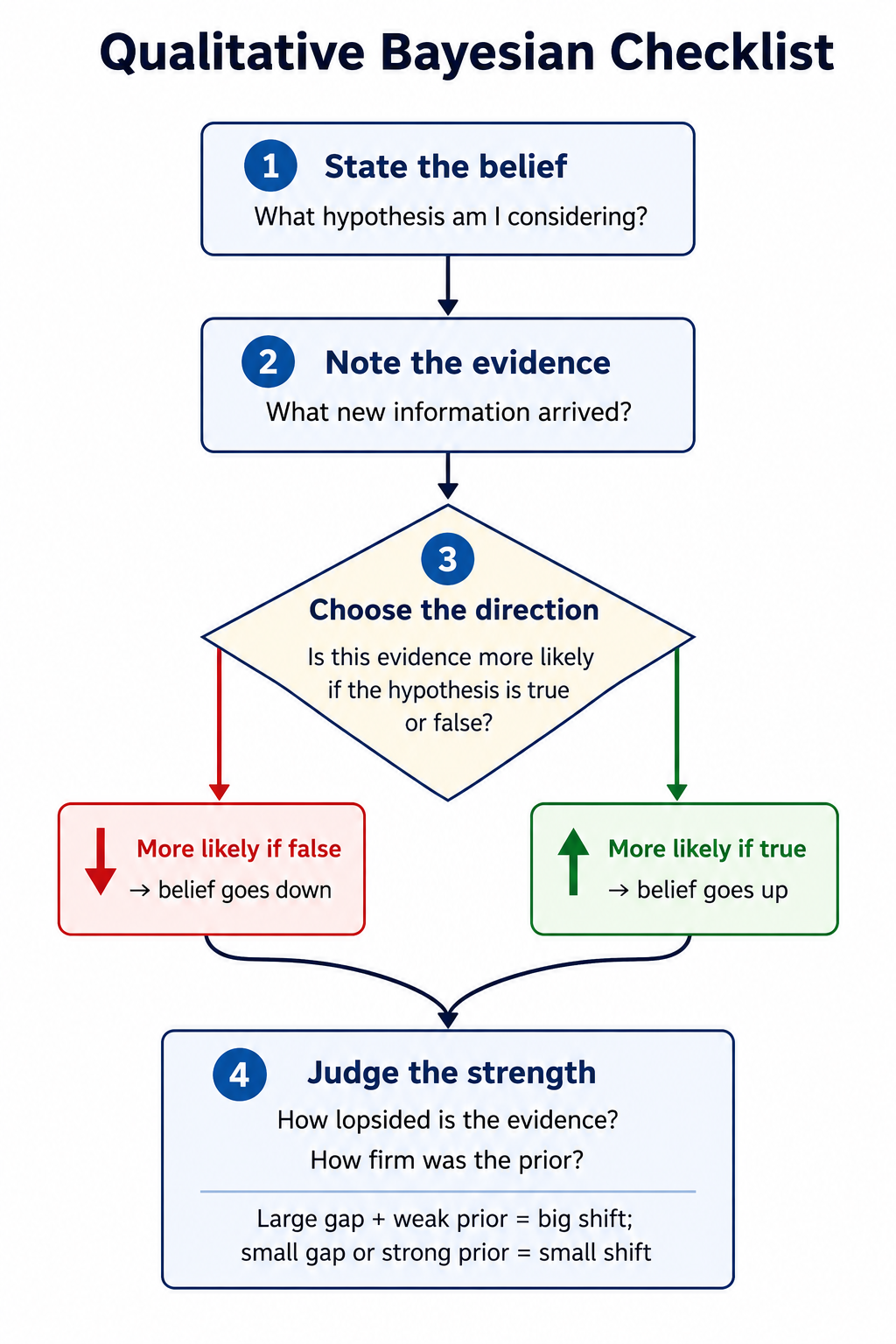
That is perfectly fine. The power of Bayesian thinking is not limited to calculation. At its heart, it offers a simple mental checklist: What do I currently believe? How does this new evidence relate to my belief? And how strongly should it move me? These three questions map directly onto the prior, the likelihood ratio, and the posterior that we have been computing all along — just without the arithmetic. Let's break the checklist into two concrete skills: choosing the direction of the shift and judging its rough strength.
Which Direction Should Belief Move?
When a new piece of evidence arrives, the first question is straightforward: does this evidence make our hypothesis more likely or less likely? The answer comes from comparing two likelihoods:
If the evidence is more probable when the hypothesis is true, the evidence supports the hypothesis and our belief should rise. If the evidence is more probable when the hypothesis is false, the evidence undermines the hypothesis and our belief should fall. In qualitative reasoning, we do not need exact numbers. We just need to decide which side the evidence favors.
Example — a friend's café review. We believe a local café serves good coffee. A friend who shares our taste tells us she tried it and was disappointed. Ask: is "my friend was disappointed" more likely if the café is good or if it is mediocre? Almost certainly more likely if it is mediocre. So this evidence should lower our belief in the café.
Example — dark clouds before a picnic. We think it probably will not rain today. Then we glance outside and see dark clouds gathering. Are dark clouds more likely on a rainy day or a dry day? Clearly more likely on a rainy day. So our belief in "no rain" should decrease, and our belief in rain should increase.