Editing and Using Images Responsibly
Editing and Using Images Responsibly ✂️
Generating an image from scratch is one workflow. The other, often more common in HR, is taking an image you already have and changing one specific thing about it. That's editing, and it's where AI tools save the most time: an About-page leadership photo that needs a former employee removed (make sure the reason is defensible and the edit doesn't misrepresent the team), a careers-page shot with the wrong background, an internal-comms graphic with a distracting object. But editing also concentrates the risk. The closer an edited image looks to a real photograph, the more carefully you have to handle what it says, what it implies about real people, and how you publish it — because a public-facing HR image can read as a claim about your workforce.
By the end of this lesson, you'll be able to:
- Identify the edit types AI tools can support — cropping, background changes, object removal, inpainting, outpainting, and style adjustments.
- Write image-edit instructions using the Image Edit Brief to preserve required elements while changing only the targeted area.
- Evaluate AI-generated or AI-edited images for brand, audience, accessibility, accuracy, and disclosure risks before sharing.
Know the Edit Types AI Can Actually Do 🎨
Before you write any instruction, it helps to know what's on the menu, because the right vocabulary gets you a faster, cleaner result:
| Edit Type | What It Does | Watch Out For |
|---|---|---|
| Cropping | Trims the frame to a new aspect ratio or focal point | Cutting off something important, or breaking a layout's safe area |
| Background change | Swaps what's behind the subject while keeping the subject intact | Mismatched lighting between subject and new background |
| Object removal | Erases something unwanted and fills the gap with a plausible patch | Ghosted edges where the object used to be |
| Inpainting | Masks a region and generates new content to appear there | Warped hands, regenerated faces, invented details |
| Outpainting | Extends the image beyond its original edges to widen the canvas | Visible seams where the new canvas meets the original |
| Style adjustment | Shifts the overall look: color grade, illustration treatment, lighting feel | Drift away from your organization's visual system |
Most HR edits are some combination of these. A "fix the About-page photo" request is usually object removal (the person who left) plus a background change plus a light color match. Naming the edit type in your head first makes the instructions you write next much sharper, because each type has its own failure modes — and when the edit touches a real person's face or the makeup of a team, drift becomes an accuracy and authenticity problem, not just a cosmetic one.
Write the Image Edit Brief ✍️
Free-form editing requests like "remove the person who left and change the background" are how good people-photos get ruined. The model has no idea what you consider untouchable, so it'll happily redraw a remaining person's face, shift their position, or warp the lighting. The fix is the Image Edit Brief, a four-part instruction:
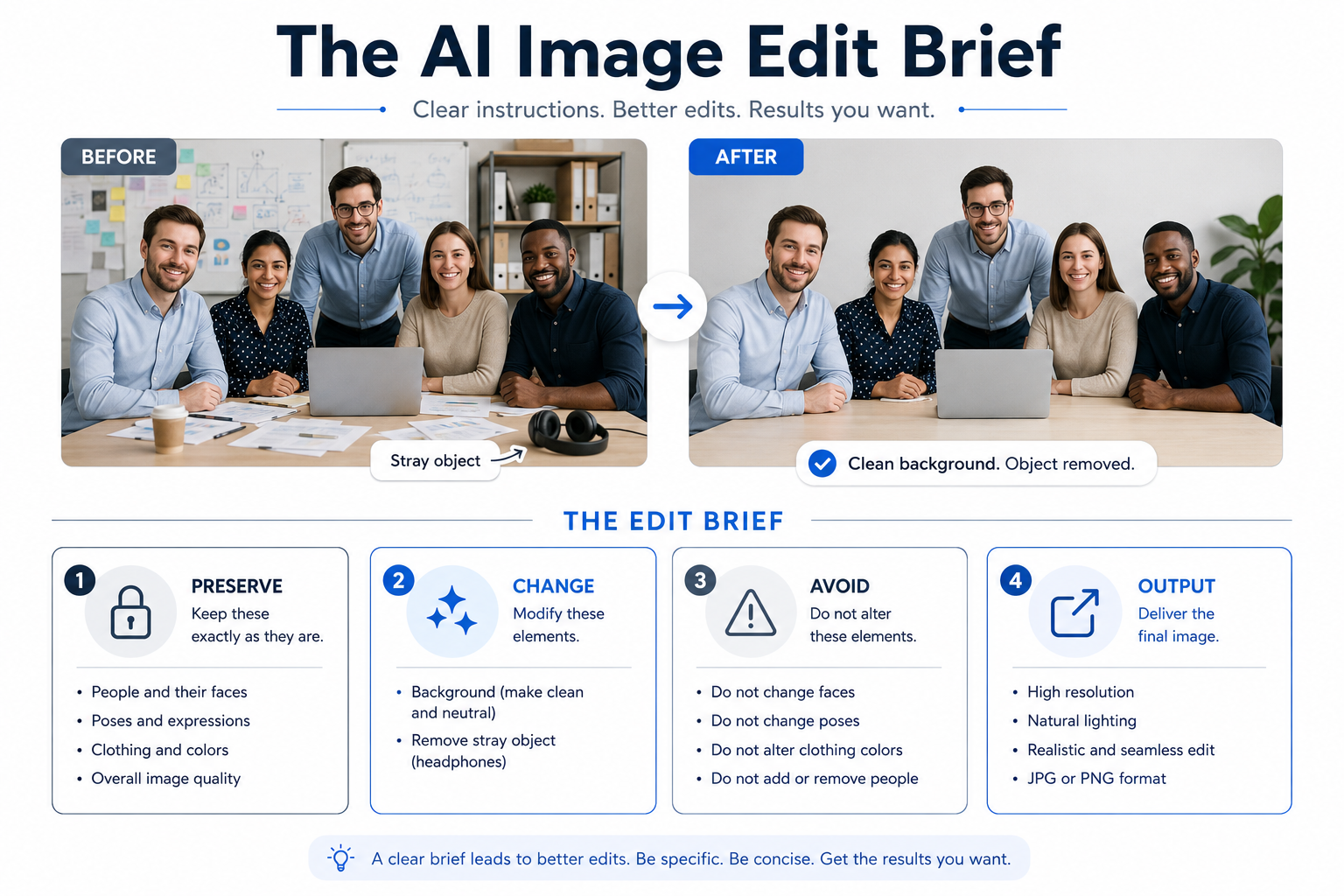
- Preserve: what must remain exactly as-is.
- Change: the specific edit, described concretely.
- Avoid: artifacts, drift, or unintended modifications.
- Output: final format, dimensions, and where it's going.
Preserve is the part people skip. You have to explicitly name the faces, positions, and lighting of the people who stay — anything you're not willing to lose, especially anything that affects how real people are represented. Change should be one or two surgical edits, not a wish list. Avoid catches the predictable failure modes: face drift, warped shoulders, mismatched lighting, seams. Output ties the edit to its real use: an About/careers page has different demands than an internal slide.
Let's look at what an HR edit conversation might sound like:
- Ryan: What's the edit?
- You: Take the person who left out of the leadership photo and freshen up the background to match the new office.
- Ryan: That'll come back with the remaining people's faces slightly redrawn. What are you preserving?
- You: The faces, positions, and lighting of everyone who stays. They come back pixel-for-pixel.
- Ryan: Good. And Avoid?
- You: No face drift, no warped shoulders, no seam where the person was, no mismatched lighting between the people and the new background.
Notice Ryan's pressure: name what stays before you name what changes, and in HR, "what stays" includes the real people whose likeness you can't distort. That order is the whole brief.
Evaluate Before You Ship 🚦
A clean edit doesn't automatically mean a publishable asset. Before any AI-generated or AI-edited image goes out under your organization's name — especially a careers page or recruiting post — run it through five checks:
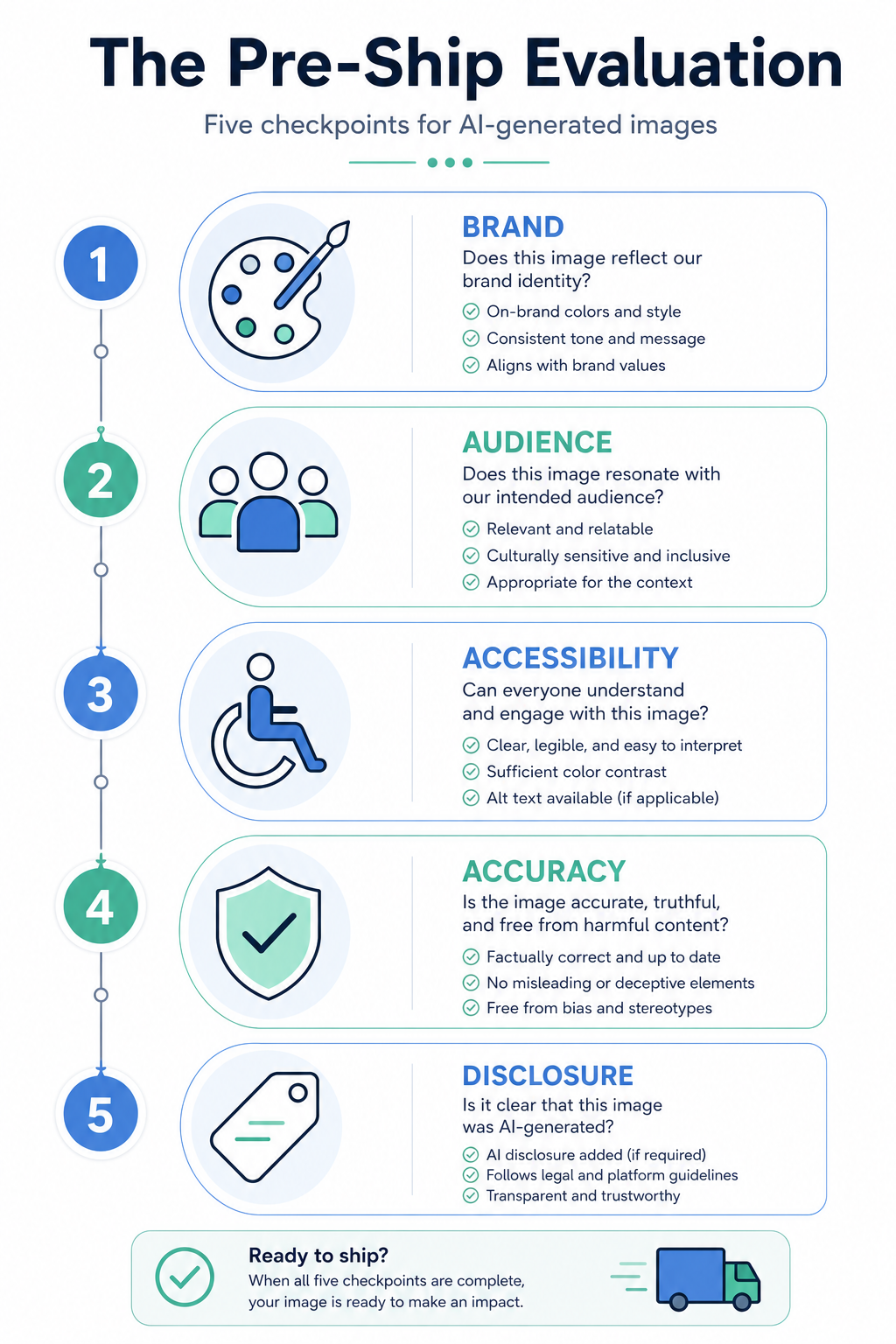
- Brand: does it match the visual system, or does it read as generic stock?
- Audience: will candidates and employees seeing it interpret it the way you intend, on this channel?
- Accessibility: does it need alt text, and is the contrast high enough where a headline overlays it?
- Accuracy: does the image imply something untrue — that these are real employees, a real team makeup, a workplace that doesn't reflect reality?
- Disclosure: if the image is AI-generated or substantially AI-edited, do platform rules or your audience's expectations call for labeling it (for example "AI-generated illustration, not actual employees")?
The accuracy and disclosure checks are where HR teams get burned. An AI image of "our employees at work," placed next to recruiting copy, reads as a depiction of real staff even if you never said so — and if the depicted roles or demographics don't reflect the actual team, that's a stereotype and a misrepresentation risk; if the faces resemble real people, it's a likeness/rights problem. For likeness-sensitive or public-facing images, a broader Responsible Visual Use Review also asks: do real people consent to this use; do you have rights to the source and style; does the edit imply something false; can you trace what's generated vs. edited vs. original; who signs off before publishing; and does the use require an "AI-generated" or "AI-edited" label? It also helps to run a lightweight Visual Preflight before you generate or edit — write down the intended use and audience, the criteria you'll judge against, the approved/non-sensitive source assets you'll use, and the consent/rights/disclosure needs — so you decide what "acceptable" means before producing anything.
The move when a risk surfaces is not always to scrap the asset: sometimes you revise the prompt, sometimes you change the caption or placement, sometimes you add a disclosure line, sometimes you swap in approved photography. The judgment call is yours, but it has to be a call, not a default.
The throughline of this unit: edits and AI images need a stated intent (the brief) and a stated standard (the five checks plus the Responsible Visual Use Review), or you'll publish something nobody actually approved — and on a careers page, "published" reads as a claim about your people. Before this becomes real, you'll get on a call with a brand lead who wants to ship an AI recruiting image tomorrow and isn't sure the risk is worth a delay. Your job is to name the specific concerns, propose options, and land on a defensible call together: revise the prompt, change the usage plan, or kill the asset. Bring specifics — vague risk talk loses to a publish deadline every time.
