Agile Versus Waterfall
Agile vs Waterfall: Context-Driven Choice
Having explored the foundational values and principles of agile in our previous lesson, you now face a critical question that every Product Manager encounters: When should you actually use agile versus traditional approaches? The reality is that neither agile nor waterfall represents a universal solution—each has its place depending on context, constraints, and objectives. As you navigate today's complex organizational landscapes, you'll need to make informed methodology decisions that balance idealism with pragmatism, explaining your choices convincingly to stakeholders who may have strong preconceptions about what approach is "right".
This lesson empowers you to move beyond dogmatic adherence to any single methodology, developing instead a nuanced understanding of when different approaches serve your goals best. You'll learn to recognize the signals that suggest agile, waterfall, or hybrid approaches, understanding that the best Product Managers aren't methodology zealots but rather thoughtful practitioners who choose the right tool for each unique situation. Most importantly, you'll develop the communication skills to articulate these choices to diverse audiences, from engineers who champion agility to executives who crave predictability.
Understanding Waterfall and Key Methodology Differences
Waterfall follows a sequential, linear progression through distinct phases: requirements gathering, design, implementation, testing, deployment, and maintenance. Each phase must be substantially completed before the next begins. Emerging from manufacturing and construction where late changes are prohibitively expensive, waterfall emphasizes comprehensive upfront planning, detailed documentation, phase gates with formal approvals, and change control processes. Requirements get locked down early, creating a contract for what will be built, when, and at what cost.
Consider the fundamental differences between agile and waterfall:
| Aspect | Waterfall | Agile |
|---|---|---|
| Planning & Requirements | Comprehensive upfront planning; requirements locked early; changes require formal process | Just-enough planning to start; requirements evolve with learning; changes welcomed as opportunities |
| Risk Management | Predict and mitigate risks upfront; works for known, stable risks | Early delivery surfaces unknowns; learn through iteration; adapts to emerging risks |
| Team Structure | Functional specialization; sequential handoffs between groups | Cross-functional collaboration; simultaneous work on features; shared ownership |
Notice how waterfall is a bit more rigid and plan heavy upfront versus agile is planning more as you go and has flexibility for risks.
Choosing the Right Approach and Communicating Your Decision
The decision between agile, waterfall, or hybrid approaches requires careful analysis of your specific context and constraints.
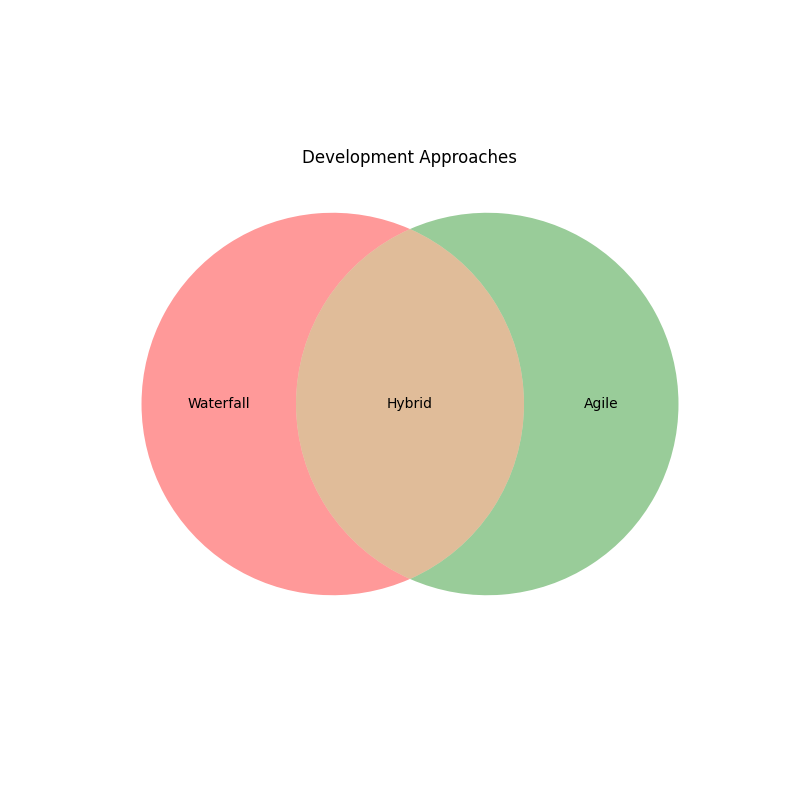
Waterfall fits best when requirements are genuinely stable with clear, unchanging objectives. Regulatory compliance projects—medical devices, financial reporting—have requirements defined by external regulations that won't change during development. When change costs are truly prohibitive (like satellite software after launch) or stakeholders need high predictability for budgeting, waterfall's upfront planning provides necessary certainty.
Agile thrives in environments characterized by uncertainty and change. When exploring new markets where you're learning what customers want, agile's iterative approach enables adjustment based on real feedback. Products requiring frequent updates—social media platforms, e-commerce sites—need a rapid response to market changes. When technical uncertainty is high with emerging technologies or novel problems, agile's short cycles enable discovery through experimentation.
Hybrid approaches recognize that pure methodologies rarely fit complex enterprise environments perfectly. Use waterfall for infrastructure and compliance components while applying agile to user-facing features. A financial services Product Manager might structure core banking integration with waterfall's careful planning and regulatory documentation, while feature teams use two-week delivery cycles (usually called sprints) to iteratively develop the customer mobile experience—a thoughtful synthesis respecting both regulatory constraints and customer needs.
In addition to making an informed decision about the development process, this choice should be communicated effectively to stakeholders. Communicating effectively means translating choices into stakeholder language—emphasize business benefits (deliver value faster, reduce risk through early feedback, continuous validation), reframe planning as ongoing (“We plan in shorter timeframes and adjust based on learning”), and tie the approach to outcomes each group values. Consider this exchange:
- Victoria: Jake, I'm concerned about shifting to agile for the customer portal. How can we commit to Q4 delivery without a detailed plan?
- Jake: We're not abandoning planning—we're adapting it. We're committing to the business outcome: reducing customer service calls by 30%. You'll have more visibility with working software every two weeks, not just status reports.
- Victoria: So we'll still hit the business goal, but exact features might evolve?
- Jake: Exactly. This gives you better predictability around what truly matters—business results, not just feature delivery.
When discussing decisions, acknowledge different approaches have merit while explaining why your chosen method fits the current situation best.
Lesson Recap
You've gained the critical ability to move beyond methodology dogmatism and make informed, context-driven decisions about when to use agile, waterfall, or hybrid approaches. By understanding the fundamental differences between these methodologies—from planning philosophies to risk management and team structures—you can now analyze your specific project context and select the approach that maximizes success. Perhaps most valuable is your ability to communicate these choices effectively to diverse stakeholders, translating methodology benefits into business outcomes that executives care about while addressing concerns about predictability and control. As you progress to building self-organizing teams, you'll apply this pragmatic, context-aware thinking to create team structures that can execute whatever methodology you've chosen, ensuring your strategic decisions translate into practical delivery.
