Agile Values and Mindset
Understanding Agile Values
Welcome to Agile Fundamentals and Mindset. As a Product Manager, you're about to discover why agile has become the cornerstone of successful product management, enabling teams to build products that customers truly love while thriving in uncertainty. Throughout this course, you'll explore the shift from traditional project management to agile thinking, master the art of building self-organizing teams, and discover how to transform customer feedback into competitive advantage. Agile represents more than just a methodology—it's a mindset shift that will change how you solve problems, make decisions, and lead teams.
The Four Core Values and Their Practical Implications
The Agile Manifesto emerged in 2001 when seventeen software practitioners articulated a value system that has transformed how we build products.
Individuals and interactions over processes and tools recognizes that even the best process fails without people driving it forward. When your team encounters a blocker, lean toward "Let's get the right people in a room" rather than "Let me check the process document". Prioritize face-to-face conversations over lengthy email chains, understanding that human connection solves problems more effectively than any tool.
Working software over comprehensive documentation shifts how you measure progress—from document thickness to what customers can actually use. Push for early prototypes and MVPs (minimal viable product) that put real value in users' hands. When stakeholders ask "Where's the detailed specification?", respond with "Let me show you what we've built so far".
Customer collaboration over contract negotiation means treating requirements as starting points for ongoing dialogue rather than fixed contracts. Invite customers into delivery cycle reviews, share early designs for feedback, and view pivots as opportunities. When a customer says "This isn't quite what I expected", see it as a chance to learn and improve, fostering partnerships built on shared success.
Responding to change over following a plan acknowledges that uncertainty is the only certainty in product development. Your roadmaps become living documents that evolve with new learning, and you celebrate when fresh information leads to better decisions. When market conditions shift or user research reveals new insights, adapt quickly rather than stubbornly adhering to outdated plans.
Applying the 12 Agile Principles to Real-World Scenarios
In addition to the core values, there are 12 actionable principles that should help with achieving and maintaining agility within the team:
- Satisfy the customer through early and continuous delivery. Continuously ask, “What’s the smallest valuable slice we can deliver now?” so customers get real value early and often.
- Welcome changing requirements, even late in development. Treat change as market feedback—reorder the backlog, swap lower-priority items, and adapt to capture customer advantage.
- Deliver working software frequently, with a preference for shorter timescales. Aim for increments in weeks, not months; release in small batches using feature flags and trunk-based development when possible.
- Business people and developers work together daily. Bring stakeholders into daily collaboration—join standups, keep shared channels active, and co-create decisions in real time.
- Build around motivated individuals; support and trust them. Set clear outcomes, remove impediments, provide context—not tasks—and trust the team to choose the “how.”
- Face-to-face conversation is the most effective communication. Favor quick huddles and video calls over long email threads to resolve ambiguity fast and align decisions.
- Working software is the primary measure of progress. Replace status reporting with demos and usage metrics; value what customers can use over what’s documented or planned.
- Promote sustainable development at a constant pace. Protect a steady cadence, limit WIP (work in progress), and avoid forced overtime—quality and velocity improve when the pace is maintainable.
- Continuous attention to technical excellence and good design enhances agility. Invest in automated tests, refactoring, and CI/CD to reduce the cost of change and keep options open.
- Simplicity—maximizing the amount of work not done—is essential. Ruthlessly trim scope, validate assumptions with the smallest experiment, and avoid gold-plating.
- The best architectures, requirements, and designs emerge from self-organizing teams. Provide vision and constraints, then let the team propose and refine the how through iteration.
- At regular intervals, reflect and adjust. Run focused retrospectives, pick one or two improvements, and experiment next iteration to continuously raise the bar.
Being Agile vs. Doing Agile
The distinction between being agile and doing agile represents the fundamental difference between genuine transformation and mere theater. Many organizations implement agile ceremonies without embracing the underlying mindset, creating a hollow shell of agility that fails to deliver promised benefits.
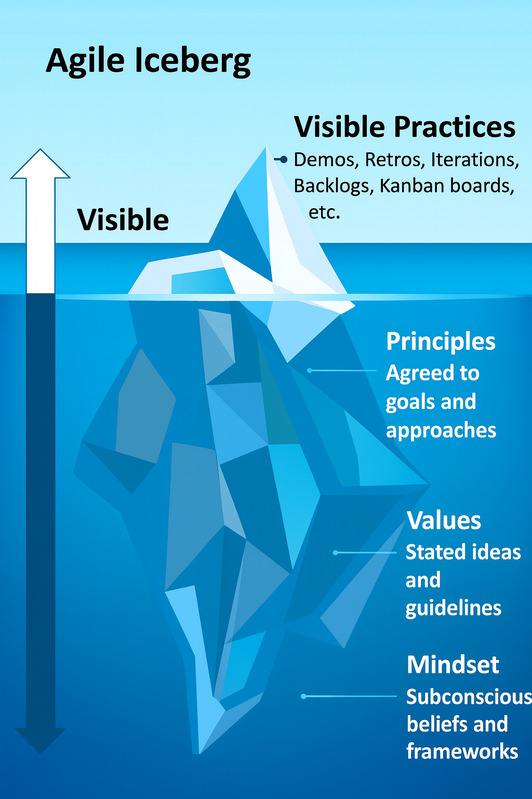
Doing agile means mechanically going through prescribed motions without embracing the underlying mindset. Teams attend daily meetings, update task boards, and follow process steps, but traditional command-and-control thinking persists. Managers continue assigning tasks rather than empowering teams, requirements remain fixed despite new learning, and direction changes are treated as disruptions rather than valuable information. When you hear "We do agile, but..." followed by exceptions that contradict core principles, you're witnessing agile theater.
Consider this conversation between two Product Managers:
- Jessica: Our team is doing great! We have our daily meetings, update our boards every day, and leadership is really happy with how we're following the process.
- Ryan: That's good. How has customer satisfaction changed since you started working this way?
- Jessica: Well, we don't really track that. But we're following all our meetings perfectly and never miss them.
- Ryan: What happened with that feature change request from your biggest customer last week?
- Jessica: Oh, we told them it has to wait until next quarter. We already planned this quarter's work, and changing course now would disrupt everything.
- Ryan: We had a similar request from a key customer. We swapped out a lower-priority item and delivered a simplified version right away to test their response.
- Jessica: But doesn't that mess up your tracking? And what about the original plan?
- Ryan: We focus more on whether we're solving customer problems than sticking to our original guess. The plan is just our current best thinking—learning something new is a reason to celebrate, not a failure to follow the plan.
You choose collaboration over documentation because you genuinely believe it produces superior outcomes, not because "that's what agile says". When faced with unexpected challenges, you apply agile thinking to discover creative solutions rather than searching for prescribed answers. Your team holds retrospectives because they value continuous improvement, and they talk to customers because they understand that feedback drives value creation.
Building a principle-based decision-making foundation means developing judgment to navigate situations where agile practices might conflict with practical constraints. When regulatory requirements demand extensive documentation, find innovative ways to create it incrementally and collaboratively while maintaining compliance. When distributed teams make daily face-to-face interaction impossible, maximize high-bandwidth communication through video calls while preserving the spirit of human connection.
This foundation empowers confident trade-off decisions. When choosing between a polished feature or early feedback on a rough version, lean toward learning because customer validation trumps internal perfection. When deciding between following the original plan or pivoting based on new information, evaluate which choice better serves customer value. Use agile principles as your north star when explaining decisions to stakeholders: "We're prioritizing working software and customer collaboration, which means shipping this simplified version now to gather feedback rather than perfecting it in isolation".
Lesson Recap
You've now explored the foundational pillars of agile thinking that will guide your entire journey as a Product Manager. The four core values—prioritizing individuals and interactions, working software, customer collaboration, and responding to change—aren't abstract ideals but practical decision-making frameworks you'll apply daily. You've seen how the twelve agile principles translate these values into concrete actions, from welcoming late requirement changes as competitive advantages to maintaining sustainable pace for long-term team health. Most importantly, you've learned to distinguish between merely "doing agile" through ceremonial compliance and truly "being agile" by internalizing the underlying mindset that values learning over prediction and adaptation over rigidity.
The conversations and examples throughout this lesson have shown you that agile success depends not on perfect process execution but on genuine commitment to the principles behind the process. When you face a blocker, your instinct to gather the right people rather than consult a process document reflects true agile thinking. When you prioritize working software that customers can actually use over comprehensive documentation, you're embodying the manifesto's wisdom. As you move forward into exploring when to use agile versus other methodologies, you carry with you this foundational understanding: agile is a mindset first, a methodology second, and success comes from applying these values and principles thoughtfully to your unique context rather than following prescribed steps blindly.
