Directing and Coaching Leadership Styles
Welcome to the Course
Welcome to Adaptive Leadership Styles in Action. In the previous course, you learned how to diagnose where each of your team members sits on the development spectrum by assessing their competence and commitment for specific tasks. Now, it's time to act on that diagnosis.
Throughout this course, you will learn how to fluidly shift between the four core leadership styles—Directing, Coaching, Supporting, and Delegating—so that your approach matches what each person actually needs, rather than what feels natural to you. You'll build tactical skills for giving crystal-clear instructions to beginners, coaching frustrated learners through setbacks, supporting capable performers who lack confidence, and delegating cleanly to self-reliant achievers. You'll also learn how to switch styles within a single conversation, manage the "switching cost" that comes with style transitions, and tailor each approach to the DISC personality of the person in front of you.
Once you master these skills, you will stop defaulting to a single management mode and start leading with the precision of a professional. In this unit, we begin with the two styles that require the most hands-on involvement from you as a leader: Directing and Coaching.
Style 1 — Directing: High Direction, Low Support for Beginners
The Directing style is your go-to approach for the Enthusiastic Beginner (S1)—someone who is highly motivated but lacks the skills or knowledge to perform the task. Because their commitment is already high, they don't need a lot of emotional cheerleading. What they need is clarity: they need to know exactly what to do, how to do it, when it's due, and what "good" looks like.
In this style, you are providing high direction and low support, which means you are telling, showing, and structuring the work. You define the goal, outline the steps, set the timeline, and establish the checkpoints. You are not asking for their input on how to approach the work, because they don't yet have the experience to give you a useful answer. Concretely, a Directing conversation might sound like this: "Here's the report template. I need sections A, B, and C filled in using data from the dashboard. Pull the numbers on Monday morning, draft it by Wednesday at noon, and send it to me for review before it goes to the client."
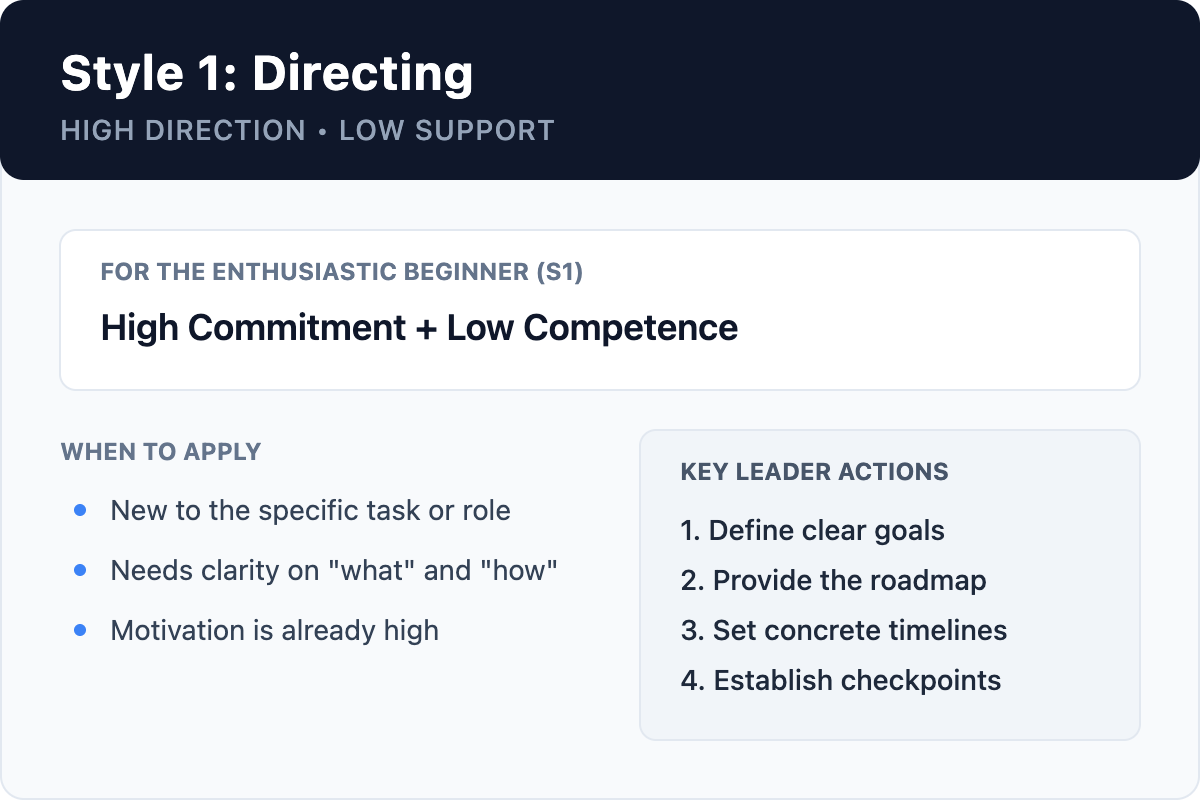
A common mistake leaders make is confusing "low support" with being cold or impersonal. You're still warm and respectful—you're simply not spending energy boosting motivation that is already there. Another pitfall is asking open-ended questions like "How do you think we should approach this?" to a true beginner. That question sounds empowering, but for someone who doesn't yet know the terrain, it creates anxiety rather than autonomy. When done well, Directing protects beginners from the frustration of failing at something they had no way of knowing how to do in the first place.
Style 2 — Coaching: High Direction, High Support for Disillusioned Learners
The Coaching style is designed for the Disillusioned Learner (S2)—the person who has started the work, hit the "reality wall," and realized it's harder than they thought. Their competence has grown a little, but their commitment has dropped. They're frustrated, discouraged, and possibly questioning whether they can do the job at all.
Here, you provide high direction and high support. You continue to guide the what and the how, but you now pair that direction with encouragement, explanation, and dialogue. This is the most time-intensive style because you are doing two jobs at once: teaching the skill and rebuilding the confidence. Coaching is not just about giving answers—it's about explaining the why behind them. It might sound like this: "I know this piece feels overwhelming. Let me walk you through why we structure it this way, and then we'll break it into three smaller steps you can tackle one at a time." You are still in charge of the roadmap, but you're inviting the person into the reasoning.
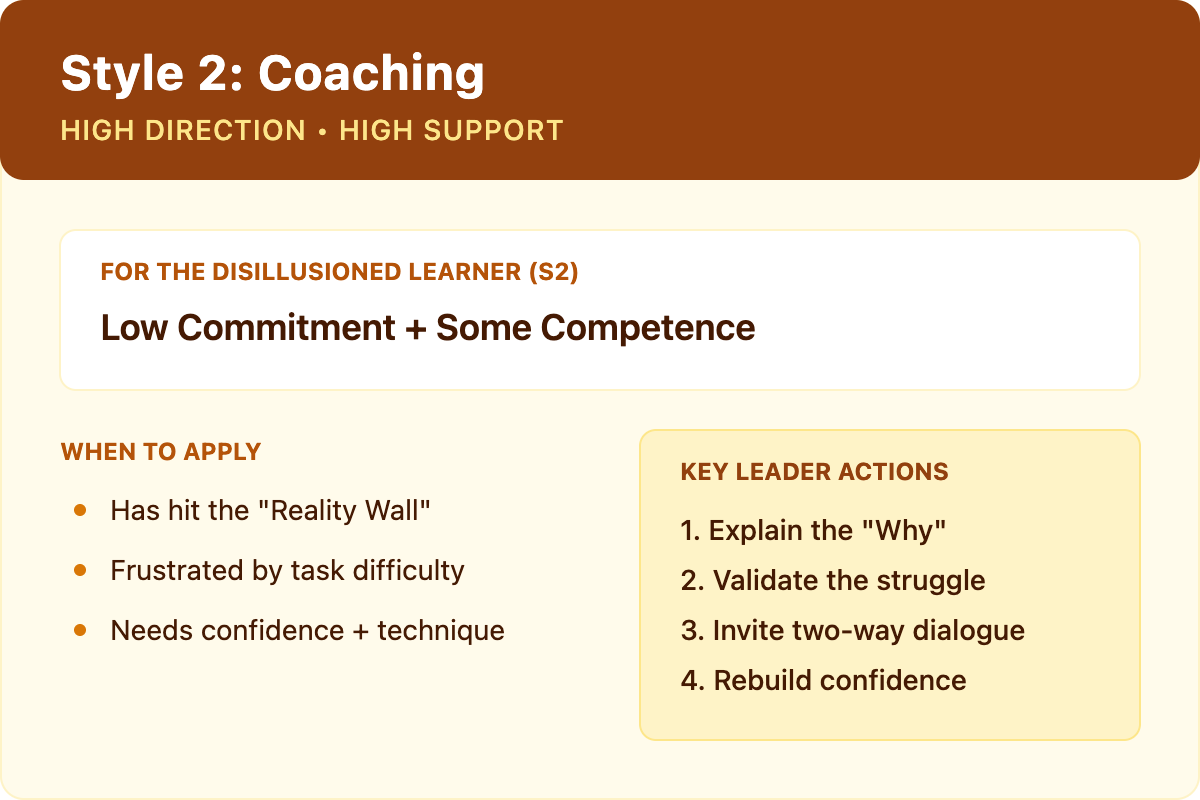
The critical shift from Directing to Coaching is the addition of two-way dialogue and empathy for the struggle. Consider how this plays out in a real conversation between a manager and a team member who has lost confidence mid-project:
- Jessica: Honestly, I don't think I'm going to get the hang of this client analysis. I've been staring at it for three days and I'm more confused than when I started.
- Ryan: I hear you—this is exactly the point where most people feel stuck. That frustration doesn't mean you're failing; it means you've hit the harder layer of the work. Can you walk me through where you got stuck?
- Jessica: I can't figure out how to reconcile the two data sources. The numbers don't match and I don't know which one to trust.
- Ryan: Good—that's actually the exact judgment call this analysis is designed to teach you. Here's the rule I use: always anchor to the system of record first, then flag variances above five percent. Let's do the first one together, then you try the next two on your own and bring them to me.
- Jessica: Okay, that feels more doable when it's broken down like that.
- Ryan: That's the goal. And by the way, the fact that you noticed the mismatch at all tells me you're further along than you think.
Notice what Ryan did. He validated the struggle without lowering the bar, gave a specific rule and a structured next step (high direction), paired it with empathy and encouragement (high support), and closed with a confidence-building observation. He did not rescue her by doing the work for her, and he did not simply bark instructions. That dual move—direction plus support—is the essence of Coaching.
A leader who stays in pure Directing mode with a Disillusioned Learner will often lose them entirely, because the person interprets the lack of support as indifference. Conversely, a leader who over-corrects by dropping direction to focus only on morale leaves the learner without the technical scaffolding they still need.
Balancing Instruction with Encouragement
The art of operating in S1 and S2 lies in calibrating how much of each ingredient—direction and support—the person actually needs in the moment. Get this wrong, and even well-intentioned leadership backfires. A useful mental check is to ask yourself two questions before each conversation.
- First, "Do they know how to do this?" If the answer is no, direction goes up.
- Second, "How are they feeling about doing this?" If they're shaky, discouraged, or losing faith, support goes up.
Notice that both Directing and Coaching share high direction, because in both cases the person still needs your expertise to navigate the work. The difference lies in the emotional temperature. An Enthusiastic Beginner walks in saying "I'm so excited, just tell me where to start!" and needs instructions, not pep talks. A Disillusioned Learner walks in saying "I don't think I'm cut out for this," and needs both instructions and a reason to keep going.
Finally, remember that your goal is never to keep people in S1 or S2—it's to move them forward. Every directing instruction should come with a mental note about what they'll be able to do on their own next time, and every coaching conversation should end with a small win they can point to. You are building their independence one task at a time.
In the upcoming role-play, you'll put these concepts into practice by delivering a clear, structured brief and defining exactly what "good" looks like for someone new to a task. You'll also draft a set of coaching questions designed to guide an employee through a problem without handing them the answer. Get ready to turn these concepts into real conversational skill.
