Strategic Culture Roadmapping
Systems Thinking and Culture Roadmapping
In the previous lesson, you equipped yourself with performance management tools — such as SMART KPIs and Performance Improvement Plans — needed to handle the full spectrum of individual performance on your team. But individual performance does not exist in a vacuum. The way your team collectively behaves, communicates, and makes decisions is shaped by something larger: culture.` As a people manager, you are the single most influential architect of your team's culture, whether you are designing it intentionally or allowing it to form by default.
Throughout this unit, you will learn how to build a deliberate 90-Day Culture Roadmap, how to recognize and leverage feedback loops that either reinforce or erode the culture you want, and how to distill everything you have learned across this entire course into two capstone documents: your Leadership Manifesto and your User Manual for Me.
Culture change happens through sustained, visible, and deliberate action over time. The 90-Day Culture Roadmap gives you a structured plan for shaping your team's culture in a way that is both ambitious and realistic. Ninety days is long enough to establish new habits and short enough to maintain urgency — it is the sweet spot for meaningful behavioral change.
Building the roadmap starts with an honest diagnosis of where your team's culture stands today. Ask yourself questions like "What behaviors are currently rewarded, even informally?" and "What does my team avoid talking about?" and "If a new hire joined tomorrow, what would they learn about how we operate within their first week?" These questions reveal the actual culture, which may differ significantly from the aspirational culture. Once you have a clear picture of the current state, define the target state by identifying two or three specific cultural shifts you want to see. These should be concrete and observable — not "be more collaborative" but something like "every project kickoff includes a cross-functional input session before decisions are finalized."
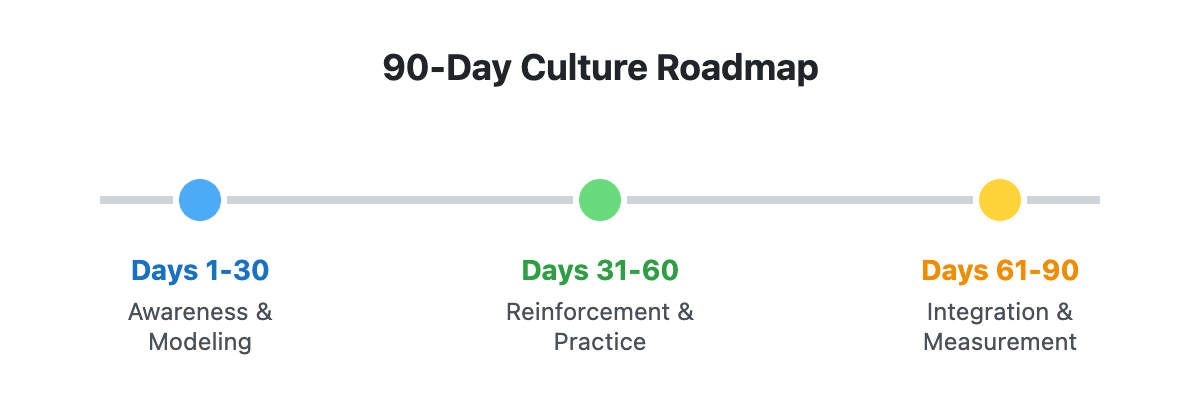
With the current and target states defined, the roadmap unfolds in three phases. Days 1–30 (Awareness and Modeling) focus on introducing the "why" and leading by example—such as publicly asking for feedback to model a culture of candor. Days 31–60 (Reinforcement and Practice) shift toward creating structured habits, like embedding "lessons learned" into every debrief and recognizing those who demonstrate the target behaviors. Finally, Days 61–90 (Integration and Measurement) involve assessing progress, gathering team feedback, and formalizing the most effective shifts into permanent cultural norms. The roadmap is not a rigid plan — it is a living framework that you adapt as you learn what resonates with your specific team. The key insight here is that culture is built, not declared.
Understanding Feedback Loops in Team Culture
One of the most powerful concepts from systems thinking is the feedback loop — the idea that the output of a system cycles back to influence its own input. In team culture, feedback loops are constantly at work, either amplifying the behaviors you want or reinforcing the ones you are trying to change. Understanding these loops is what separates a manager who reacts to culture problems from one who designs culture proactively.
A reinforcing feedback loop amplifies a behavior in a given direction, and when it is positive it creates a virtuous cycle. For example, when you publicly recognize a team member for raising a concern early, other team members see that candor is rewarded, which makes them more likely to speak up, which gives you more opportunities to recognize the behavior, and so on. The loop feeds itself. However, reinforcing loops can also work against you. If a team member who takes initiative consistently gets punished with extra work while those who stay quiet maintain a lighter load, the implicit message becomes "Don't volunteer." Over time, fewer people step up, which increases the burden on those who do, which causes them to burn out or disengage — a classic downward spiral.
In contrast, a balancing feedback loop works to maintain the status quo and actively resists change. Imagine you introduce a new norm that every team member should share a brief written update before the weekly meeting. Initially, a few people comply, but because most do not, those who took the time to write updates feel their effort was wasted. They stop doing it, and the norm dies. The balancing loop — "nobody else is doing it, so why should I" — pulled the system back to its previous state.
To see how a manager can identify and disrupt a negative feedback loop in practice, consider the following exchange between two peers discussing a pattern on one of their teams.
- Natalie: I keep noticing the same thing — whenever Dan flags a risk early, he ends up owning the fix. Now nobody on the team speaks up until problems are unavoidable.
- Jessica: That's a textbook reinforcing loop working against you. The punishment for initiative is more work, so initiative disappears.
- Natalie: Exactly. So I'm thinking about interrupting it at the assignment step. When someone flags a risk, I'll thank them publicly but assign the resolution to whoever owns that workstream, not the person who raised it.
- Jessica: That's smart. You're keeping the recognition piece but decoupling it from the extra burden. Have you told the team why you're changing the approach?
- Natalie: Not yet, but I plan to name it explicitly in our next team meeting — something like,
"I want flagging risks to feel like a contribution, not a punishment. Here's how we're going to handle it going forward."- Jessica: That transparency is what will make it stick. Otherwise they'll just assume it's a one-time thing and wait to see if the old pattern comes back.
Notice how Natalie first identified the loop by observing the pattern — initiative leading to overload leading to silence. She then pinpointed the exact mechanism sustaining it and designed an intervention that preserves the positive element (recognition) while removing the negative consequence (extra work). Jessica's final point highlights why naming the change explicitly matters: without transparency, a balancing loop will pull the team back to the old behavior. This is the kind of systems-level thinking that turns a reactive manager into a culture architect.
As a people manager, your job is to identify which loops are active on your team and decide how to intervene. To break a negative reinforcing loop, you need to interrupt it at a specific point — just as Natalie did by redistributing the resolution work. To overcome a balancing loop that resists a positive change, you need to add energy at the critical moment — perhaps by personally following up with each team member about the written updates during the first two weeks until the behavior reaches a tipping point. Think of feedback loops as the invisible machinery behind your culture. The 90-Day Culture Roadmap tells you what to change, while feedback loops explain why change sticks or fails. When you notice a cultural pattern — good or bad — that seems to sustain itself without your direct involvement, you are looking at a feedback loop. Your ability to spot it, name it, and either amplify or disrupt it is one of the highest-leverage skills you can develop as a leader.
Drafting the Final "Leadership Manifesto" and "User Manual for Me"
Throughout this learning path, you have mastered everything from regulating neurobiological stress and anchoring in values to delivering SBI feedback and managing systemic performance. Now, you will synthesize these capabilities into a Leadership Manifesto: a concise statement of intent that defines your philosophy. This document answers what you believe about leadership, the culture you will build, and what you will never compromise on. It serves as a principled guide for your team, ensuring they understand the core values and non-negotiables that drive your decisions.
While the manifesto covers philosophy, the User Manual for Me captures your tactical operating style. This document outlines how to work with you effectively—specifying your communication preferences, decision-making approach, and how you best process critical feedback. By naming your known blind spots and sharing this manual with your team, you model the vulnerability and intellectual humility necessary to sustain psychological safety. Together, these living documents transform isolated skills into a coherent leadership identity that serves as your permanent professional compass.
Together, the Leadership Manifesto and the User Manual for Me transform your learning from a set of isolated skills into an integrated leadership identity. They are living documents — you should revisit and revise them as you grow, as your team evolves, and as new challenges reshape your understanding of what great leadership looks like. In the upcoming exercises, you will have the opportunity to present your Culture Roadmap to your team, articulating how the norms you are introducing will improve their daily experience and inviting their questions and input. This will be your chance to practice vision casting — turning the ideas from this unit into a compelling, grounded conversation that inspires your team to build the culture alongside you.
