Matching Thinking to Stakes
Matching Your Thinking to the Stakes 🎚️
You've now built real tools: pre-mortems to surface how a plan fails, pre-set weighted criteria to compare options fairly, and decision journals to keep reviews honest. Powerful, but running all of them on every call would bury you. The final move in this toolkit is deciding how much thinking a decision actually deserves before you spend the effort. Think of it as a decision about your decision: right-size the deliberation so you slow down productively instead of just slowly.
In this lesson, you will learn to:
- Read a decision on five factors: stakes, reversibility, feedback quality, familiarity, and available time
- Use the Decision Mode Matrix to choose a fast call, a bounded check, or full deliberation
- Right-size your own decisions so effort matches what is actually at stake
The Five Factors That Pick Your Mode 🖐️
Before you choose how hard to think, read the decision on five factors:
- Stakes: how much rides on getting it wrong
- Reversibility: how cheaply and quickly you can undo it if you're wrong
- Feedback quality: whether you'll get fast, accurate signal on how it's playing out
- Familiarity: whether you've made this kind of call many times before
- Available time: whether there's genuinely room to deliberate before it must be decided
These pull in different directions, and reversibility is the one managers most often underweight. A pricing tweak you can roll back in a day is a very different animal from a headcount commitment you can't unwind for a year, even if both feel "big." A vendor you can switch next quarter buys you room to move faster than the reasoning alone would suggest. So don't let raw size stampede you into treating everything as a bet-the-quarter call.
Run one call through all five. Say you're weighing a 10% price increase in a single region. Stakes: real but bounded — one region, not the whole book. Reversibility: high — you control the price in the system and can roll it back in a day. Feedback quality: strong — sales data lands within days. Familiarity: moderate — you've adjusted regional pricing before. Time: adequate — nothing forces the call this hour. Read together, those factors point away from a bet-the-quarter deliberation and toward a quick, time-boxed check, since the one condition that would justify heavy analysis is irreversibility paired with weak feedback, and neither is present here.
The Decision Mode Matrix 🗂️
Those five factors sort into three modes, which is the whole of the Decision Mode Matrix.
| Mode | When to use it | Conditions |
|---|---|---|
| Fast call | Familiar, low-stakes, reversible choices | Reliable feedback, little time needed |
| Bounded check | Mixed conditions | A quick, targeted verification with a firm time limit |
| Full deliberation | High-stakes, hard-to-reverse, novel choices | Weak feedback, mistakes expensive to unwind |
Fast call. Favor it for familiar, lower-stakes, reversible choices where feedback is reliable — trust the pattern you already have and move.
Bounded check. Use it for mixed conditions: a quick, targeted verification with a firm time limit that buys you a little certainty without stalling the decision.
Full deliberation. Reserve it for the high-stakes, hard-to-reverse, novel choices where feedback is weak and a mistake is expensive to unwind — that's where real effort earns its keep.
The two failure modes are symmetric. Treat everything as high-stakes and you drown routine calls in analysis and miss windows. Treat everything as routine and you wave through the one irreversible decision that deserved a pre-mortem.
Here's the matrix in motion. Tom is about to over-think a big-sounding pricing decision, and Nova walks him back to the factor that actually sets the mode:
- Tom: The regional pricing change is huge. We should run a full deliberation, right?
- Nova: Big stakes, agreed. But how fast can we reverse it if it flops?
- Tom: Within a week. We control the price in the system.
- Nova: Then it's high-stakes but reversible, with fast sales feedback. That's a bounded check, not a month of analysis.
- Tom: So the sheer size scared me into over-thinking a call we can actually walk back.
Notice that reversibility, not size alone, set the mode. Once Tom saw he could undo the move quickly and watch results in real time, the honest answer was a fast, bounded verification, not a full committee review.
Right-Sizing Your Own Decisions ✂️
The habit to build is sorting your real pipeline of decisions by mode, and being able to defend each assignment out loud. Take three calls sitting on your desk and ask the five factors of each. A temporary coverage swap you make constantly and can reverse tomorrow is a fast call. A limited pilot with clear metrics and an easy off-ramp is a bounded check. A once-a-year architectural or structural commitment that's novel, expensive, and hard to unwind earns full deliberation. Say why for each, and the contrast becomes obvious: the redesign warrants far more of your attention than the reversible pilot precisely because you can't course-correct your way out of it.
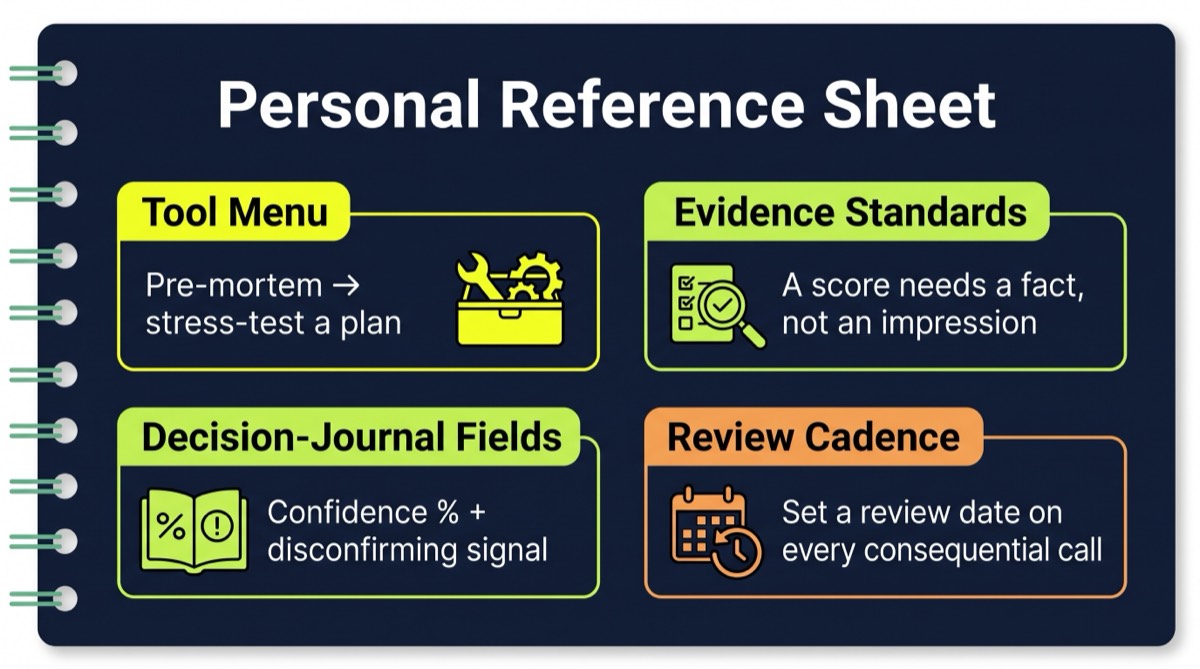
This lesson also closes your Course 3 toolkit, so capture it in your personal reference sheet: your tool menu (which tool fits which problem), your evidence standards, your decision-journal fields, and your review cadence. That's the reference you'll carry into decisions under real uncertainty.
The single takeaway is that you should match the depth of your thinking to what a decision can cost you and how easily you can take it back. Stakes without reversibility will trick you every time. Up next, you'll take on three practices — a pattern-spotting exercise matching real decisions to a mode, a live defense against a skeptical partner, and a written assessment right-sizing three decisions for your sponsor.
