Welcome to Three-Variable Systems and a First Look Beyond! This is the first lesson of the course, and it marks a genuine step up in scale. So far, our systems have involved two unknowns at a time, solved by substitution or elimination and interpreted back in everyday situations.
Now we let a third unknown into the room. That one change affects how we write a solution, how many equations we need to pin it down, and what the whole thing looks like geometrically. Before we start solving, we will get comfortable reading these systems and verifying candidate solutions, which is the foundation for every technique in the lessons ahead.
From Pairs to Triples
You may recall that a solution to a two-variable system is an ordered pair (x,y) that makes both equations true at the same time. Each equation drew a line, and the solution was the crossing point.
With three variables, the same logic gains one more slot: a solution is an ordered triple (x,y,z) that satisfies every equation in the system at once. Order still matters, so (1,2,3) means x=1, y=2, z=3, while (3,2,1) describes a completely different point in space. If a problem uses other letters, such as a, b, and c, we follow the order the problem names them in.
Think of a combination lock with three dials. Getting two dials right is not "almost open" — the lock is simply closed, and that is exactly how a three-variable system treats a triple that satisfies only part of it.
Reading a Three-Variable System
A three-variable linear system typically comes with three equations, each mixing x, y, and z in some way. Here is the system we will work with throughout this lesson:
⎩⎨⎧x+y+z=62x−y+3z=9x+2y−z=2
Every equation here is still linear: each variable appears to the first power, with no products like xy, no squares, and no variables in denominators. A variable can also be absent, which just means its coefficient is 0 — so x+4z=7 is a perfectly legitimate member of a three-variable system, readable as x+0y+4z=7.
Systems like this show up whenever three quantities are tangled together by three different requirements. Imagine blending three ingredients into a smoothie so that the calories, the protein, and the cost all hit specified targets. Each requirement becomes one equation, and the recipe you want is the triple of amounts that satisfies all three requirements at the same time.
Join the 1M+ learners on CodeSignal
Be a part of our community of 1M+ users who develop and demonstrate their skills on CodeSignal
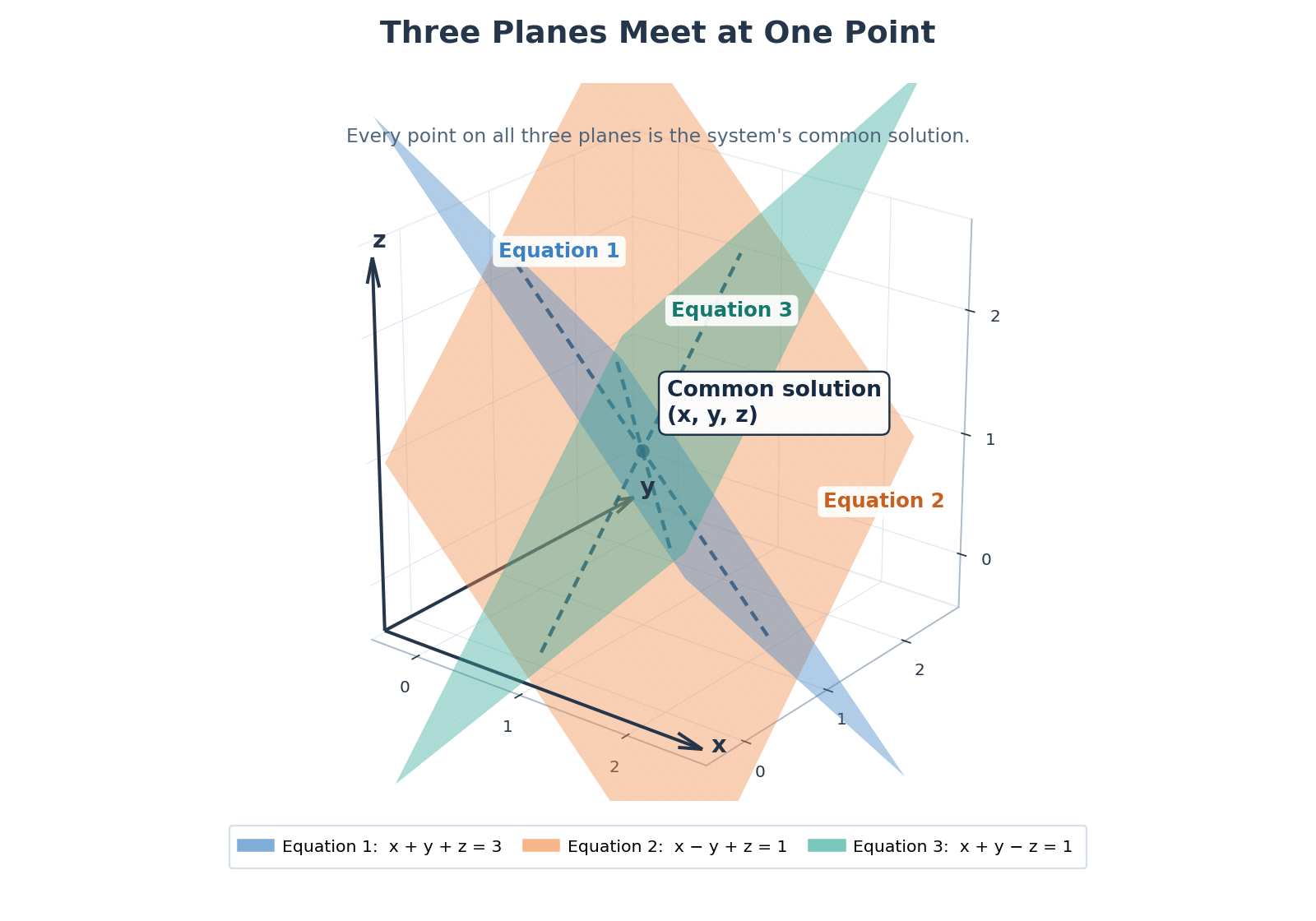
Here is what makes three variables feel genuinely new. A linear equation in two variables graphs as a line on a flat page. A linear equation in three variables, such as x+y+z=6, graphs as a plane in three-dimensional space: a flat surface extending forever in every direction.
So a system of three equations describes three planes, and a solution is a point lying on all three of them. The handiest real-world image is the corner of a room: two walls and the floor are three flat surfaces, and they meet at exactly one point. That corner is the kind of ordered triple we are hunting for.
Note: This illustration is not drawn from the specific system used in this lesson. It simply shows what it looks like when three planes share exactly one point in common.
Planes do not always cooperate this neatly — they can be parallel with no common point, or they can share an entire line of points. For now, we will focus on the well-behaved case with a single meeting point, and simply keep in mind that "where the planes meet" is the geometric meaning of a solution.
Verification is a routine we will use constantly, so let's make it explicit: substitute the values, simplify the left side, then compare it to the right side. One equation at a time, no shortcuts. Here is the triple (1,2,3) tested against our system.
Equation
Substitute x=1, y=2, z=3
Left side
True?
x+y+z=6
1+2+3
6
Yes, 6=6
2x−y+3z=9
2(1)−2+3(3)
9
Yes, 9=9
x+2y−z=2
1+2(2)−3
2
Yes, 2=2
All three rows check out, so (1,2,3) is a solution. Geometrically, this single point sits on the first plane, on the second plane, and on the third plane — it is the corner where all three surfaces meet.
Near misses are worth studying, because they show how unforgiving the word simultaneously really is. Consider (5,1,0) in the same system:
x+y+z=5+1+0=6 ✓
2x−y+3z=2(5)−1+3(0)=9 ✓
x+2y−z=5+2(1)−0=7=2 ✗
Two out of three, and yet it is not a solution. This point lies on the first two planes — it sits somewhere along the line where those two surfaces cross — but it floats off the third plane entirely. There is no partial credit here.
Order matters just as much. Test (3,2,1), which uses the same three numbers as our actual solution in a different arrangement: the first equation gives 3+2+1=6 ✓, but the second gives 2(3)−2+3(1)=7=9 ✗. Once a single equation fails, we can stop immediately, because the triple is already disqualified.
Most verification errors come from a handful of small habits, and each one is easy to defend against:
Sign handling. In 2x−y+3z, the coefficient of y is −1, so a positive y value gets subtracted.
Missing variables. If an equation has no z, treat that coefficient as 0 instead of quietly dropping the equation from your check.
Declaring victory too soon. Two true equations prove nothing on their own; all three must hold.
Scrambling the order. Match the first number to the first variable named in the problem, every time.
A quick way to build the habit: write each substitution out fully before simplifying. It feels slower for the first two problems and considerably faster after that.
In this lesson, we moved from ordered pairs to ordered triples. A three-variable system asks for values of x, y, and z that make every equation true at the same time, each equation describes a plane in space, and the solution is the point where those planes meet — the corner of the room. We also established a dependable checking routine: substitute, simplify, compare, and stop as soon as one equation fails.
Now it is your turn. In the practice exercises ahead, you will pin down what genuinely counts as a solution, test triples against complete systems, and identify the single equation that exposes an impostor. Let's get checking!