Eliminating by Adding
Introduction
Welcome to Solving Systems by Elimination, the first lesson of this five-lesson course! In the previous course, you learned how to solve systems of two equations by substitution — isolating a variable in one equation and plugging it into the other. That approach works well, but it is not always the most efficient path. In this course, you will explore a different strategy called elimination, where you combine equations so that a variable disappears entirely.
Today's lesson covers the most straightforward case: systems where a variable already has opposite coefficients, ready to cancel the moment you add the two equations together. By the end, you will be able to spot these ready-made setups, perform the addition step, and solve for both variables with confidence.
Why Adding Equations Works
Before diving into the technique, let's build some intuition. Suppose two statements are both true: and . Because each equation says its left side and right side are the same quantity, we can add the left sides together and the right sides together to get a brand-new true equation:
This principle is called the Addition Property of Equality, and it is the engine that powers the elimination method. Think of each equation as a perfectly balanced scale. If you pour the contents of both left pans into one pan and both right pans into another, the combined scale stays balanced. Since every equation in a system is its own balanced scale, adding any two of them always produces another valid equation.
Why does this matter for solving systems? Because if you choose which equations to add carefully, one variable can vanish from the sum, leaving you with a single-variable equation you already know how to solve.
Spotting Opposite Coefficients
Adding two equations is especially helpful when one variable cancels out in the sum. This happens when that variable's coefficients are opposites — same absolute value, different signs — like and .
Take a look at this system:
Written vertically, the cancellation pattern becomes easy to see:
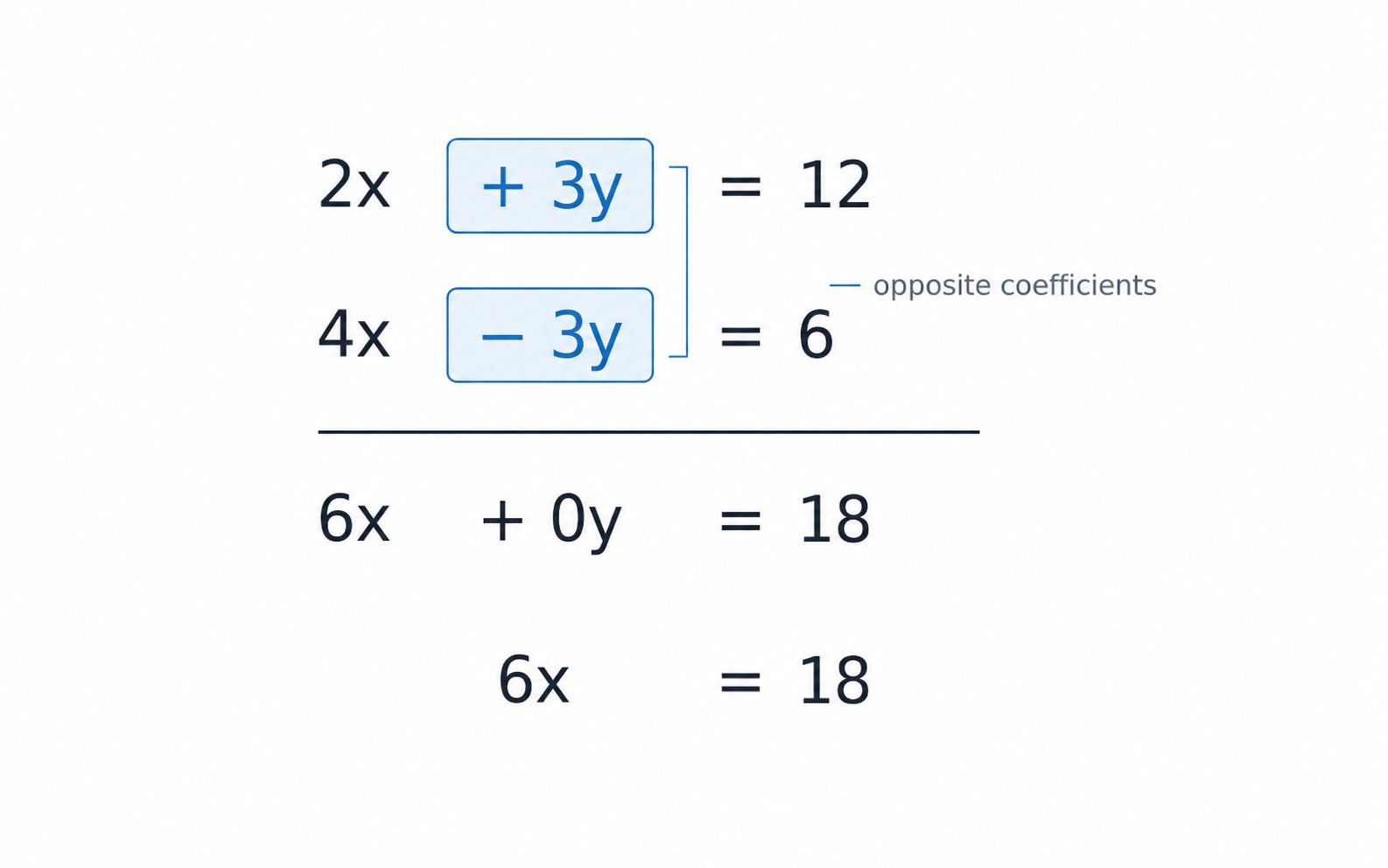
The -coefficients are and . Because , adding the two equations will eliminate completely. That is your signal to use the addition method. If no pair of coefficients is opposite right away, you would need extra steps — something we will explore in upcoming lessons.
