You have made it to the final lesson of Solving Multi-Step Inequalities — congratulations on getting this far! Over the previous four lessons, we built a powerful toolkit: two-step solving, combining like terms, expanding with the distributive property, and collecting variable terms from both sides. Every problem we have solved ended with a clean result like x<4 or x≥3, where one boundary value neatly divides the number line into solutions and non-solutions. In this lesson, we meet the two surprising cases where that does not happen. Sometimes an inequality has no solution at all, and sometimes every real number is a solution. Let's find out how to recognize and interpret both.
When the Variable Vanishes
In the last lesson, we practiced moving variable terms to one side of the inequality. Usually that left us with a nonzero variable term we could isolate. But what happens when the variable terms on both sides are identical? When we subtract one from the other, they cancel completely, and we are left with a statement that contains only numbers — no x in sight.
For example, simplifying might lead to something like 5>2 or 3<0. There is no variable left to solve for, so the statement is either true or false on its own, regardless of what x might be. These are the two special outcomes we will study in this lesson: always true and always false.
Always False: No Solution
Always True: All Real Numbers
Join the 1M+ learners on CodeSignal
Be a part of our community of 1M+ users who develop and demonstrate their skills on CodeSignal
Let's work through an example step by step. Consider:
2x+9<2x+1
Step 1 — Subtract 2x from both sides to collect the variable terms:
9<1
The variable is gone. We are left with 9<1, which is simply false. Nine is never less than one, no matter what value x takes.
Because the original inequality simplifies to a false statement, there is no value of x that can make it true. We say the solution set is empty, or equivalently, there is no solution. A quick check confirms this: try x=0 and we get 9<1 (false); try x=100 and we get 209<201 (still false). No value works.
Now let's see the opposite outcome. Consider:
3(x−2)≤3x+5
Step 1 — Distribute the 3 on the left side:
3x−6≤3x+5
Step 2 — Subtract 3x from both sides:
−6≤5
Again, the variable has disappeared. This time the remaining statement, −6≤5, is true. Negative six is always less than or equal to five.
Because the original inequality simplifies to a true statement, every value of x makes it true. The solution set is all real numbers. Plug in x=0 and you get −6≤5 (true); plug in x=−1000 and you get −3006≤−2995 (true). Any value we choose will work.
Why There Is No Boundary Point
Special Cases in a Real-World Setting
Recognizing the Pattern Across Techniques
Conclusion and Next Steps
In this lesson, we discovered what happens when simplifying a multi-step inequality causes the variable to cancel out entirely. If the leftover number-only statement is always false, the inequality has no solution; if it is always true, the solution set is all real numbers. In both cases, no single boundary value exists because there is nothing left to divide the number line. This wraps up the complete set of techniques in the course: two-step solving, combining like terms, distributing, collecting variables on both sides, and now handling these special outcomes.
Up next, you will put these ideas to the test in a set of practice exercises. You will classify simplified statements as always true or always false, connect those outcomes to the correct solution set, solve full inequalities that lead to special cases, and explain in your own words why no boundary point exists. Let's finish strong!
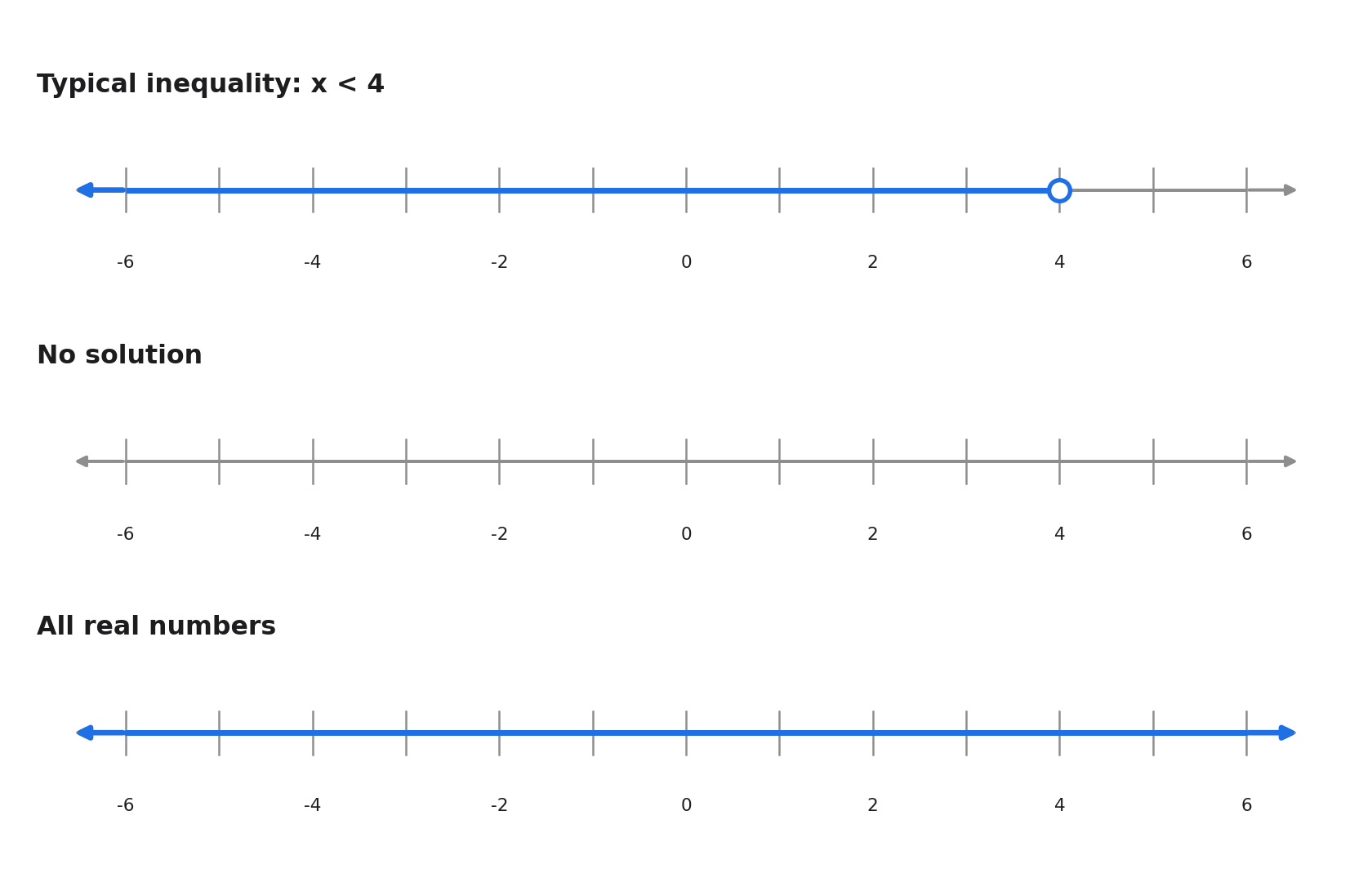
A typical inequality like x<4 produces a boundary value — the number 4 — that divides the number line into two regions: values that satisfy the inequality and values that do not. In the special cases we just explored, the variable cancels out entirely, so no boundary value is ever produced. There is nothing to split the number line, and the result is one of two extremes:
No solution: no region of the number line is shaded at all.
All real numbers: the entire number line is shaded.
A comparison on number lines makes the difference visual:
Think of it this way. Ordinary inequalities are like a fence dividing a field into two parts. The "no solution" case is a field with a sign that says keep out — nobody gets in. The "all real numbers" case is an open field with no fence at all — everyone is welcome.
These special outcomes are not just abstract curiosities — they show up in everyday comparisons. Imagine you and a friend both work as freelance tutors. You charge $20 per hour plus a $15 travel fee, and your friend charges $20 per hour plus a $30 travel fee. A client asks: for how many hours of tutoring is your total cost greater than your friend's?
Let h represent the number of hours. The inequality is:
20h+15>20h+30
Subtract 20h from both sides:
15>30
This is always false, so there is no solution. Because you both charge the same hourly rate, your lower travel fee means your total will never exceed your friend's — no matter how many hours the session lasts. The identical variable terms (20h on each side) are the giveaway: the comparison comes down to the constants alone.
Now flip the question: when is your cost less than or equal to your friend's? The inequality 20h+15≤20h+30 simplifies to 15≤30, which is always true. Every possible number of hours works, so the solution set is all real numbers (restricted in practice to nonnegative hours, of course). Notice how the same real-world setup can produce either special case depending on the direction of the comparison, and how the practical domain — hours cannot be negative — is separate from the algebraic "all real numbers" result.
These special outcomes can appear after any combination of the techniques we have learned in this course. Here is an example that mixes several steps:
4(x+1)−x>3x+10
Expand the left side: 4x+4−x>3x+10. Combine like terms on the left: 3x+4>3x+10. Subtract 3x from both sides: 4>10. This is false, so there is no solution.
The key signal is always the same: once the variable terms cancel, look at the number-only statement that remains and decide whether it is true or false.