Multiplying Signed Fractions
Introduction
Welcome back to Sign Rules and Multiplying Rational Numbers! This is the third and final lesson in the course, so you are almost at the finish line. In the first two lessons, we mastered the sign rules for two-factor products and then extended those rules to products of any length using parity. Now we will take the next natural step: applying those same sign rules to fractions and other rational numbers.
By the end of this lesson, you will be able to multiply signed fractions, simplify products to lowest terms, and handle mixed numbers with confidence.
From Integers to Fractions
So far, every factor we have multiplied has been an integer. But many real-world quantities are not whole: half a tank of gas, three-quarters of an hour, or a loss of two-fifths of a dollar. These quantities are expressed as fractions, and they can carry a positive or negative sign just like integers.
The encouraging part is that the sign rules you already know apply without any changes. Like signs still produce a positive product, and unlike signs still produce a negative product. The parity rule from the previous lesson works for signed fractions too. The only exception, as with integers, is if any factor is zero; in that case, the product is simply zero. The only new piece is learning how to multiply the numerators and denominators and then simplify the result.
The Three-Step Method
Multiplying signed fractions follows a clean process that builds directly on what you have already learned:
- Determine the sign of the product. Like signs → positive. Unlike signs → negative. (If any factor is zero, the product is zero).
- Multiply the numerators to get the product's numerator.
- Multiply the denominators to get the product's denominator.
Let's see this in action with an example. Consider . The first fraction is negative and the second is positive (unlike signs), so the product is negative. For the numerator we compute , and for the denominator we compute .
The product is . This is correct, but we are not quite done — we still need to simplify.
Simplifying to Lowest Terms
Whenever possible, we should express the result in lowest terms by dividing both the numerator and the denominator by their greatest common factor (GCF). The GCF is the largest whole number that divides evenly into both values.
Continuing from the example above, the GCF of and is :
The final answer is . Notice that simplifying changes only the size of the numbers, not the sign.
We can also simplify before multiplying by canceling common factors across numerators and denominators. This focuses on the numerical "size" of the fraction, which we then combine with the sign we determined in step 1. In our example, the in the first numerator and the in the second denominator share a factor of . Canceling first gives us , and then we attach the negative sign to get .
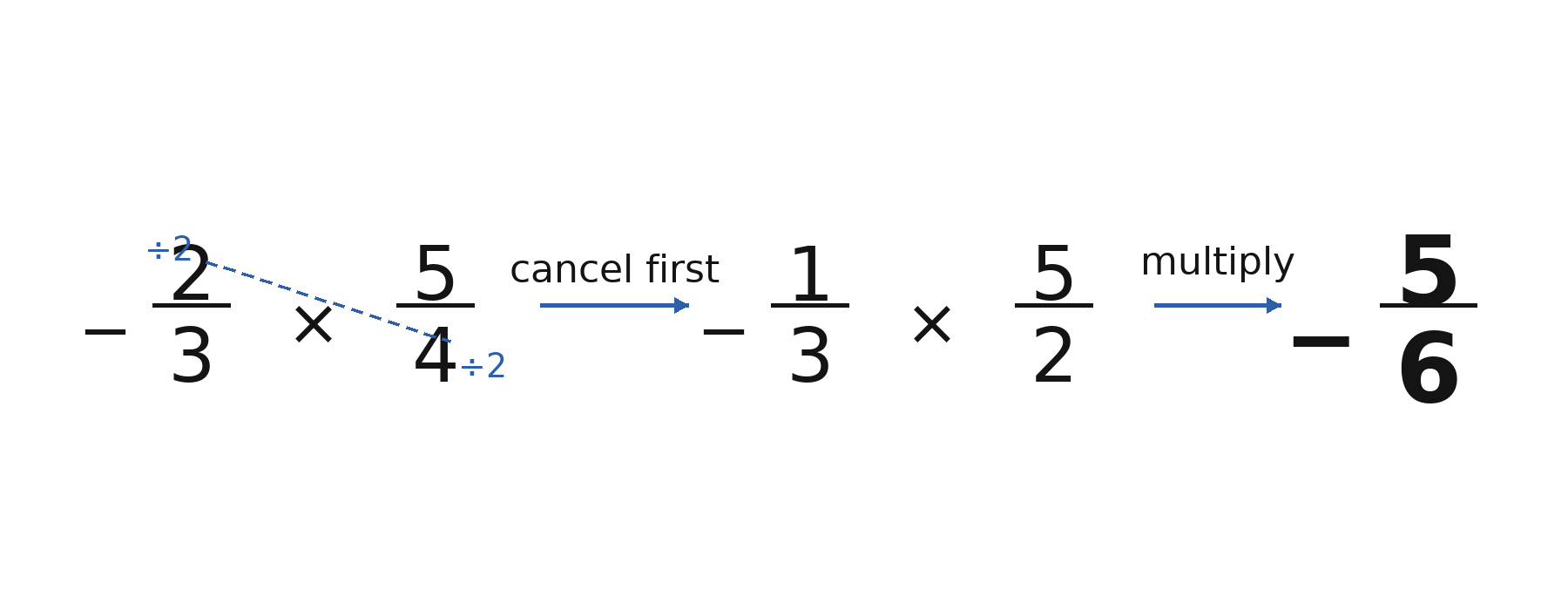
Note: The visual above shows the cross-canceling process for the absolute values; remember to re-apply the negative sign to the final result.
