Semantic Decision Records
From Ambiguity to a Decision Record 🧭
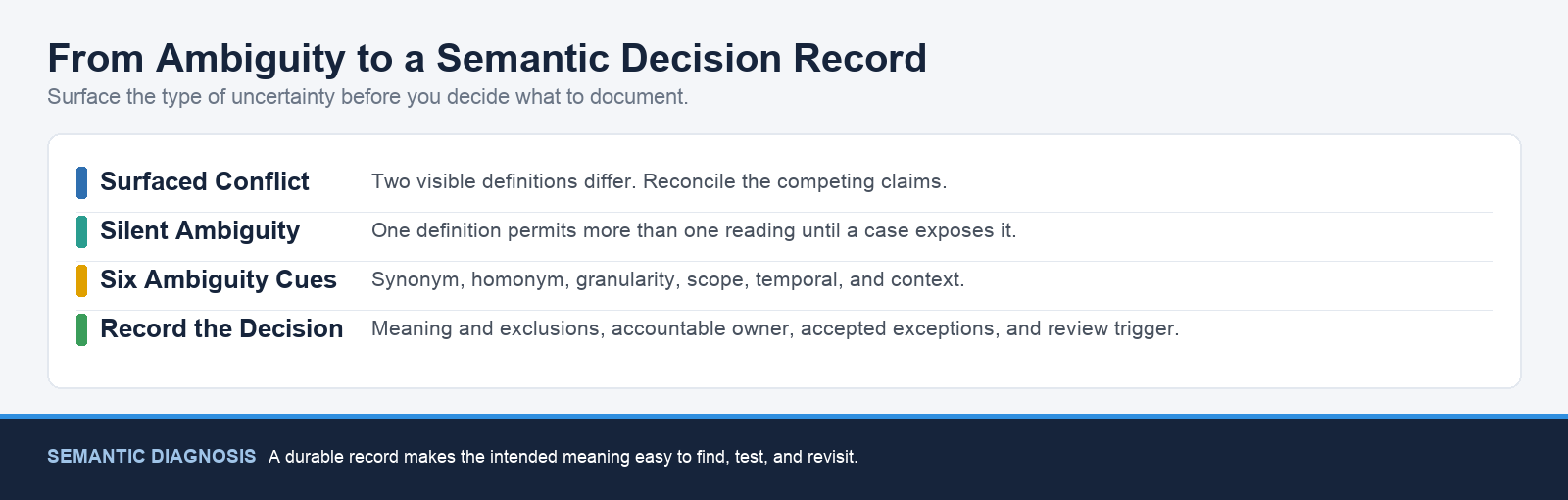
The controlled vocabulary work in the last unit gave you three diagnostic labels: homonyms, synonyms, and granularity mismatch. A conflict is one you can see because two definitions sit side by side and get argued about; an ambiguity is the harder case, because it hides inside a single definition nobody is disputing, where each reader quietly supplies a different meaning. This unit extends the diagnostic set to six types, then turns the diagnosis into something you can put on the record.
Same pattern, different symptom: a conflict is argued about, an ambiguity is not noticed. The type names are shared across both units, so the conflict-versus-ambiguity distinction is only about whether the divergence has surfaced yet.
In this lesson, you will learn to:
- Classify six common forms of semantic ambiguity
- Assess ambiguity by the decision risk it creates for a named consumer
- Create a semantic decision record with ownership, boundaries, exceptions, and a review trigger
The Six Ambiguity Types 🔀
The six ambiguity types are best understood as six distinct places meaning can slip. Synonym ambiguity is different words for one idea: "live user" and "active customer" describing the same population. Homonym ambiguity is one word carrying different ideas: "active" meaning app-opened to analytics and non-suspended to membership operations. Granularity ambiguity is mixed levels of detail, where one team means any single event and another means a sustained pattern.
The three you have not yet worked with are subtler. Scope ambiguity is an unclear boundary: does "customer count" include trial accounts, internal test accounts, or customers in other regions? Nothing in the wording says, so each consumer draws the line where it suits them. Temporal ambiguity is unclear time conditions: "monthly" that never says calendar month or trailing thirty days, or "as of" that never says as of when. Context ambiguity is meaning that shifts with business setting: "active" is a reasonable word for both a trial account and a fifty-seat enterprise agreement, but it describes materially different behavior in each.
The last three rarely surface in a definition review, because they are absences rather than disagreements. Nobody objects to a sentence that simply fails to mention the time window.
| Ambiguity type | What slips | One-line example |
|---|---|---|
| Synonym | Different words, one idea | "live user" and "active customer" name the same population |
| Homonym | One word, different ideas | "active" = app-opened to analytics, non-suspended to operations |
| Granularity | Mixed levels of detail | "any single event" vs. "a sustained four-day pattern" |
| Scope | Unclear boundary | does "customer count" include trials, test accounts, or other regions? |
| Temporal | Unclear time condition | "monthly" that never says calendar month or trailing thirty days |
| Context | Meaning shifts with setting | "active" for a trial vs. a fifty-seat enterprise agreement |
Decision Risk for a Named Consumer 🎯
Ambiguity is not intrinsically a problem. It becomes one when a named consumer makes a decision on the number. So the architectural question is never "is this term ambiguous?" but "which of these ambiguities could change the decision this specific consumer is about to make?"
That reframing does two useful things. It gives you a materiality test, separating ambiguities that could flip an outcome from ones that shift a figure by a rounding error. It also converts an abstract semantic argument into a conversation about consequence, which is far easier to have with a metric owner who believes their definition is already clear.
- Chris: The delivery sheet says "on time" if the order arrives by the promised date. I am not sure what needs unpacking.
- Jake: If a delivery is rescheduled after the promise, do we judge it against the original date or the revised date?
- Chris: We have used both readings in different reports.
- Jake: And if a supplier score determines renewal, could those readings change the decision?
- Chris: Yes. We need one reading recorded before the score is used.
Observe that the ambiguity was surfaced through a specific counterexample tied to a specific decision, not through the word "ambiguous."
The Semantic Decision Record 📝
Diagnosis without a record just repeats itself in six months. The semantic decision record captures five fields, and a record missing any of them tends to fail in a predictable way. Meaning states what the term denotes and, just as importantly, what it deliberately excludes. Scope states the boundary of where the definition applies and where it does not. Owner names the individual with authority to change it, which is what prevents quiet drift. Accepted exceptions record where a different reading is permitted and by whom, because unrecorded exceptions become undocumented contradictions. Review trigger names the condition that forces re-examination, such as the count sitting within a narrow margin of a decision threshold.
| Field | Question it answers | Failure mode if left vague |
|---|---|---|
| Meaning | What does the term denote, and what does it exclude? | Each reader supplies a different meaning |
| Scope | Where does the definition apply, and where not? | Boundary cases counted inconsistently |
| Owner | Who has authority to change it? | "To be confirmed" means no one owns it; quiet drift |
| Accepted exceptions | Where is a different reading permitted, and by whom? | Unrecorded exceptions become undocumented contradictions |
| Review trigger | What condition forces re-examination? | The definition silently goes stale against decisions |
The discipline is refusing to leave a field vague. "To be confirmed" in the owner field means no one owns it.
The insight worth carrying: an agreed definition is not settled until someone is named as able to change it and something is named as forcing that change. Two quick checks come first to sharpen your classification of ambiguity types and decision-record fields, then you'll take this into a live conversation with a metric owner who is convinced his definition is already unambiguous.
