Testing Right Triangles
Introduction
Welcome to Real-World and 3D Applications, the final course in our Pythagorean Theorem learning path! Over the previous three courses, you built a strong foundation: you learned the theorem itself, solved for unknown sides, and applied it to coordinate-plane distances. Now we are going to put all of that knowledge to work in practical, real-world settings.
In this first lesson, we tackle an important question that comes up surprisingly often in everyday life: given three side lengths, how can we tell whether they form a right triangle? The tool that answers this question is called the converse of the Pythagorean theorem, and it is the gateway to every application we will explore in this course.
From the Theorem to Its Converse
As you may recall from the very first course, the Pythagorean theorem says:
If a triangle is a right triangle, then .
Notice the direction of that statement. We start by knowing the triangle has a 90° angle, and we conclude something about the side lengths. But what if the situation is reversed? What if we only have three side lengths and need to decide whether the triangle is a right triangle?
This kind of question pops up constantly in the real world. A carpenter checking whether a doorframe is square, a landscaper verifying the corners of a rectangular patio, or a tiler confirming a floor meets the wall at exactly 90° — all of them need a way to test for a right angle using only measured lengths.
That is exactly what a converse does: it swaps the "if" and "then" parts. Fortunately, the Pythagorean theorem is one of those special statements whose converse is also true, which gives us a powerful test we can use anytime we have three measured lengths.
Stating the Converse
Here is the converse of the Pythagorean theorem in precise terms:
If for three side lengths of a triangle, then the triangle is a right triangle.
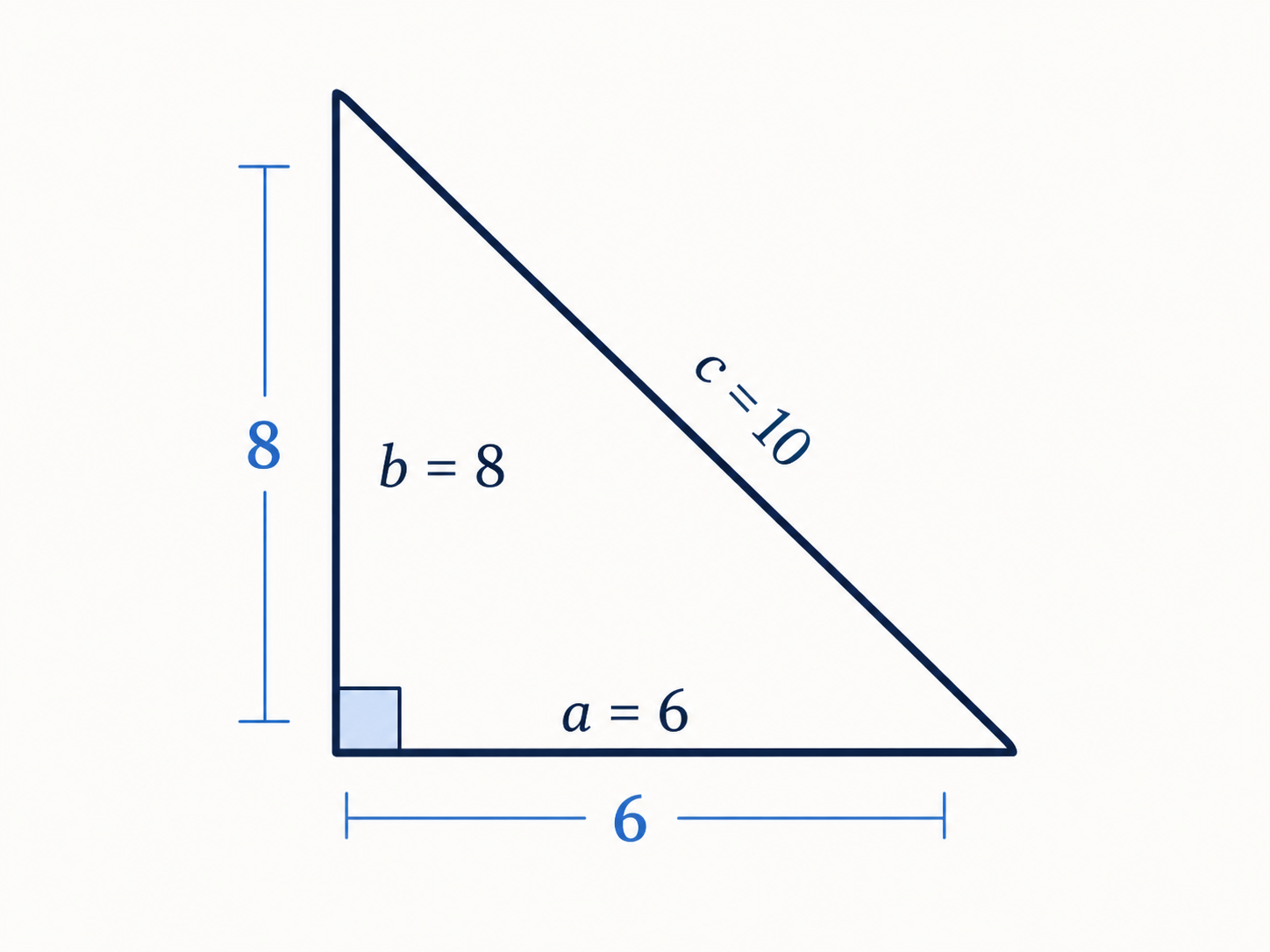
In this statement, is the longest side and and are the two shorter sides. The right angle, if one exists, sits directly opposite the longest side.
So instead of using the right angle to find a missing side, we are now using all three known sides to find out whether a right angle exists. Think of it as the theorem working in reverse.