Interpreting the Intercept
Introduction
Welcome back to Reading and Using Regression Lines! In our first lesson, we learned how to interpret the slope as the predicted change per one-unit increase. Now, we turn our attention to the other piece of the equation: the intercept.
By the end of this lesson, you will be able to state what the intercept means in context. More importantly, you will learn to judge whether that meaning is actually sensible. A regression line always has an intercept, but whether that number describes a real baseline or is just a "mathematical artifact" depends entirely on the data used to build the model.
The Starting Point: When x = 0
Recall that the least-squares regression line is written as:
The intercept () is the value of when . Graphically, this is where the line crosses the vertical axis.
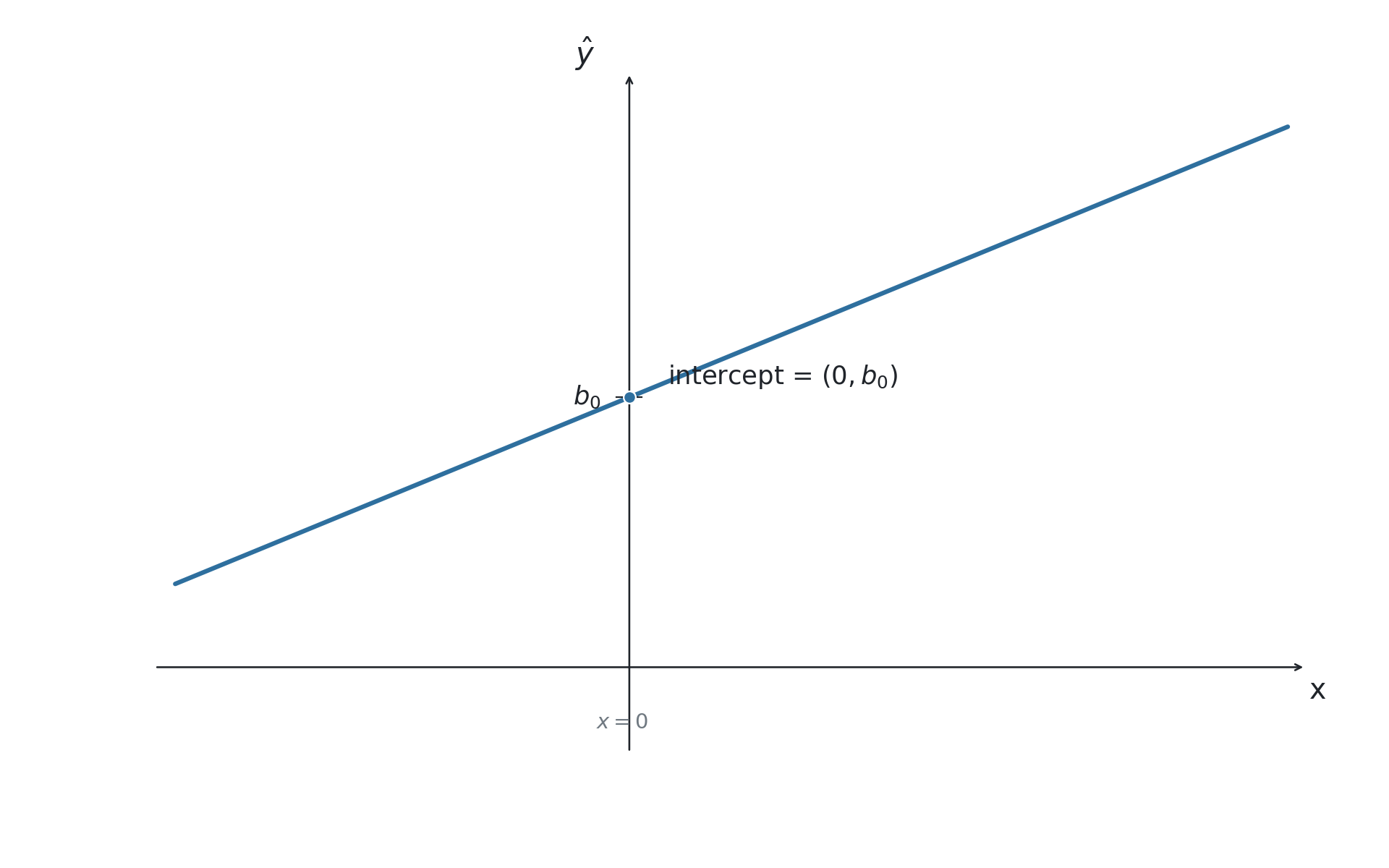
While the math is simple, the interpretation requires care. We use a template similar to the one we used for slope:
When [explanatory variable] is zero, the predicted [response variable] is [intercept value and units].
For example, if a model predicts annual salary based on years of experience and the intercept is , the interpretation is: When years of experience is zero, the predicted annual salary is $35,000.
The Three-Question Trust Test
Not every intercept is meaningful. Because a regression line is a mathematical model, it will calculate an intercept even if "zero" makes no sense in the real world. To decide if an intercept is a meaningful baseline or just a mathematical artifact, ask these three questions:
- Is within (or very near) the observed range of the data? If you only collected data on houses between 1,500 and 4,000 square feet, predicting the price of a "0 square foot" house is an extrapolation. Since you have no data near zero, you can't be sure the linear pattern actually starts there.
- Can the explanatory variable actually equal zero in this context? In a study of human height vs. weight for adults, "Age = 0" isn't part of the population being studied.
- Is the predicted value of at a plausible value? If a model predicts that at 0 °F, you will sell −30 ice cream cones, the intercept is clearly not meaningful because you cannot sell a negative number of items.
