Computing Unit Rates
Introduction
Welcome back to Ratios, Rates, and Unit Rates! This is the fifth and final lesson in the course, and you have built a strong foundation to get here. You started by writing and interpreting ratios, moved on to generating equivalent ratios and organizing them in tables, and most recently learned to identify rates as comparisons involving different units. Now we take one more step: turning any rate into a unit rate by finding the amount per one unit.
This is one of the most practical skills in the entire course. Whether you are comparing gas mileage on a road trip, checking your reading pace, or scanning price tags at the grocery store, the ability to calculate a unit rate lets you make quick, fair comparisons. Let's dive in.
Why "Per One" Matters
In the previous lesson, we wrote rates like miles per hours or $6 per 4 pounds. Those rates are perfectly correct, but they can be hard to compare directly. Imagine trying to decide which car is faster when one travels miles in hours and another travels miles in hours. The numbers do not line up neatly, so a side-by-side comparison is awkward.
The fix is simple: bring everything down to one unit. If we know how many miles each car covers in one hour, the comparison becomes instant. That "per one" value is what we call a unit rate, and computing it requires just one operation — division.
What Is a Unit Rate?
A unit rate is a rate in which the second quantity (the denominator) is exactly 1. It tells us the amount of the first quantity for each single unit of the second quantity.
- miles per 1 hour (often written simply as miles per hour)
- $1.50 per 1 pound
- words per 1 minute
Notice that once the denominator equals , we usually drop the "" and just say "per hour," "per pound," or "per minute." The word unit in "unit rate" comes from exactly this idea: we are expressing the rate for a single unit.
Computing a Unit Rate
To find a unit rate, divide the first quantity by the second quantity. This mirrors the fraction form we practiced in the last lesson — when we write a rate as a fraction, the division is already built in.
Example 1 — Speed. A car travels miles in hours. What is the unit rate in miles per hour?
We divided . The car covers miles for every hour.
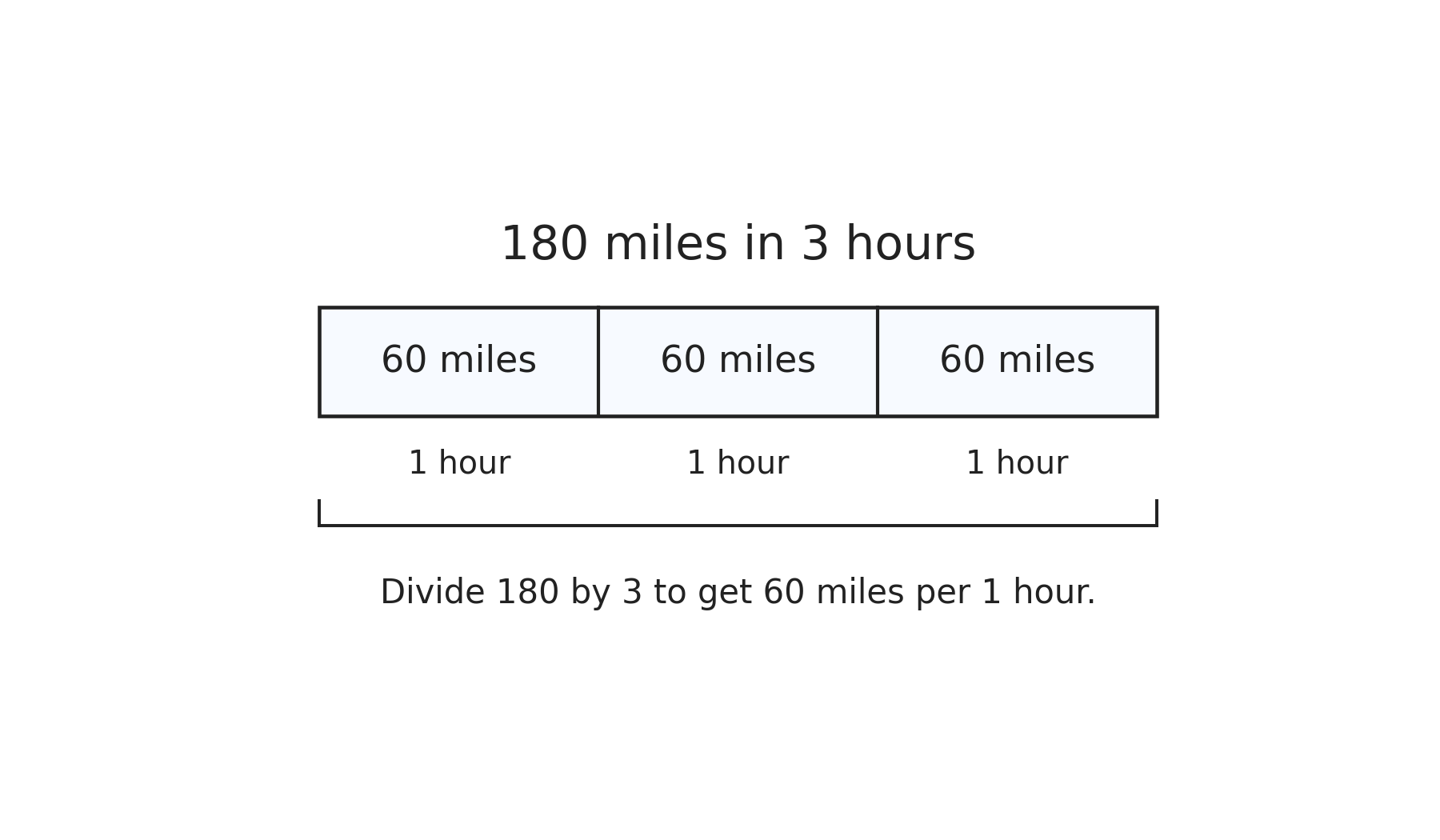
Example 2 — Reading pace. A student reads pages in days. What is the unit rate in pages per day?
Here, . The student reads pages for every day.
The pattern is always the same three steps:
- Write the rate in fraction form with the units attached.
- Divide the numerator by the denominator.
- Keep the units — the denominator becomes (which we can leave unwritten).
