Why Rational Decimals Repeat
Introduction
Welcome to the fourth and final lesson of Rational Numbers as Decimals — you have made it to the finish line! Over the first three lessons, you built a complete toolkit: converting fractions to terminating decimals with long division, identifying repeating blocks and writing them in bar notation, and predicting decimal behavior by checking the prime factors of the denominator. All of that work answered the how and the when of rational decimals.
This lesson tackles the why. We will explore the deeper reason that every rational number's decimal must either terminate or eventually repeat. No other behavior is possible, and by the end of this lesson you will be able to explain exactly why that is the case.
The Question Behind the Pattern
Every fraction you have converted so far landed in one of two camps: a decimal that stopped (like ) or a decimal that settled into a repeating cycle (like ). You never encountered a decimal that wandered on forever without forming any pattern. Was that just a lucky streak?
Not at all. There is a built-in limitation in long division that forces one of these two outcomes every single time. To see it, we need to take a closer look at what happens with the remainders during division.
Remainders Are Limited
When you divide a number by a positive integer , each step of long division produces a remainder. That remainder is always a whole number from up to . There are no other options, because by definition a remainder must be less than the divisor and cannot be negative.
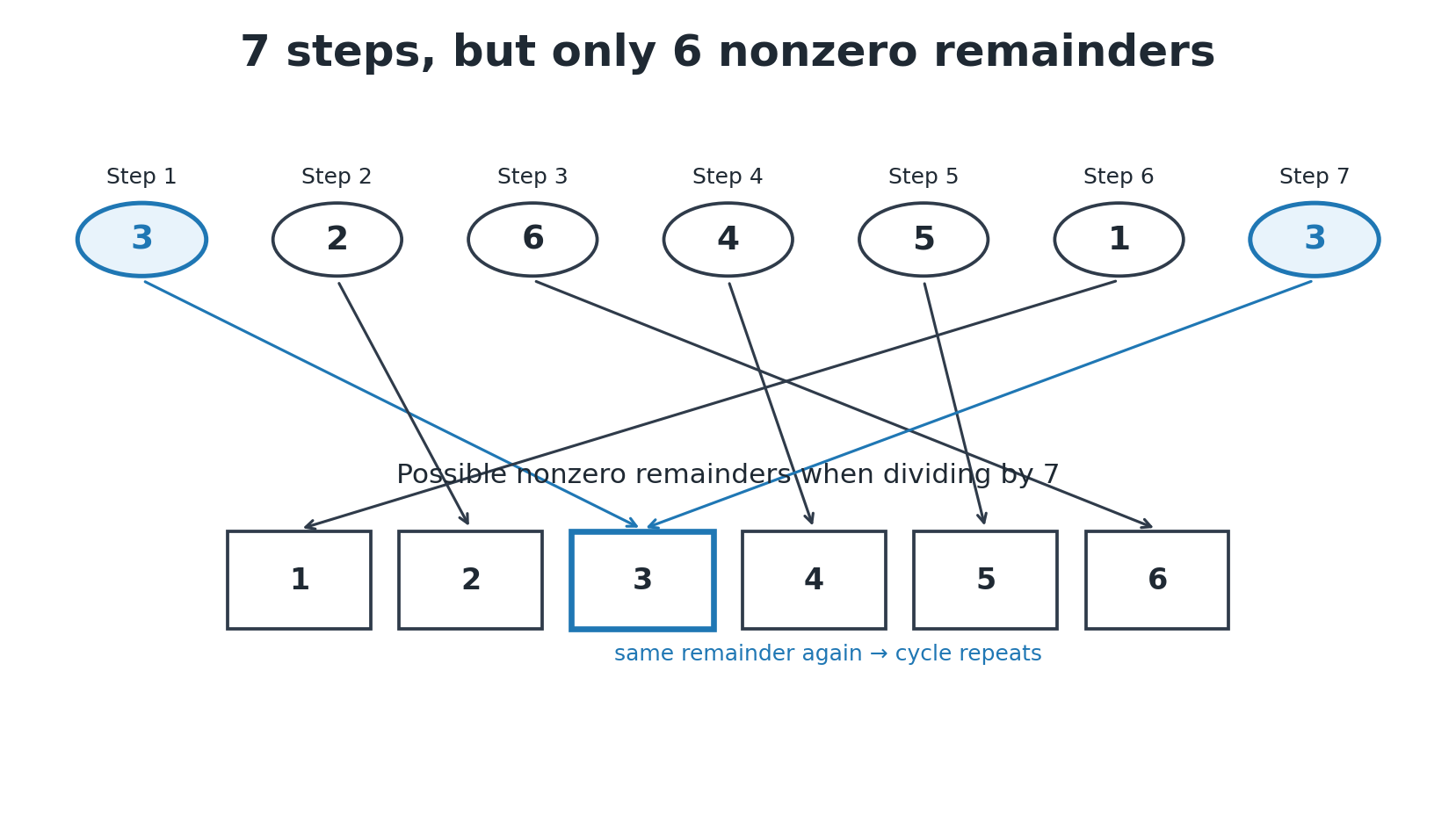
This means the total collection of possible remainders is finite. If , the only possible remainders are — just four values. If , they are — seven values. No matter how large is, the set of possible remainders has exactly members and not one more.
Why a Remainder Must Reappear
Here is the crucial step. Suppose you are dividing by and the decimal has not terminated. That means you have not yet reached a remainder of , so each remainder you encounter is one of the nonzero values .
Because there are only nonzero remainders available, you cannot carry out more than division steps without seeing a remainder you have already seen. An everyday analogy helps here: imagine a week has days and you schedule meetings on different days. At least two meetings must land on the same day, because there are not enough days to go around. Remainders work the same way — if you have possible nonzero remainders and you perform steps, at least two of those steps must produce the same remainder.
Once a remainder reappears, the long division process returns to exactly the same state it was in before. The same remainder leads to the same next digit, the same next remainder, and so on. From that point forward, the entire sequence of digits repeats in a cycle.