Decoding Digital Hooks
Welcome to the Course
Here's an uncomfortable question to open with: when you reach for your phone in the middle of a task, are you deciding to, or is something reaching back? Your phone was never designed to be neutral. It was built by teams whose entire job is to capture and extend your attention, and as a busy knowledge worker juggling reports, messages, and your own goals, you are precisely the target. This course pulls back the curtain on those design tricks so you can decide for yourself whether they deserve your focus.
By the end of this course, you'll be able to:
- Decode the design patterns (variable rewards, notification badges, validation loops) that make your phone feel urgent and rewarding
- Interrupt infinite scroll and checking loops by setting deliberate stopping points
- Add friction to your phone setup so boredom no longer leads automatically to a check
- Challenge the belief that "one more check is harmless" using real switching-cost math
- Design a goal-aligned attention plan that treats distraction as an obstacle to what you actually want
This first unit starts at the source: the specific cues engineered into your apps, and why they work on you even when you know better.
Three Different Hooks, Three Different Effects
Not every pull on your attention works the same way, even though they feel identical in the moment. Attention scientists group the main hooks into a set of Smartphone Design Patterns, and three of them are worth telling apart clearly.
The first is the variable reward schedule. Think of a slot machine: you pull the lever not because you know a jackpot is coming, but because it might be. Your feed runs on the same logic. Sometimes a refresh brings something great, usually it brings nothing, and that unpredictability is exactly what keeps you pulling.
The second is the notification badge, that little red dot with a number on it. Its power isn't excitement, it's discomfort. It works through loss aversion: your brain treats the unread count as something wrong that must be cleared, manufacturing urgency the message rarely earns.
The third is the validation signal: the likes, comments, and shares that trickle in after you post. These feed on anticipation of social approval. You're not waiting for information, you're waiting to learn whether people reacted to you.
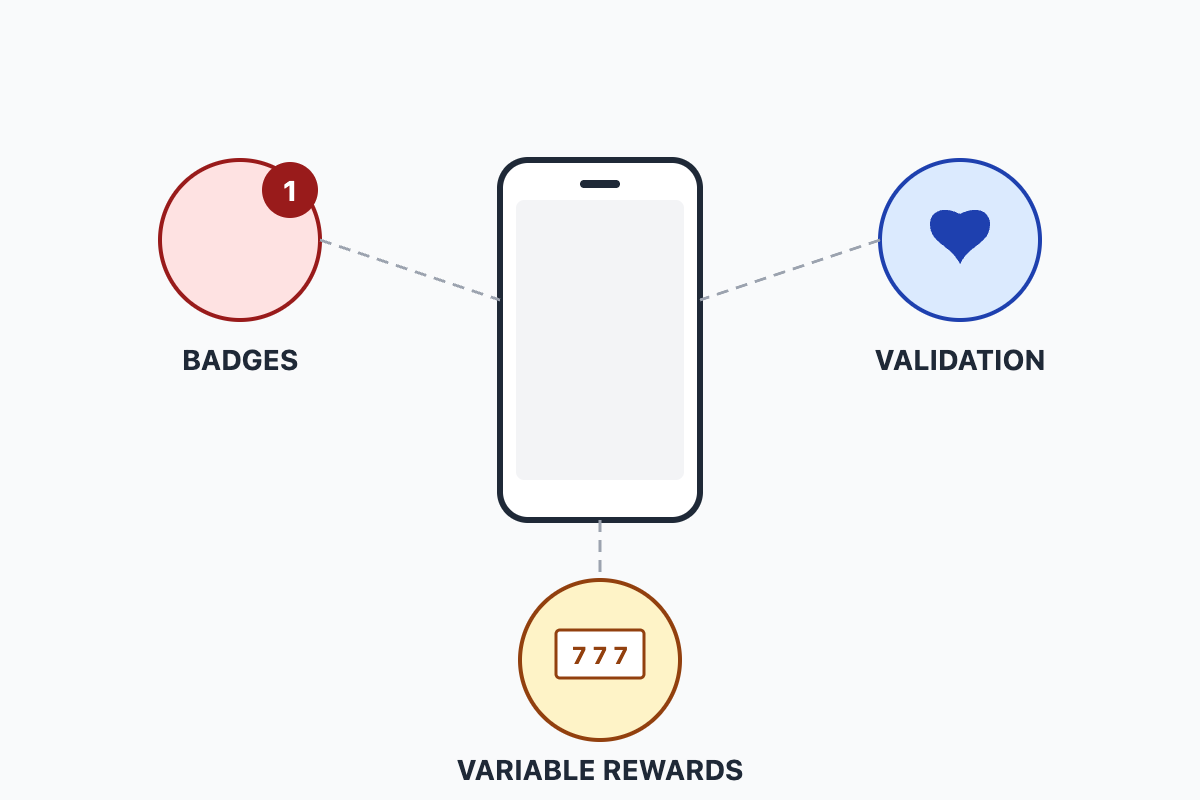
So variable rewards run on possibility, badges run on discomfort, and validation runs on social anticipation. Same phone, three different levers.
Why You Check Even When You Expect Nothing
Here's the tension worth sitting with: if you already know most checks turn up nothing useful, why do you keep checking? The honest answer is that the reward was never the point. The anticipation is.
Your brain releases a small hit of dopamine, the anticipation chemical, not when a reward arrives but when one merely might. Uncertainty is the fuel. A guaranteed reward stops registering after a while, while an unpredictable one keeps you coming back. That's why "there might be something" beats "there's definitely nothing" every single time your hand drifts toward the screen.
The red badge adds a second push. Because your brain dislikes the feeling of a loose end, an unread count reads as a tiny unfinished task nagging at you. Clearing it delivers relief, and relief is its own reward, so the badge trains you to check on its schedule rather than yours.
- Dan: I only check my phone when something actually matters.
- Natalie: So the last five times you unlocked it, what was waiting?
- Dan: Honestly? A sale email, a group chat meme, nothing, and nothing.
- Natalie: Right. You're not chasing the thing. You're chasing the maybe.
- Dan: Huh. So it's the not-knowing that keeps me reaching.
Notice how Dan's belief ("I only check when it matters") collapses the instant he recalls what he actually finds. That gap, between the story we tell and the evidence, is exactly where these patterns hide.
Reading the Cues in Your Own App
So turn the lens on yourself. Open the app you check most during the workday, and instead of asking "is this bad for me?", ask a sharper question: which specific cue is pulling me here?
Walk through it. Does the app serve up unpredictable content every time you open it? That's a variable reward at work. Is a red badge waiting before you even tap in? That's loss aversion manufacturing urgency. Do you circle back after posting to see who reacted? That's a validation loop feeding on anticipation. Most apps stack several of these at once, which is why a "quick check" is rarely quick. Naming the exact cue matters, because a vague "I'm on my phone too much" gives you nothing to act on, while "the badge count is baiting my loss aversion" tells you precisely what you're up against.
The one idea to carry out of this unit: your phone pulls you through anticipation and manufactured urgency, not because something important is genuinely waiting. Next, you'll do a quick pattern-spotting exercise, matching real cues (unpredictable content, loss aversion, social anticipation) to the design pattern behind each, so the labels become second nature. As you go, sit with one question: of all the checks you'll make today, how many answer a real need, and how many just answer the maybe?
