Tracing Business Lineage
Tracing Lineage for Business Context
In the last unit you dropped a "short lineage summary" into a catalog record without stopping to ask what lineage really is. Now you'll slow down, because tracing lineage is how you keep a small change from causing a big surprise. As a Data Governance Analyst, this is one of your most protective moves: before anyone redefines a term, swaps a source, or rewrites a report, you can show them exactly who downstream will feel it.
Lineage Is the Story of Where Data Comes From and Where It Goes
Business lineage is simply the path a piece of data travels from the moment it's created to the moment it shapes a decision or reaches a customer. Picture a supply chain: a raw material gets sourced, processed, packaged, shipped, and finally used by someone at the end. Data works the same way, and lineage is the map of that journey.
The Business Lineage Map names the stops along the path: the origin (where the data first comes into being), the capture point (where it's first recorded), the upstream provider (the team or process that supplies it), the business transformations (the calculations or rules that reshape it), the handoffs (where it passes from one team to another), the downstream uses (the reports and processes that consume it), the decisions affected, the owners or stewards involved, and the quality checks that catch problems along the way.
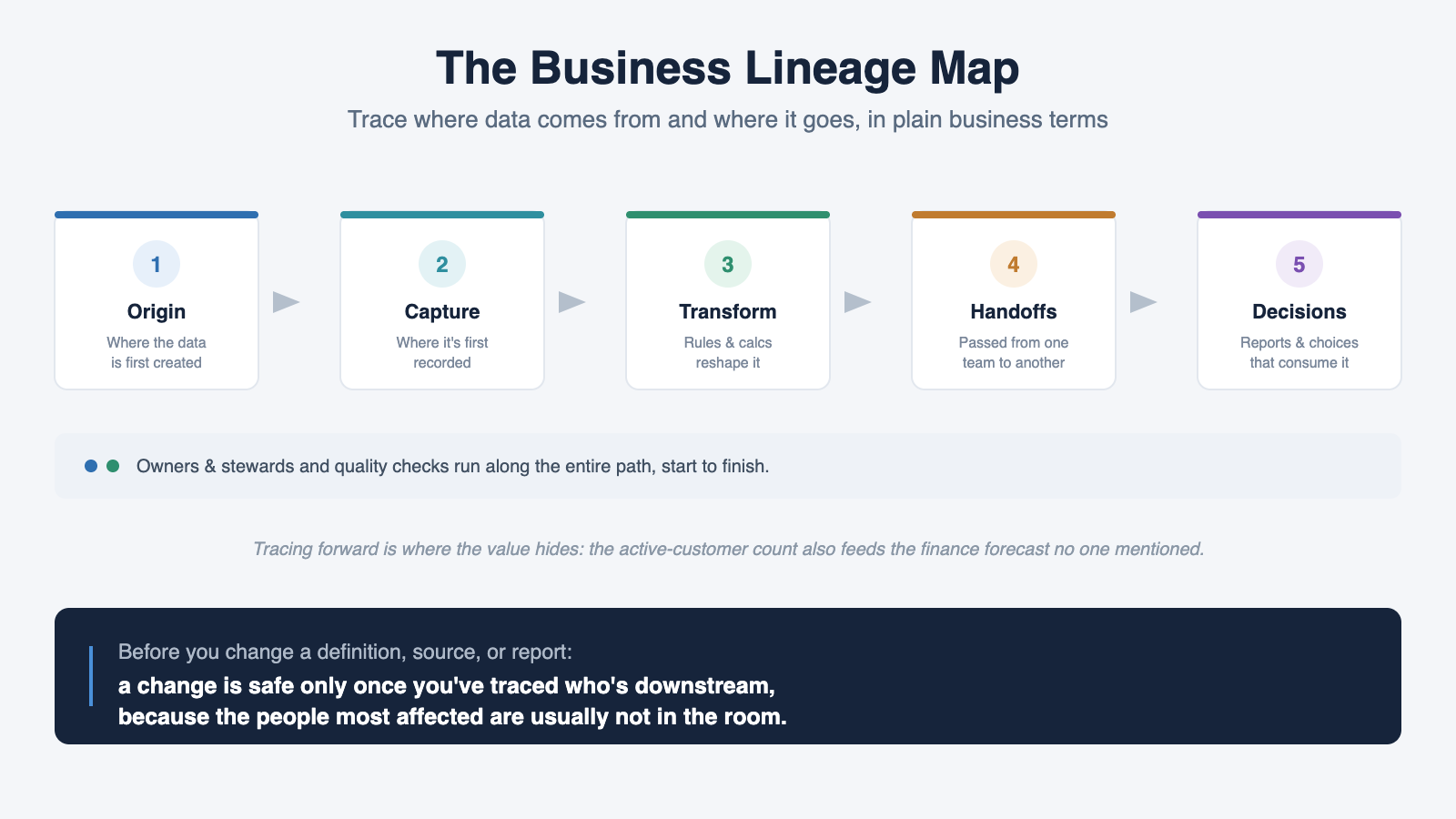
One thing matters most here: business lineage tells this story in plain business language, not system mechanics. You're not mapping databases or code. You're mapping who touches the data, what they do to it, and why.
- Jake: I want to tweak how we calculate the active-customer count. It's just one field.
- Natalie: Before we touch it, let's trace where that number travels. Where does it start?
- Jake: Sales enters the signup, then we tag anyone active in the last 90 days.
- Natalie: And who reads the count after that?
- Jake: The marketing dashboard, and... oh, finance uses it for the quarterly forecast. I forgot about them.
- Natalie: That's the whole point of tracing it. Change it without telling finance, and their forecast quietly breaks.
Notice that Natalie didn't argue about the change itself. She just walked the path, and the risk revealed itself.
Map One Element at a Time, and Hunt for the Hidden Consumers
The practical move is to pick a single critical data element and trace it in both directions: backward to its origin and forward to everyone who relies on it. Resist the urge to map a whole system at once. One element, fully traced, is far more useful than a vague picture of everything.
Tracing backward is usually the easy half, because people remember where their data comes from. Tracing forward is where the real value sits. Almost everyone underestimates who depends on their data downstream, since they only see their own slice. So you keep asking two plain questions: "Who else looks at this?" and "What decision breaks if it changes?" Each answer often points to another consumer nobody documented, like a collections team, a customer email, or a finance report. Your job is to make those quiet dependencies loud before anyone is blindsided.
Check the Impact Before You Change Anything
Once the map exists, it becomes your pre-change checklist. Whenever someone proposes changing a definition, a source, a report, or a policy, you walk the lineage and ask what each step would feel. Which reports shift? Which decisions get made on a different number? Which handoffs land on someone who isn't expecting a change? Which owner needs a heads-up?
From there, you name the riskiest dependency out loud (the one where a quiet change does the most damage) and you recommend a check-first path rather than a change-first one. That means notifying the affected owners, confirming the quality checks still hold under the new definition, and sequencing the change so downstream users adjust in step rather than discovering it after the fact. The lineage map turns "let's just tweak it" into "let's tweak it without breaking three things we forgot about."
The single idea to carry out of this unit: a change is only safe once you've traced where the data goes, because the people most affected are usually the ones not in the room. Three practices sit ahead of you. First you'll spot the lineage components in a plain data-flow story, then you'll walk a stakeholder through a live map to surface the consumers they overlooked, and finally you'll turn that conversation into a written impact analysis. Start with one habit: before agreeing to any data change, ask "who reads this after us, and what decision does it drive?"
