Clarifying Decision Rights
Clarifying Decision Rights with RACI
In the last unit, you learned to name the owner and steward for a piece of data. That settles who sits in the seat. But naming a role doesn't answer the question everyone actually trips over: when a real decision lands on the table, who decides, who does the work, who gets a say first, and who just needs to hear about it afterward. That gap is where good intentions stall, and it's exactly what the RACI model closes.
Who Decides, Who Does, Who Gets a Say
Picture a routine bit of governance work: someone proposes changing the official definition of a metric. Five people are on the email thread, everyone has an opinion, and three weeks later nothing has moved. The problem isn't effort. It's that no one agreed on roles before the work started. The RACI model fixes this by sorting everyone into exactly four buckets for a single decision.
The letters stand for Responsible, Accountable, Consulted, and Informed. The person who is Responsible does the actual work, like drafting the new definition. The person who is Accountable owns the outcome and makes the final call, and there should be exactly one. Consulted people give their input before the decision is made. Informed people are simply told after it's done.
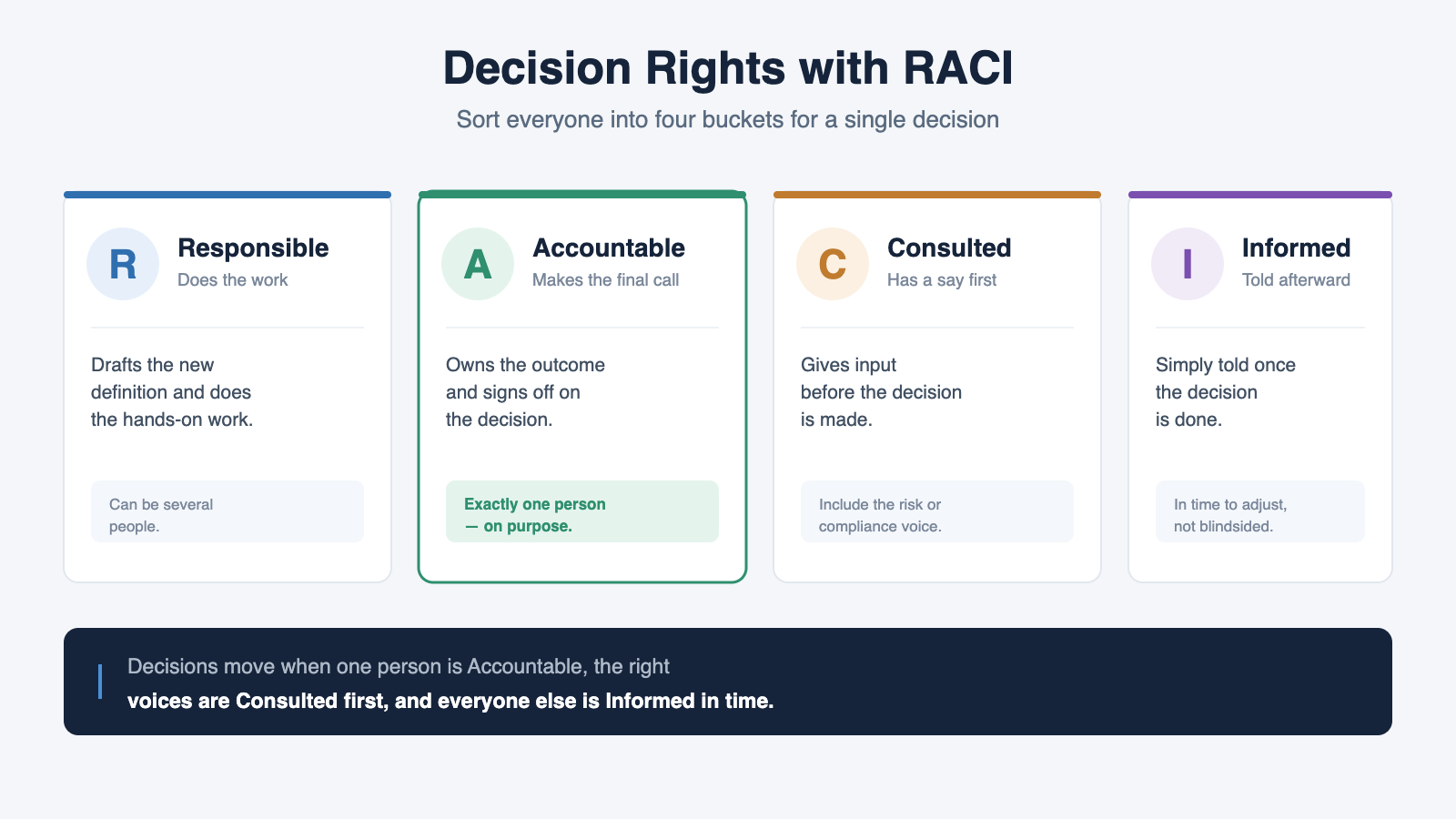
Think of renovating a kitchen. The contractor is Responsible because they do the work. You, the homeowner, are Accountable because one person signs off. You Consult the plumber and electrician before deciding, and you Inform the neighbors once the work is scheduled.
- Natalie: I keep getting tagged on the metric-definition change. Am I supposed to decide it or just weigh in?
- Chris: Those are different roles. If you're Accountable, you make the final call and own it. If you're only Consulted, you give input before I decide, but the call isn't yours.
- Natalie: And there can be more than one Accountable, right? Finance and I both signed off last time.
- Chris: That's what stalled it. Accountable is one person, on purpose. Two owners means each waits for the other.
- Natalie: So name one owner, and list me as Consulted. Got it.
Notice the key move: Chris separates "give input before" from "make the call," and he refuses to split the Accountable seat.
Spotting Where It Breaks Down
Once you can read the four letters, your next job is to catch where a chart quietly fails. Most broken RACIs fail in one of three predictable ways, so train yourself to scan for them.
First, watch for two Accountable owners. Accountability can't be shared. When two names sit in that seat, each one assumes the other will close the decision, and it drifts. Second, look for a missing Consulted party. If a decision touches a regulated or sensitive field, the person who weighs compliance risk must be Consulted before the change, not surprised by it later. Leave them off, and you've created real exposure. Third, hunt for silent stakeholders, the heavy users who only appear as Informed after launch. If a change affects how they do their work, being told afterward gives them no chance to adjust, and they'll push back hard once the damage is done.
The discipline here is to tie each defect to the confusion it causes: a split owner stalls the decision, a missing approver invites risk, and a too-late Informed user gets blindsided.
Building One You Can Use Tomorrow
When you build a RACI from scratch, keep it almost stubbornly simple. Start by naming one specific decision, like "who can change the official definition of net revenue." Then assign exactly one Accountable owner, because that single name is what makes the decision movable. Add the Responsible person who'll do the drafting (often a steward), list the parties you'll Consult before deciding, and finally name who gets Informed once it's settled. The whole point is that affected people are consulted before the change, not informed after it.
Decision rights only work when one person owns each call, the right voices are heard first, and everyone else is told in time. That single principle prevents the slow-motion stalls you've watched drag on for weeks.
A few practices sit ahead of you. First a quick self-check to lock in which letter fits which action, then you'll write a sharp review of a flawed RACI before proposing the corrected version yourself. Starting now, whenever a data decision feels stuck, ask one question: "Who is the single Accountable owner here?" and watch how fast the fog clears.
