Welcome back to Modeling and Solving Everyday Systems! This is the third lesson of the course, and it is where the brace finally opens: today we solve.
At the end of the previous lesson we deliberately stopped with a finished model on the page. That restraint pays off now, because the algebra ahead is short — a few lines at most. The genuinely interesting work has moved to the end of the problem. Once the numbers appear, what do they tell a real person choosing between two audiobook plans or two job offers? A pair of numbers is not yet an answer; it becomes one only when we can say what it means in the language of the situation.
The Meeting Point Idea
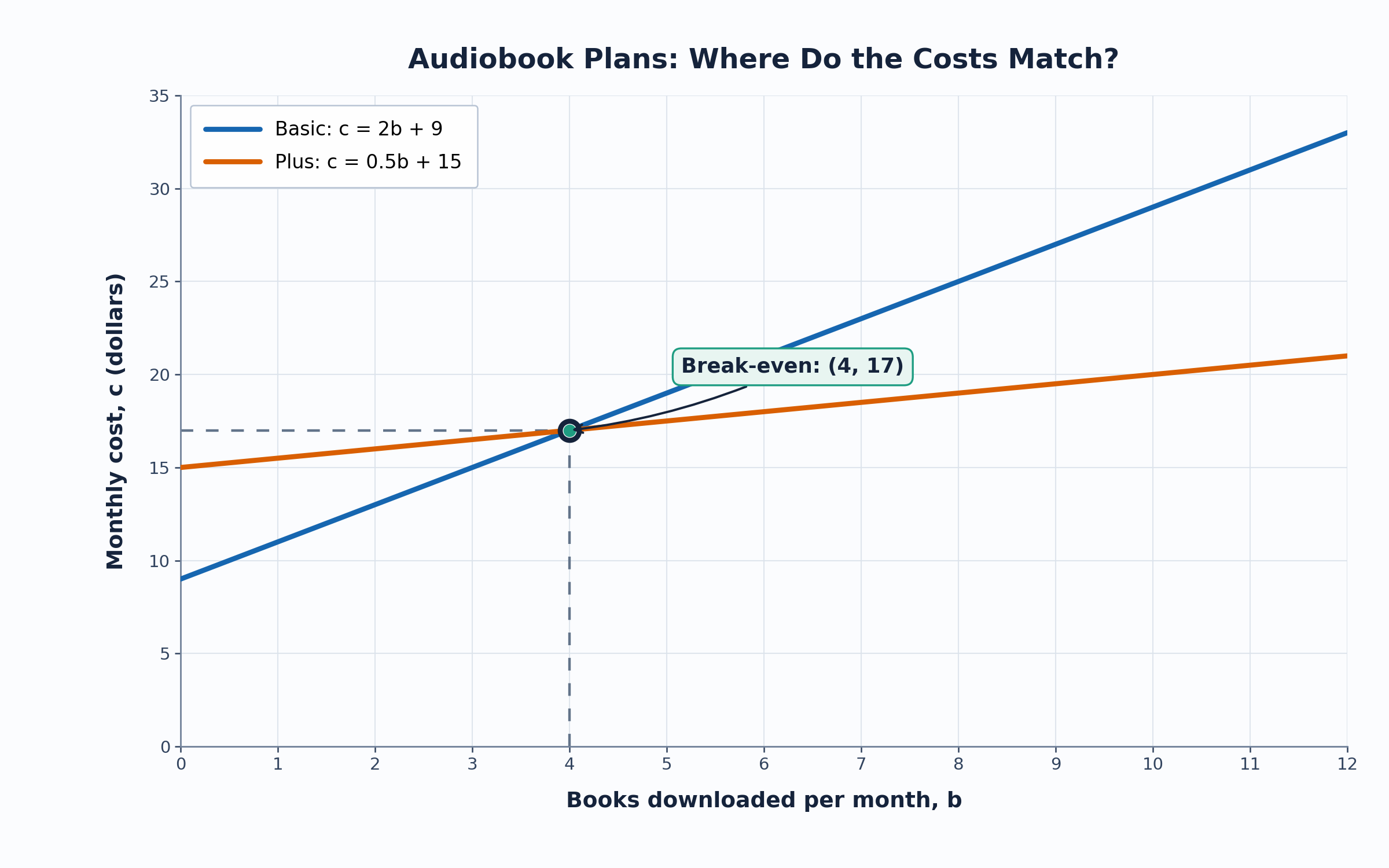
Here is the picture behind every comparison system. Two plans, each growing at its own steady rate from its own starting point, can cross at most once — but how many times they actually cross depends on whether their rates differ.
If the two plans share the same rate but different fixed amounts, their graphs are parallel lines: the gap between them never closes, so there is no break-even at all and one option is cheaper at every usage level. If the two plans are truly identical — same rate and same fixed amount — their graphs overlap completely, meaning every usage level is a tie. Both of these edge cases are worth recognizing, though they are less common in real comparisons (and easy to spot: identical rates in the model are the giveaway).
The situation this lesson focuses on is the typical one: two plans with different rates. There, the lines must cross exactly once. Before the crossing, one plan is cheaper; after it, the other one is. That single crossing has a familiar name in everyday speech: the break-even point, the usage level at which both options come out the same.
Algebraically, that crossing is exactly what a solution to the system is. When we write
{c=2b+9c=0.5b+15
we are asking for a number of books b and a cost c that satisfy both rules at the same time. Any such pair describes a moment when the two plans agree — which is why solving and interpreting are really two halves of one job.
Join the 1M+ learners on CodeSignal
Be a part of our community of 1M+ users who develop and demonstrate their skills on CodeSignal
Why Substitution Is the Natural Fit
Solving a Comparison System Step by Step
Turning Numbers into a Sentence
Checking That the Answer Is Reasonable
A Second Example: Salary Versus Commission
From Break-Even to a Recommendation
Common Pitfalls
Conclusion and Next Steps
In this lesson we closed the loop on comparison situations. Because both equations arrive already solved for the total, substitution collapses into setting the two totals equal, which we then solve, back-substitute, and verify in the untouched equation. From there we did the work that gives the numbers meaning: a sentence naming the usage level and the matching total, a four-question reasonableness check, and a test value on each side of the break-even that turns one crossing point into a real recommendation.
Now it is your turn. Ahead of you are a scaffolded solution to complete, a reasonableness judgment to make, and three scenarios where you will solve for a break-even and explain it for a phone bill, a paycheck, and a plan choice. Solving is satisfying, but explaining the answer clearly is the skill people will actually thank you for.
As you may recall from the first lesson of this course, we scan a system's structure before picking a method, and an already isolated variable is the strongest possible cue for substitution. Comparison systems hand us that cue twice over: both equations arrive in the form c=(rate)b+(fixed), already solved for the total.
Because both left sides are the same variable c, substitution takes an especially short route here. If c equals 2b+9 and c also equals 0.5b+15, then those two expressions must equal each other:
2b+9=0.5b+15
In one step we have gone from two equations in two variables to one equation in one variable, with no rearranging and no new fractions. People often call this move setting the totals equal; it is simply substitution with the tidiest possible setup.
Let us carry the audiobook system all the way through. Recall the definitions from our model: b is the number of books downloaded in one month, and c is the total monthly cost in dollars.
Substitute. Replace c in the second equation with 2b+9, giving 2b+9=0.5b+15.
Collect the variable terms. Subtract 0.5b from both sides: 1.5b+9=15.
Collect the constants. Subtract 9 from both sides: 1.5b=6.
Solve. Divide both sides by 1.5: b=4 books.
Back-substitute. Put b=4 into whichever original equation looks simpler: c=2(4)+9=17 dollars.
The solution is the ordered pair (b,c)=(4,17). Before moving on, we verify it in the equation we did not use for back-substitution — that is the point of checking in the other equation, since a fresh equation can catch a slip the used one would hide: 0.5(4)+15=2+15=17. Both plans report $17, so the pair is a genuine solution and not an arithmetic accident.
Now for the part that separates this lesson from a pure algebra drill. The pair (4,17) means nothing to a friend deciding on a subscription, so we translate it back using the variable definitions we wrote while modeling.
A good interpretation sentence names the usage level, names the shared total, and says explicitly that the two options match:
At 4 books downloaded in a month, both plans cost the same amount, $17.
The structure is worth reusing: at [value of the varying quantity], both options give [value of the total]. Two habits keep these sentences honest:
Carry the units. "4" is meaningless on its own; "4 books per month" is a fact.
Say "the same," not "the better deal." The break-even point is precisely where neither option wins, so calling it the cheaper plan misreads the math.
Verifying a pair in both equations proves the algebra is right. It does not prove the answer makes sense for the situation, so we add one more deliberate step before reporting anything: a quick reality check.
Question to ask
Why it matters
Warning sign
Is the usage value non-negative?
Nobody downloads −3 books or drives −50 miles.
A negative break-even
Is the total non-negative and plausible?
Costs and wages are positive amounts.
A $4,000 monthly phone bill
Should the value be a whole number?
Books, classes, and texts come in whole units.
b=4.5 books
Is the value in a reachable range?
A break-even at 10,000 classes a month is out of reach.
A number no real person could hit
The audiobook answer passes on all four counts: 4 books is non-negative and whole, and $17 is a believable monthly bill. And a failed check is not automatically a mistake — a negative break-even often carries real information, telling us the two lines never cross in the range a person can actually use, so one option is cheaper at every realistic usage level.
Comparison systems are not only about spending. Let us solve the pay system from the previous lesson, where s is weekly sales in dollars and p is total weekly pay in dollars:
{p=760p=0.06s+400
The first equation gives p as a bare number, so substitution is nearly instant. Replacing p with 760 leaves 760=0.06s+400; subtracting gives 360=0.06s, and dividing by 0.06 gives s=6000. The solution pair is (s,p)=(6000,760).
Interpreted in context: at $6,000 in weekly sales, both jobs pay the same $760 per week. Is that reasonable? Weekly sales of $6,000 is positive and plausible for a salesperson, and unlike a book count, a sales figure need not be a whole number — so an answer like $6,142.50 would have been perfectly acceptable here.
One number can drive a real decision, but only once we look at what happens on either side of it. The break-even splits usage into two ranges, and testing a single convenient value in each range shows who wins where. This beats memorizing a rule about which rate is larger, because it works every time and takes seconds.
Break-even for the audiobook plans is 4 books, so we test one value below and one above:
Books per month
Basic: 2b+9
Plus: 0.5b+15
Cheaper plan
2
$13
$16
Basic
4
$17
$17
Tie
10
$29
$20
Plus
The recommendation now writes itself: a light reader who downloads fewer than 4 books a month should choose Basic, while anyone reading more than 4 should choose Plus. That also confirms the intuition we flagged during modeling — the plan with the higher fee and lower rate takes over once usage grows.
These are the slips that turn correct algebra into a wrong or unusable answer.
Stopping at the first variable. Finding b=4 and calling it done leaves out the shared total, which is half the interpretation.
Back-substituting into the equation you just manipulated. Use an original equation to find the second value, then check in the other one.
Reporting bare numbers. "(4,17)" is a solution, not an interpretation. Name the units and the plans.
Confusing "equal" with "better." At the break-even, neither option wins; the recommendation lives on either side of it.
Skipping the reality check. A result of b=−7 books can satisfy both equations perfectly and still needs a real-world explanation.