Midpoints of Diagonal Segments
Introduction
Imagine two neighborhood addresses connected by a straight path that runs both east-west and north-south. To find a true halfway meeting point, you need to split both parts of the change evenly. In this final lesson of Midpoints of Segments, you’ll extend your midpoint skills from horizontal and vertical segments to diagonal ones.
Halfway Along a Diagonal
On a diagonal segment, both coordinates change as you move from one endpoint to the other. The halfway point must be halfway between the endpoints’ -values and, separately, halfway between their -values. Think of a coordinate pair as two readings of the same location: one horizontal and one vertical. That idea leads to two coordinate averages.
Average the Coordinates Separately
For endpoints and , average the -coordinates together and the -coordinates together:
Write the first average as the midpoint’s -coordinate and the second as its -coordinate, in order. Keep any negative signs when adding; do not average all four values together because and describe different directions. Let’s apply the rule to a segment with straightforward coordinates.
The horizontal and vertical rules from the previous lesson are special cases of this general formula. For a horizontal segment, , so their average keeps that same -value. For a vertical segment, , so their average keeps that same -value.
A Diagonal Segment in One Quadrant
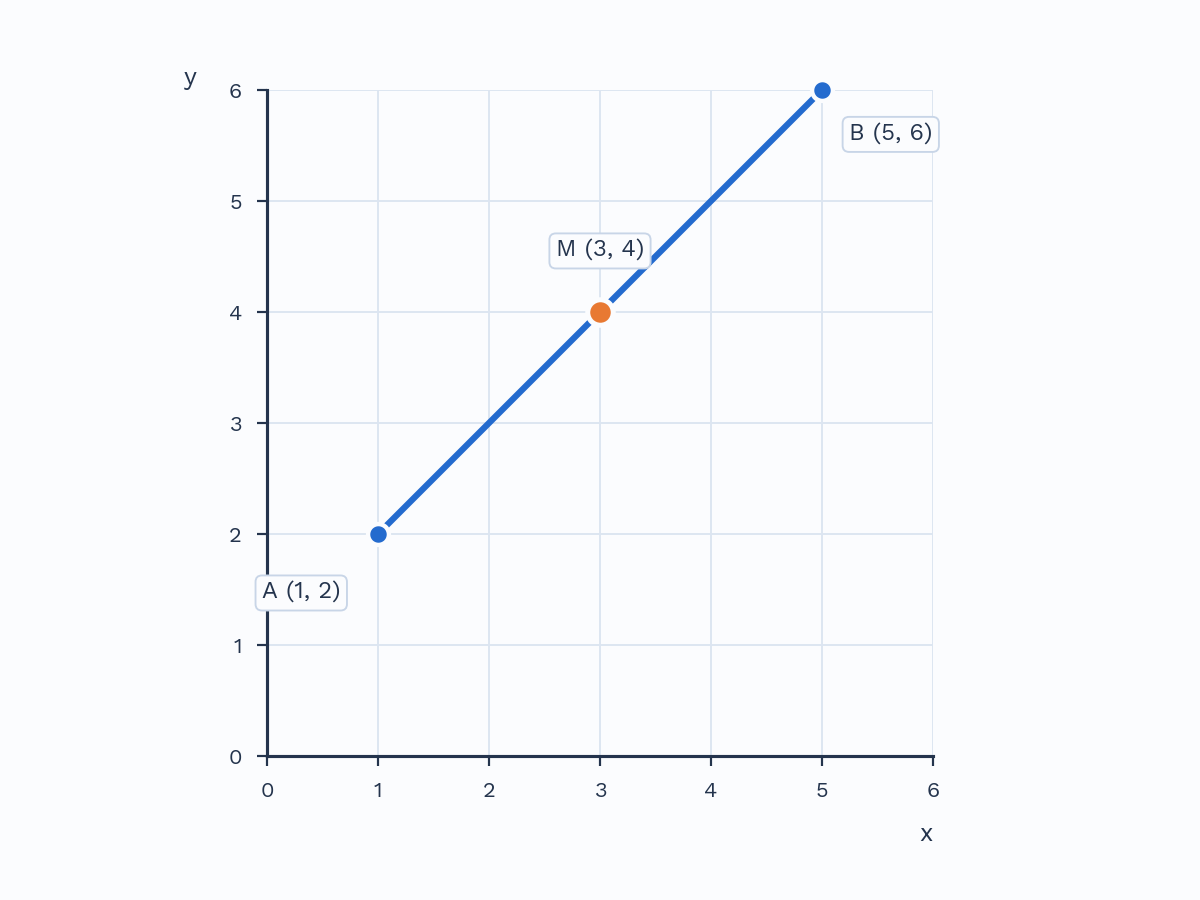
Suppose and , both in Quadrant I. Average each pair of matching coordinates:
So the midpoint is . From to , increases by and increases by ; from to , both increase by again. These equal changes show that lies on the finite segment and divides it into two equal lengths.
The same rule works when endpoint coordinates have different signs.
Midpoints Across Different Quadrants
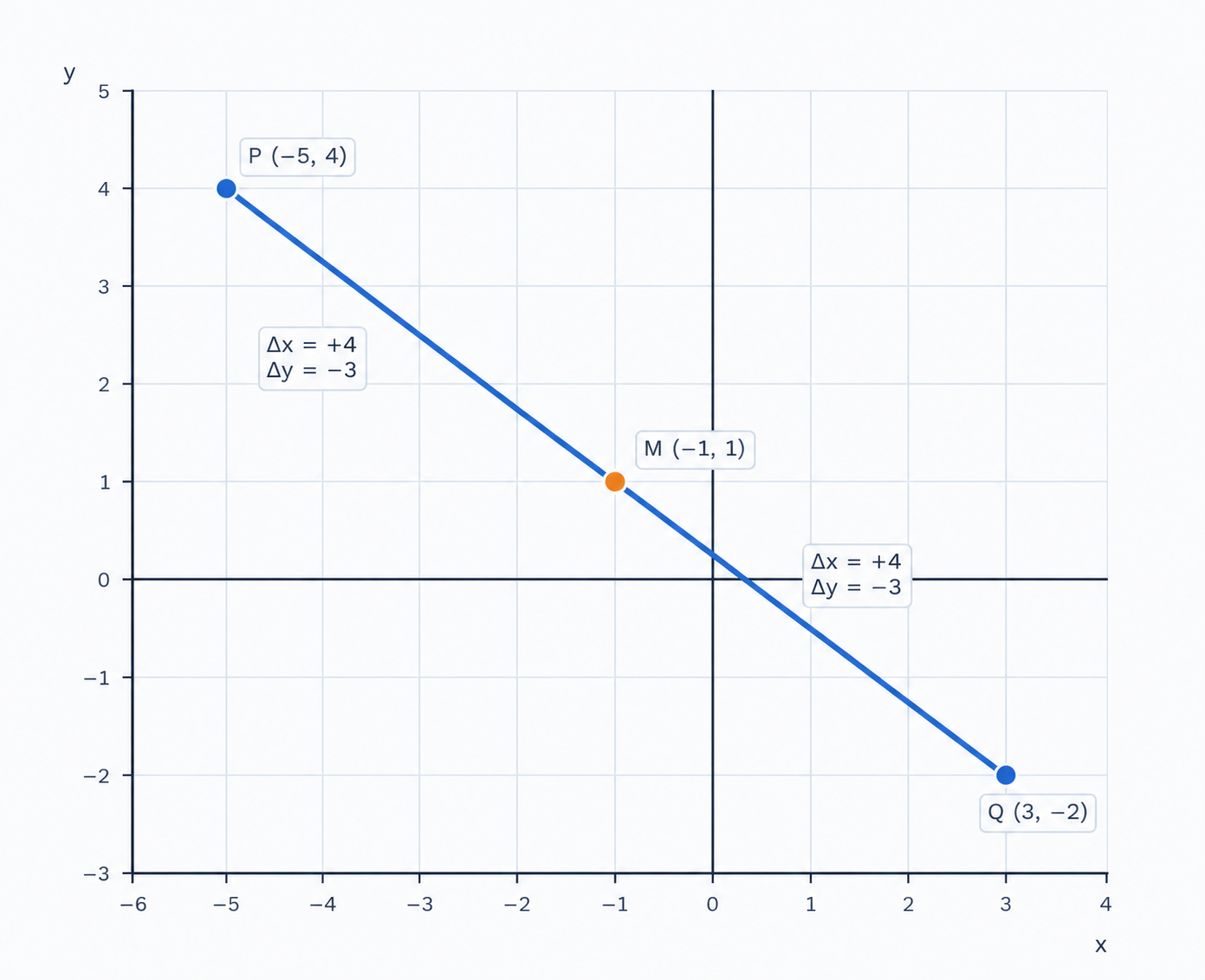
Suppose two stores are at and . The endpoints are in Quadrants II and IV, but we still average the -coordinates and -coordinates separately:
The midpoint is . From to and from to , increases by and decreases by each time. Keep negative signs as written; the midpoint rule does not change across quadrants.
The averages can also land between grid lines.
Half-Unit and Decimal Midpoints
A midpoint does not have to land on a whole-number grid intersection. For endpoints and :
So . Both coordinates fall between whole-number grid lines, but they are exact values.
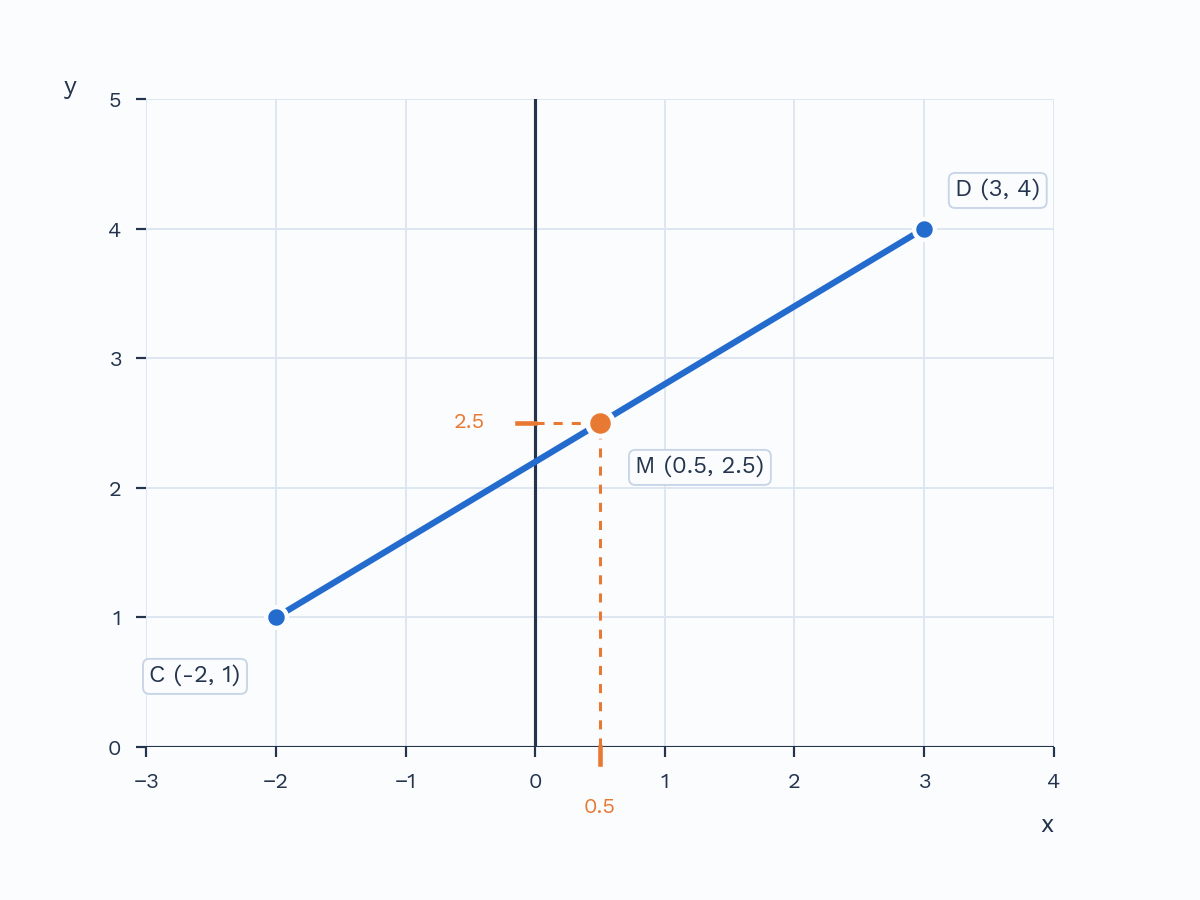
Decimal coordinates use the same method. For endpoints and , the averages are and , so .
Conclusion and Next Steps
For a diagonal segment, average the two endpoint -coordinates and the two -coordinates separately. The resulting ordered pair is the exact midpoint, even when the endpoint signs differ or the point falls between grid lines.
In the practice that follows, you’ll complete separate - and -averages, calculate midpoints for endpoints in the same or different quadrants, and work with half-unit or decimal coordinates. You’ll finish by plotting the halfway meeting point between two addresses.
