Checking Midpoint Conditions
Introduction
Welcome to the first lesson in Midpoints of Segments. You’ve already worked with coordinates and distances in earlier parts of the learning path; now you’ll bring those ideas together to decide when a point truly lies halfway between two endpoints. A meeting spot in a hallway gives us a useful test: it must be along the hallway between its ends, with each end the same distance away.
A Segment Is a Finite Path
A segment is the straight path from one endpoint to another, including the endpoints and nothing beyond them. In a hallway, for example, the segment might be the stretch between two doors; a spot past either door may be on the same straight line, but it is not on that segment. This matters because a midpoint must be halfway along a specific segment, not merely somewhere nearby.
Two Checks for a Midpoint
Let and be distinct endpoints, and let be a candidate point. The point is the midpoint of only if both of these conditions are true:
- lies on the finite segment .
- is the same distance from and .
In symbols, both conditions must hold:
Every segment with two distinct endpoints has exactly one midpoint.
Equal distances alone are not enough. A point can be equally far from both endpoints while lying off the segment.
Compare Three Candidate Points
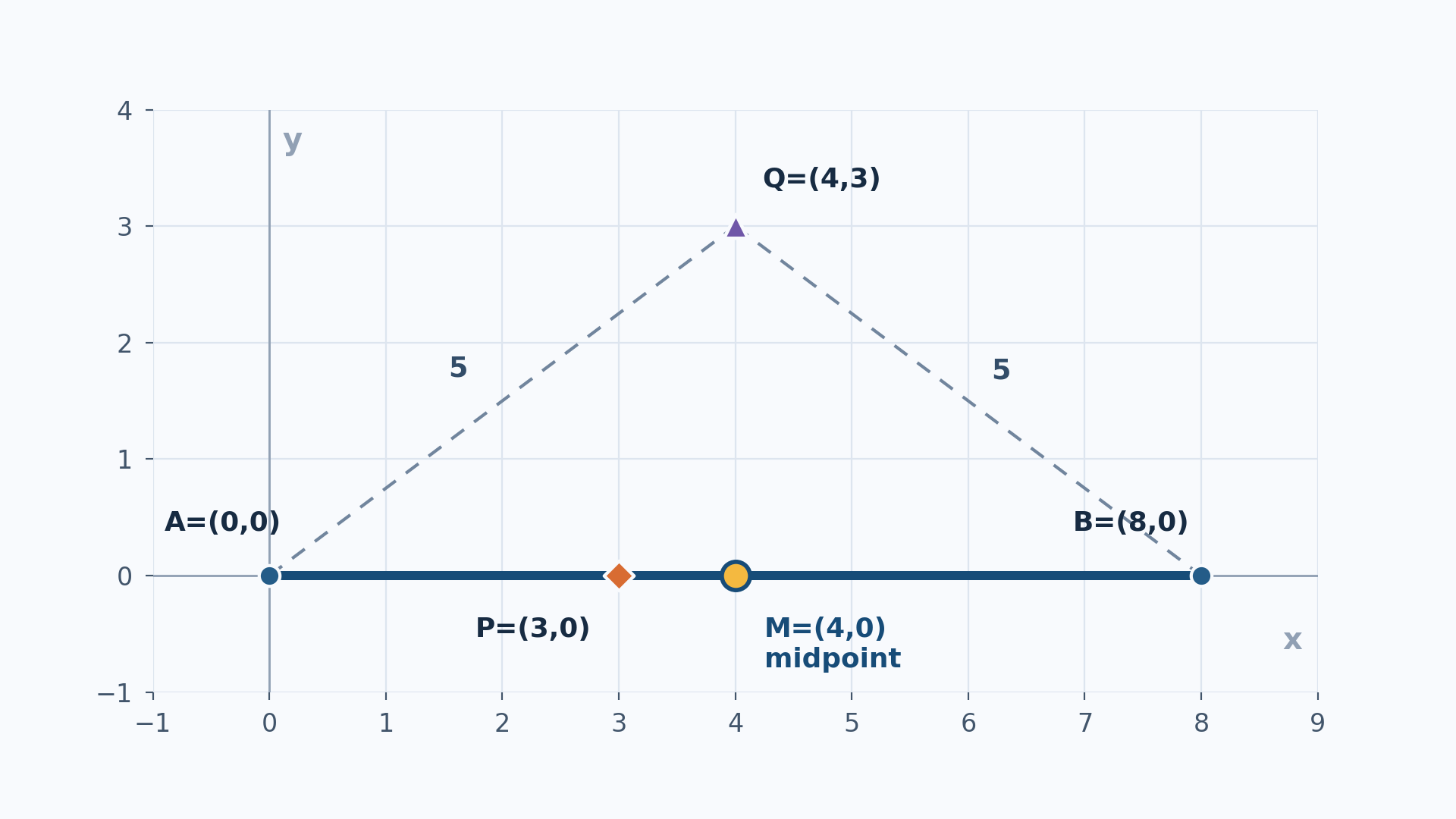
Take endpoints and . The segment lies along , from to . The diagram and table below compare three candidate points.
| Candidate | On segment ? | Distance from | Distance from | Midpoint? |
|---|---|---|---|---|
| Yes | Yes | |||
| Yes | No; the distances differ | |||
| No | No; it is off the segment |
For , the horizontal and vertical changes from either endpoint are and , so each straight-line distance is . Although is equally far from both endpoints, it is not on the segment. Only meets both midpoint requirements. Another way to check is together with . Here , but for , , not . This also proves that is not on the segment.
A Quick Decision Routine
When checking a candidate point, use these two steps:
- Check whether it lies on the finite segment, not beyond an endpoint or off the line.
- Compare its distances from the two endpoints.
The point is a midpoint only if it passes both checks. This order helps catch the common mistake of treating equal distance as sufficient.
Conclusion and Next Steps
To identify a midpoint, confirm that it lies on the finite segment and is equally distant from both endpoints. A point that meets only one of these conditions is not a midpoint, even if it appears centered.
In the practice that follows, you’ll inspect labeled hallway and park-path diagrams and use these checks to classify candidate points. Pay special attention to points that are equally far from both ends but off the path: equal distance does not replace the on-segment requirement.
