Welcome back to Measurements in the Kitchen! This is the second of five lessons in the course, and things are about to get hands-on. In the previous lesson you learned how to classify every common kitchen unit as either volume or weight — a skill that makes everything from here on much easier.
Now we take the next step: converting between volume units. Recipes mix teaspoons, cups, fluid ounces, and milliliters freely, so knowing how to move from one unit to another is a daily kitchen skill. By the end of this lesson, you will be able to convert confidently among teaspoons, tablespoons, cups, fluid ounces, quarts, milliliters, and liters using standard equivalences and sensible kitchen rounding.
Why Conversions Come Up So Often
Recipes rarely stick to a single volume unit. One line might say "2 tablespoons of olive oil," while the next says "¾ cup of broth," and a European recipe might list "200 mL of cream." If your measuring tools do not match the unit in the recipe, you need to convert.
The good news is that every volume conversion is just multiplying or dividing by a fixed number. Once you memorize a short list of equivalences, the rest is arithmetic you already know. Think of these equivalences as a small set of exchange rates between units.
Be a part of our community of 1M+ users who develop and demonstrate their skills on CodeSignal
US cooking volume units line up in a neat sequence, from smallest to largest. In the previous lesson we met teaspoons, tablespoons, cups, and fluid ounces. This lesson adds one more: the quart (abbreviated qt), a larger unit you will see in soup, stock, and beverage recipes. Here are the core equivalences you will use most often:
Equivalence
What It Means
1 tbsp=3 tsp
One tablespoon holds exactly 3 teaspoons
1 fl oz=2 tbsp
One fluid ounce equals 2 tablespoons
1 cup=8 fl oz
One cup holds 8 fluid ounces
1 cup=16 tbsp
One cup equals 16 tablespoons
1 quart=4 cups
One quart equals 4 cups
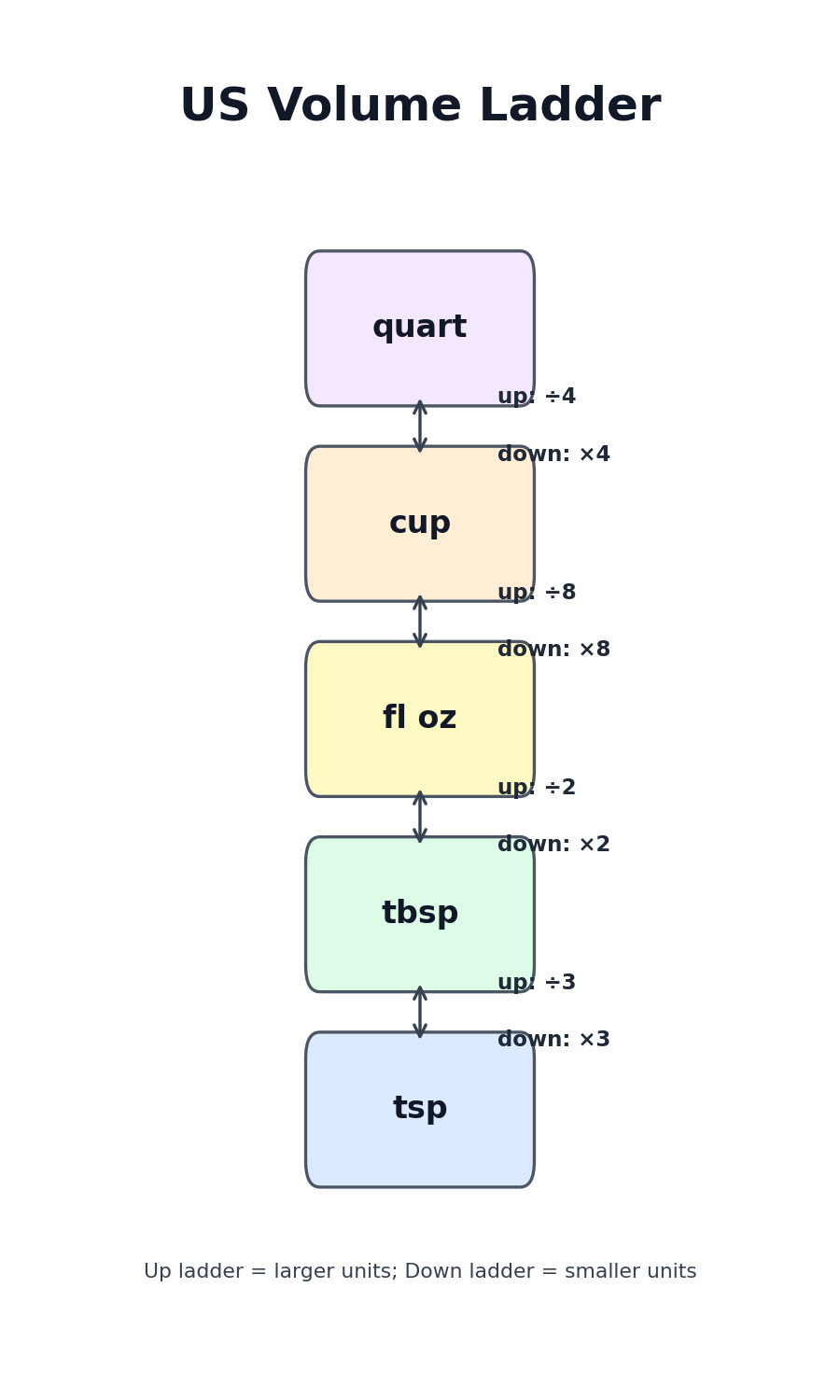
You can picture these as rungs on a ladder. To go up the ladder (from a smaller unit to a larger one), you divide. To go down (from a larger unit to a smaller one), you multiply. For example, converting cups to tablespoons means moving to a smaller unit, so you multiply.
For a quick reference, here is that ladder in diagram form:
Let us walk through a few examples so the pattern becomes clear.
Example 1 — Tablespoons to teaspoons. A recipe says 2 tbsp of vanilla extract, but you only have a teaspoon measure. Since 1 tbsp=3 tsp, we multiply:
2 tbsp×3=6 tsp
Example 2 — Cups to tablespoons. You need 43 cup of lemon juice and want to measure it in tablespoons. Since 1 cup=16 tbsp:
43×16=12 tbsp
Example 3 — Quarts to cups. A soup recipe calls for 2 quarts of stock. Since 1 quart=4 cups:
2×4=8 cups
Example 4 — Fluid ounces to tablespoons. You need 5 fl oz of cream. Since 1 fl oz=2 tbsp:
5×2=10 tbsp
Notice the pattern: identify the right equivalence, then multiply (going to a smaller unit) or divide (going to a larger unit). Once you have that rhythm down, every US volume conversion follows the same steps.
Many international recipes measure liquids in milliliters (mL) and liters (L). You already know mL from the previous lesson's volume list; its bigger sibling, the liter, appears whenever quantities are large — think a bottle of broth or a carton of milk. The two are connected by one clean relationship:
1 L=1,000 mL
To translate between metric and US units, two approximate equivalences do nearly all the heavy lifting:
Equivalence
Note
1 cup≈240 mL
Rounded from 236.6 mL
1 fl oz≈30 mL
Rounded from 29.6 mL
These are not exact, but they are close enough for everyday cooking. In a kitchen we are rarely precise to the last drop, so rounding to 240 mL per cup and 30 mL per fluid ounce keeps the math simple without affecting the dish.
With those two approximations in hand, cross-system conversions work the same way: multiply or divide by the equivalence factor. Let us see a few in action.
Example 5 — mL to cups. A French recipe calls for 480 mL of milk. Using 1 cup≈240 mL:
480÷240=2 cups
Example 6 — Cups to mL. You want to tell a friend in Europe how much broth to use, and your recipe says 121 cups. We multiply:
1.5×240=360 mL
Example 7 — mL to fluid ounces. A recipe lists 150 mL of cream. Using 1 fl oz≈30 mL:
150÷30=5 fl oz
Example 8 — Liters to quarts. A recipe asks for 1.5 L of water. First, convert to mL: 1.5×1,000=1,500 mL. Then convert to cups: 1,500÷240=6.25 cups. Finally, convert to quarts: 6.25÷4≈1.6 quarts. In practice, you would round this to about 121 quarts — close enough for a pot of soup. Multi-step chains like this are common when adapting foreign recipes, and each individual step uses the same multiply-or-divide logic.
In a chemistry lab every decimal matters. In the kitchen, a few milliliters here or there will not ruin dinner. Two simple guidelines will serve you well:
Round to the nearest kitchen-friendly amount. If your math gives you 6.25 cups, think about what you can actually measure. Rounding to 641 cups is easy because most liquid measuring cups show quarter-cup marks.
When in doubt, round to the nearest tablespoon or half-tablespoon. For smaller volumes, results like 4.8 tbsp can be rounded to 5 tbsp without any noticeable impact on flavor or texture.
The goal is a result you can actually measure with the tools in your kitchen drawer. Perfect precision is less important than practical accuracy.
In this lesson we covered the core US volume equivalences — 1 tbsp=3 tsp, 1 fl oz=2 tbsp, 1 cup=8 fl oz, 1 cup=16 tbsp, and 1 quart=4 cups — along with the two key bridges to metric: 1 cup≈240 mL and 1 fl oz≈30 mL. We also saw how sensible rounding keeps conversions practical in a real kitchen.
Up next, you will put all of these equivalences into action through a series of hands-on exercises. You will start with quick single-step conversions, work through trickier mixed quantities, practice translating between US and metric, and finish by adapting an entire European recipe into US measurements. Time to grab your (virtual) measuring cups!