Cloud Service Models
IaaS, PaaS, and SaaS 🧱
Cloud service models determine what a provider manages and what remains your responsibility. In this lesson, you will learn to:
- Explain Infrastructure, Platform, and Software as a Service
- Distinguish the management boundary in each model
- Choose an appropriate model for common business needs
You now know that cloud computing means renting computing power over the internet, and that providers organise that capacity into regions and availability zones around the world. What we haven't looked at yet is how that capacity is packaged when it's sold to you. The same provider, in the same data centre, can hand you a bare machine to configure yourself, a ready-made place to drop your application, or a finished product you simply log into. Those three packages are the service models, and telling them apart is what lets you sit in a supplier meeting and know what you are actually buying.
What Each Service Model Delivers ⚙️
Start with the full names, because the short forms are used constantly and explained rarely.
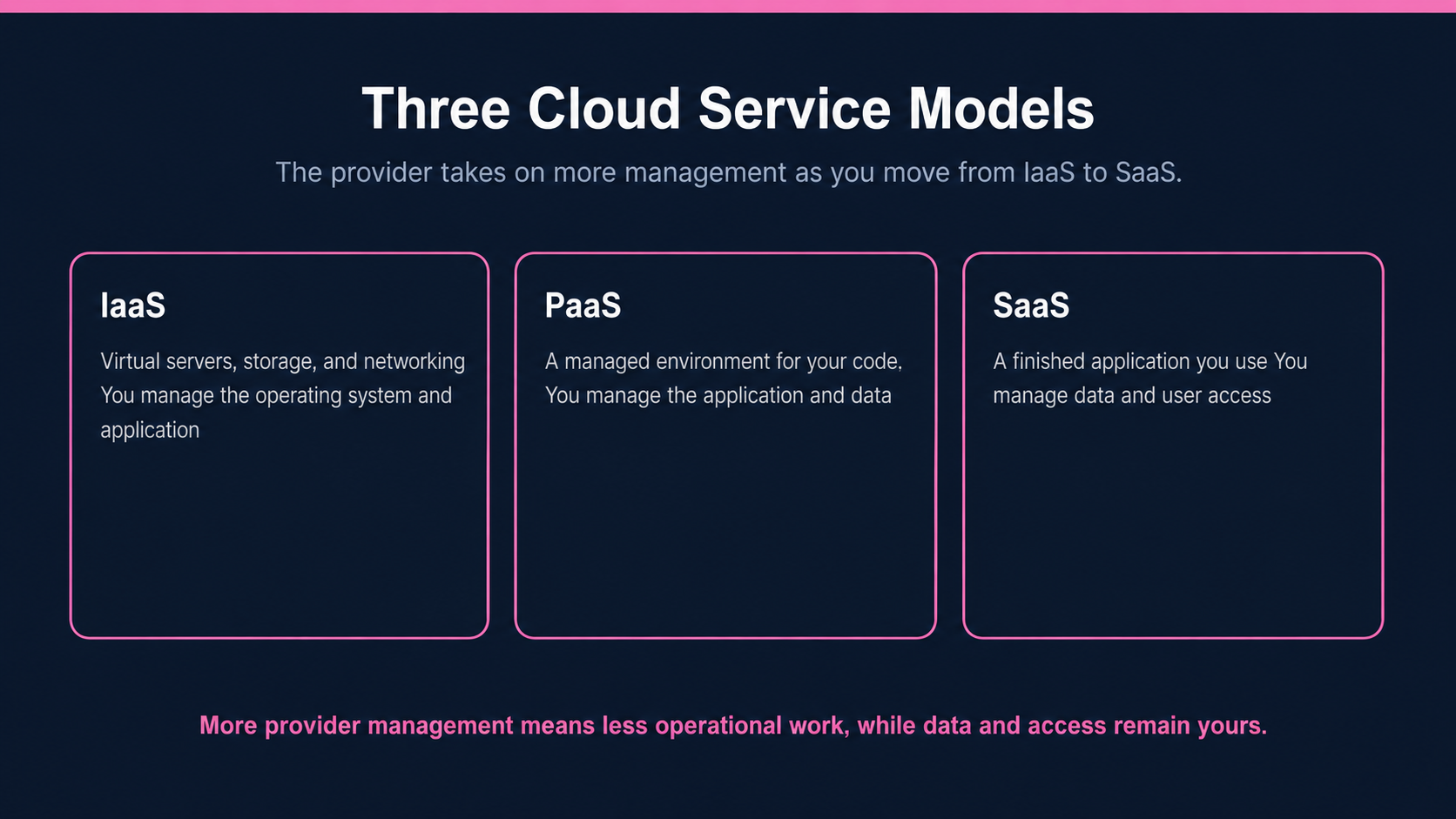
Infrastructure as a Service (IaaS) gives you the raw ingredients: virtual servers, storage, and networking. The provider owns and runs the physical hardware, the building, the power, and the software layer that carves one physical machine into many virtual ones. Everything above that is yours. You choose the operating system, install it, patch it, and put your application on top. Amazon Elastic Compute Cloud (Amazon EC2), Azure Virtual Machines, and Google Compute Engine are the classic examples.
Platform as a Service (PaaS) gives you a prepared environment to run your own code. The provider handles the servers, the operating system, and the runtime, meaning the language environment your application needs to execute, such as a particular version of Java or Python. You supply the application and the data, press deploy, and the platform runs it. Azure App Service and Google App Engine sit here.
Software as a Service (SaaS) gives you a finished application. Someone else wrote it, hosts it, updates it, and fixes it. You log in through a browser and use it. Microsoft 365 and Salesforce are the examples most people already use daily without thinking of them as cloud.
The cooking analogy is worth keeping in your head because it survives contact with non-technical colleagues. Infrastructure as a Service is buying groceries and cooking at home: maximum control, maximum work, and you clean the kitchen. Platform as a Service is take-out: the kitchen and the cooking are handled, but you still set the table and decide what to order. Software as a Service is a restaurant: you turn up, eat, and leave.
