Mapping Cues and Triggers
Welcome to the Course 🎉
Welcome to Interrupt the Spiral! If you've ever lost an evening to a two-word message, or re-run a meeting in your head until you couldn't remember what you originally wanted to say, you already know the cost of a spiral: it doesn't just feel bad, it delays the decision. This course is about catching the loop early and cutting it short so you can choose and move on.
By the end of this lesson, you'll be able to:
- Tell the difference between productive reflection and mental spin-out in real time
- Notice the early physical and cognitive signals that a spiral is starting
- Map the situations that trigger your spirals and identify the ones most likely to come up soon
🧭 Distinguish Productive Reflection From Mental Spin-Out
Let's start with a crucial distinction that will change how you view your thoughts. Not all deep thinking is overthinking. Some mental processing actually helps you solve problems and move forward. Productive reflection has a clear purpose. It asks answerable questions, gathers something you didn't have a minute ago, and ends in a conclusion or an action.
Mental spin-out circles. It re-runs material you already have, generates more questions than it closes, and ends only when you're too tired to continue.
Here's the key difference: reflection moves you forward while overthinking keeps you stuck in loops. Reflection sounds like: "Which part of my recommendation had the weakest evidence? The cost estimate. I'll rebuild it tomorrow morning." Spin-out sounds like: "Why did the room go quiet? Was it my tone? Did they already decide before I spoke? What if they think I'm not ready for this?" Same event, same person. One closes in forty seconds and the other runs until midnight.
The good news? You can catch yourself mid-spiral by using the Time–Control–Output Check method to identify which kind of thinking you’re doing:
- Time: Does this thinking have a clear stopping point?
- Control: Is it focused on something you can influence or change?
- Output: Is it producing new information, a conclusion, or a next step?
If you can answer yes to all three, you’re probably reflecting productively. If the thinking is open-ended, focused on other people’s minds or the unchangeable past, and producing only more questions, you’re likely in a spin-out.
Let's see how this works in a conversation:
- Milo: It sounds like Wednesday's meeting has been weighing on you. Want to try the Time–Control–Output Check together?
- Ryan: Yeah. I keep replaying the director’s comment that my proposal "needs more work" and wondering if she thinks I’m not ready.
- Milo: That makes sense. Have you set a stopping point, and are you focused on anything you can control?
- Ryan: No stopping point. I’m mostly trying to guess what she thinks of me.
- Milo: Has replaying it produced new information or a next step?
- Ryan: No. But I could spend ten minutes listing the questions I need to ask her about the proposal.
Notice that Milo first acknowledges what’s weighing on Ryan, then guides him through the Time–Control–Output method. That helps Ryan recognize the loop and turn it into a concrete, time-bounded next step.
Identify Physiological and Cognitive Rumination Signals 📶
Your body usually registers the spiral before your thinking does, which makes it the better early-warning system. Common physical signs include: tight jaw, clenched fists, shallow breathing, tense shoulders, or a churning stomach. Your body literally prepares for stress when overthinking kicks in, even if you're just sitting quietly.
The cognitive signals are just as countable. Mental replay is one of the clearest cognitive signals: notice when you repeatedly revisit the same moment in your mind without gaining new information or reaching a conclusion. Repeated replays are a cue to run the Time–Control–Output Check, not a category on their own: even the second replay may be spin-out if there’s no stopping point, it focuses on something you can’t control, and it produces no new information or next step.
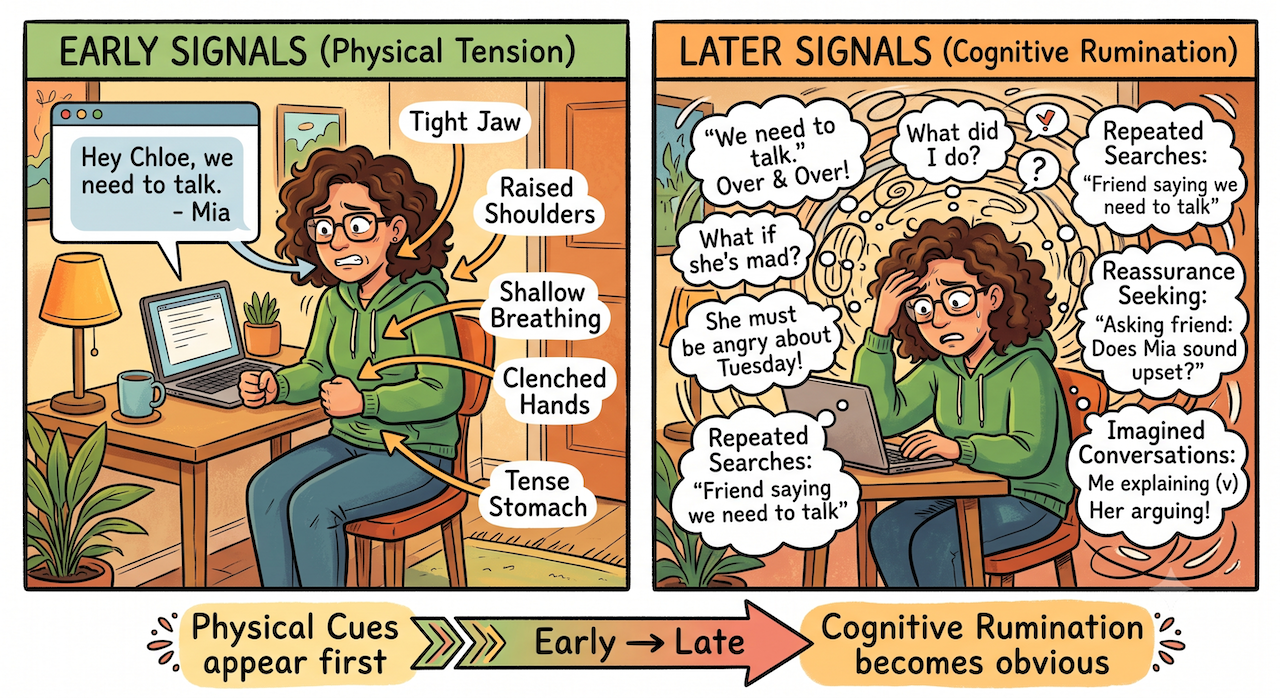
Crucially, some signals arrive early and some arrive late. Your jaw might tighten within seconds while the imagined confrontation shows up ten minutes in. Early signals are the ones worth learning, because that's where an interrupt is cheap.
🗺️ Design Your Personal Cue-and-Trigger Map
Now that you know your overthinking cues, let's identify what triggers those spirals in the first place. Run a five-minute recall audit of the past two weeks and list four to six situations that reliably sparked overthinking. Common overthinking triggers include: difficult conversations, work deadlines, social situations, relationship conflicts, and major decisions. The key is getting specific. "Work stress" is too broad. "Sending important emails" or "team meetings" are more useful. Then, for each situation, name the earliest cue it produced, the first signal that showed up rather than the loudest one. Finally, flag the two triggers highest-risk in the week ahead and state exactly what you'll watch for.
Here's the powerful part: once you map your triggers, you can prepare for them. It's like having a weather forecast for your mental storms. Instead of being blindsided by overthinking, you can spot high-risk moments coming and take preventive action. Your trigger map should include three categories: social triggers, work triggers, and personal triggers. And just like the triggers you identified above, it is important to make them specific and observable to spot them coming and prepare your interrupt strategies in advance.
You cannot interrupt what you don't notice, and noticing is a skill built on specifics, not feelings. Next you'll sort real thought samples into reflection or spin-out to sharpen the pattern-spotting, then run a live self-scan out loud, then build the map itself into something you'd actually pin up.
