Supporting Capable Performers
🙌 Supporting Capable but Uncertain Performers
Now let's flip the picture. This time the person in front of you already knows how to do the work. They've done it well before. But something has gone quiet: maybe their confidence took a knock, maybe their motivation has faded, maybe they've quietly stepped back from owning it. Here, the instinct to jump in and explain how would be exactly the wrong move. This unit is about the supporting style: easing off on direction and leaning hard into support.
By the end of this lesson, you will have learned to:
- Spot a Supporting situation by reading high competence paired with low or variable commitment.
- Lead with questions instead of instructions, so a capable person surfaces and works through their own block.
- Add support that targets the real gap without quietly taking the work back.
🔍 Spotting a Supporting Situation
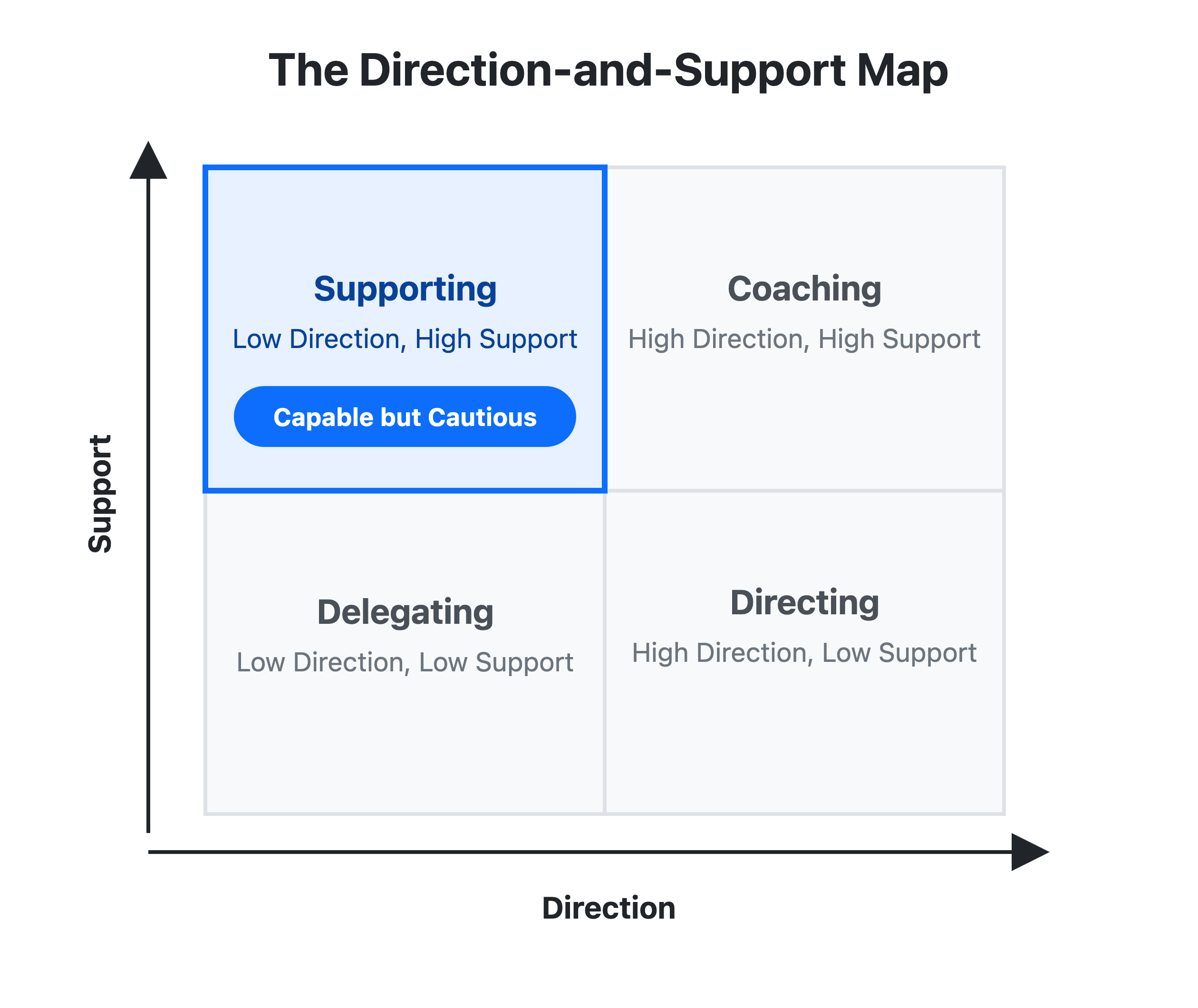
The signal to watch for is high competence paired with low or variable commitment. Competence is the easy part to confirm: they've done this kind of work before, and done it well, so skill clearly isn't what's holding them back. What's wavering is their commitment, which you'll remember is a blend of confidence, motivation, and willingness to own the work. One of those three has cooled.
The trap is easy to fall into. A capable person goes quiet or hesitant, and you read it as "they need more guidance," so you start handing out instructions. But telling skilled people how to do a job they already know says you don't trust them, and that only deepens the withdrawal you were trying to fix. It also quietly strips away the ownership you want them to feel.
So in a supporting situation, you flip your usual dials and turn down the "how-to." Because the commitment is shaky, you turn up your presence, your listening, your encouragement, and your recognition. Low direction, high support.
🙋 Ask, Don't Tell
The core move of supporting is to ask, don't tell. Since the person already knows how, your job isn't to hand over answers. It's to surface what's actually blocking them and let them find their own way forward. That means open questions, genuine listening, and getting comfortable with a little silence rather than rushing to fill it.
Compare two openings. "Here's what I'd do first..." is telling, and it lands like a demotion. "What's your read on where this stalled?" is asking, and it hands the thinking back to the person who's fully capable of doing it. Watch how Chris, a manager, reopens a stalled report with Milo, a capable specialist who has gone quiet, by leading with questions instead of instructions:
- Milo: I can take another look at the report, I suppose.
- Chris: You've built ones like this before and they landed really well. Something feels different this time. What's changed for you?
- Milo: Honestly? Last time I put a real idea forward, it went nowhere. Not sure it's worth sticking my neck out again.
- Chris: That's fair, and I'm glad you said it. If your input did land this time, what would you want to try?
- Milo: ...There's one angle I never got to finish. I could pick that back up.
Notice that you didn't hand Milo a plan. One honest question surfaced the real block, and the next drew his own idea back out. That's the whole shape of an ask-don't-tell conversation.
🤲 Support Without Taking It Back
Once the real concern is on the table, your support needs to act on it without quietly reclaiming the work. Useful Supporting actions each target the specific thing that's low, whether that's confidence, motivation, or ownership:
- Recognize their expertise out loud so their confidence gets a real, specific boost.
- Remove a barrier that's genuinely in their way.
- Provide a resource they actually asked for.
- Keep a steady, low-pressure check-in going.
There's one line you must not cross: taking the work back. Redrafting their proposal for them, reassigning the decision, or "just handling it" this once all feel generous in the moment, but they confirm the person's underlying fear that their contribution doesn't really matter. That's rescue, not support. The difference comes down to who owns the work when you're done:
| Support (keeps them the owner) | Rescue (makes you the owner) |
|---|---|
| Name their expertise and past wins | Redraft their proposal "to help" |
| Remove a barrier in their way | Reassign the decision to someone else |
| Provide a resource they asked for | "Just handle it" this once |
| Keep a light, steady check-in | Take the work back entirely |
A quick gut-check keeps you honest: after you've helped, is the person more in charge of the work or less? If they're less in charge, you've slipped from supporting into controlling, however kindly it was meant.
The heart of this unit is a single reflex: when a proven performer goes quiet, resist adding direction and instead add support, asking rather than telling so they rebuild their own footing. Your next step is a quick pattern-spotting check to see whether you can tell a genuine supporting moment from one that calls for a different style. After that you'll take it live in a conversation with a capable but disengaged expert, then turn the diagnosis into a support plan you could actually put to use. For now, try catching yourself the next time you're about to say "here's what I'd do," and swap in a question instead.
