Directing Work with Clarity
📣 Welcome to the Course
Welcome to Flex the Four Leadership Styles! Every day you hand off work, answer questions, and decide how closely to stay involved, and the manager who uses one approach for everyone tends to smother their strongest people while leaving their newest ones stranded. Here you'll learn to flex between four distinct leadership styles so each person gets the exact amount of direction and support the task calls for.
In this lesson, you will learn to:
- Recognize when a willing beginner needs the "directing" style (high direction, low support) over simple encouragement.
- Structure a clear hand-off using four key components: outcome, standards, sequence, and deadline.
- Verify understanding using a playback check to ensure instructions have landed before the work begins.
🧭 When a Willing Beginner Needs You to Take the Lead
All four styles come from one simple idea, the Direction-and-Support Map. Every style is a mix of two things. Direction means telling someone what to do, how to do it, and by when. Support means encouraging, listening, and building their confidence. Turn each up or down and you get four combinations:
- Directing is high direction and low support.
- Coaching is high direction and high support.
- Supporting is low direction and high support.
- Delegating is low direction and low support.
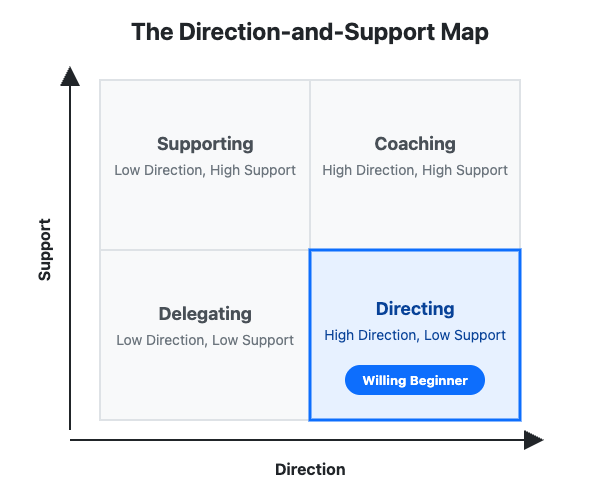
Directing fits one specific situation: someone is new to a task, genuinely eager to do well, but doesn't yet know how. They have the willingness but they lack the know-how. This is the willing but untested beginner.
Here's the trap. Because this person is so enthusiastic, it feels natural to respond to that energy with encouragement. But they aren't short on motivation, they're short on instructions. That's why support stays low and direction goes high. The two classic mistakes are opposites: abandoning them ("here's the template, figure it out") leaves them guessing and quietly panicking, while over-encouraging them ("you've got this, I believe in you") gives a pep talk to someone who actually needs to be shown the steps. Directing means you provide the structure and save the cheerleading for when it's the missing ingredient. Right now, clarity is the kindest thing you can offer.
🤝 Making the Hand-Off Clear
A good directing hand-off consists of four parts:
- Outcome: Define exactly what the finished, correct result looks like.
- Standards: Establish the quality bar—the specific difference between "done" and "done right."
- Sequence: Map out the order of steps so a beginner isn't forced to guess what comes first.
- Deadline: Set a precise time for completion rather than a vague "soon."
But naming those four things isn't enough, because a willing beginner will almost always say "got it" whether or not they actually do. Enthusiasm makes people nod. So the final move in any directing hand-off is to verify understanding by having the person play it back in their own words, rather than accepting a nod as proof. Let's see this in action. Victoria is a manager handing a first-time report task to Dan, a newer team member, and she uses a "playback" to surface a hidden gap before any work begins:
- Victoria: Before you start, walk me back through it. What's the first thing you'll do, and what does "done right" look like?
- Dan: Sure, I'll pull the report, then check the totals against the source file... I think?
- Victoria: Close. The source-file check comes first, before you touch the report. And if the numbers don't match?
- Dan: Honestly, I'm not sure.
- Victoria: Good that you said so. If they don't match, stop and message me right away, don't guess. Now say the full order back to me.
Notice how the quick "I think?" hid a real gap, and how asking for the playback surfaced it while there was still time to fix it, rather than after a missed deadline.
📝 Creating a Standalone Brief
The spoken hand-off gets the work started, but a beginner can't hold every instruction in their head. That's why directing usually leaves behind a written brief, something they can keep at their desk and follow without you in the room.
The spoken hand-off gets the work started, but a beginner can't hold every instruction in their head. That's why Directing usually leaves behind a written brief, something they can keep at their desk and follow without you in the room. A strong brief captures the essential elements in a clear format:
- The Basics: The expected result, the standards for quality, the ordered steps, and the hard deadline.
- Escalation Triggers: Explicit "come get me if..." moments so they know exactly when to flag a problem instead of guessing.
- Self-Checks: Simple milestones they can use to confirm they are on track.
Keep it directive. This is not the place for motivational language; padding instructions with a pep talk only buries the steps a first-timer actually needs to follow.
When someone is eager but green, resist both abandoning them and merely encouraging them, and instead give clear structure you confirm has landed. Up next is a quick self-check to spot which everyday situations truly call for Directing rather than one of the other three styles. From there you'll run a live hand-off out loud and draft a brief a real novice could follow, so try leading with structure first and saving the encouragement for when it's genuinely what's missing.
