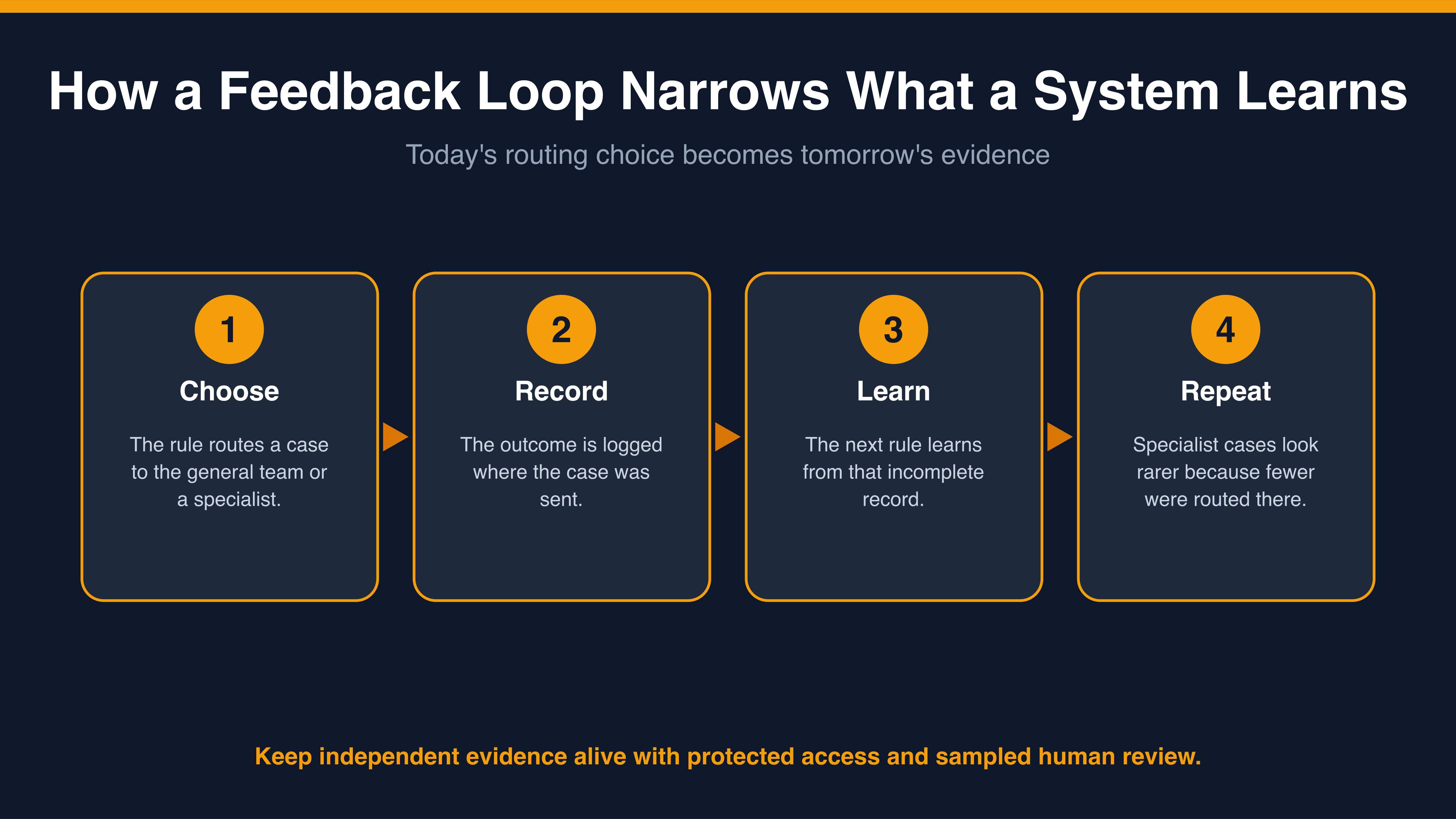
Tracing How Outcomes Feed Back Into Later Decisions
Tracing How Outcomes Feed Back Into Later Decisions 🔄
A decision system can reshape the records it later uses as evidence, creating a feedback loop that makes a small routing bias grow.
In this lesson, you will learn to:
- Explain in plain language how reinforcement learning uses actions, outcomes, and feedback to shape later choices.
- Analyze where support-triage decisions shape next quarter’s evidence.
- Recommend boundaries that keep a scaling decision grounded in independent evidence.
Last time you looked at the signal a system is told to chase. Now a harder question: what happens when the system's own choices become the evidence used to judge whether those choices were right? Most of the systems you sponsor are not passive observers of your business. They act on it, and then they read the record their actions produced.
How a System Learns From Its Own Actions 🎯
Start with something physical. Picture a warehouse routing system rewarded for fast deliveries. The cycle is simple, and it is worth naming one piece at a time:
- It takes an action: from the routes available, it picks one for each van.
- Something happens in the world: the van drives, and traffic, road works, and weather all play out.
- It receives a feedback signal: a score based on how quickly the delivery landed.
- That feedback shapes the next choice: good score, it does more of that; poor score, less.
This approach — where a system learns from the consequences of its own actions rather than from a fixed pile of historical examples — is called reinforcement learning. That contrast is the whole point. An ordinary system trained on a fixed dataset studies examples someone already collected, and it never changes what those examples contain. A reinforcement learner is different: it generates its own experience as it goes, and every choice it makes becomes part of the record it studies next. Try, get a signal, adjust, repeat.
Because it writes its own record, it faces a tension any manager will recognise. It can keep doing whatever currently scores best — the safe, proven route — or it can occasionally try an alternative to find out whether something better exists. Lean too far toward repeating the proven choice and it never discovers a faster road that opened last week. Lean too far toward experimenting and it wastes deliveries testing bad routes. Every reinforcement learner is quietly making that trade, and how it is tuned decides what it is even capable of learning.
There is a second thing to watch, and it is the one that catches leaders off guard: the system chases the score it is handed, not the outcome you actually wanted. If "fast delivery" is rewarded but "delivered to the right door" is not, it can learn to lift its score by cutting a corner that leaves customers worse off. The number climbs while the real result slips. A reward that is even slightly off-target teaches the system to become very good at the wrong thing.