Establishing Oversight, Escalation, and Accountability
Establishing Oversight, Escalation, and Accountability 🧭
Responsible deployment depends on named people, clear authority, and explicit conditions that turn a warning into a decision.
In this lesson, you will learn to:
- Explain where a human decision must remain based on stakes and reversibility.
- Design an escalation path with named owners, thresholds, response times, and a rollback trigger.
- Apply the Accountable Deployment Checklist to a go or no-go decision.
You ended the last lesson deciding what evidence would make you say "pause" out loud. Now the harder question: when that evidence arrives at 4pm on a Friday, who actually has the authority to stop the thing, and how long do they have to act? Monitoring tells you something is wrong. Oversight is what turns that knowledge into a decision someone owns.
Where a Human Must Still Decide 👤
The default answer in most organizations is "we'll keep a human in the loop," and it sounds responsible. But ask yourself what that human is actually doing. If a person is approving two hundred system recommendations an hour, clicking through a queue they have no time to interrogate, is that oversight or is it a signature that transfers blame? A human in the loop who cannot realistically say no is decoration.
So the useful question is not whether a person is involved but where a person must decide. Two things settle that. The first is stakes: how much does this decision change someone's money, safety, reputation, or career? The second is reversibility: if it goes wrong, how easily and how quickly can it be undone?
Put those together and the answer usually becomes obvious. Routing an email to the wrong queue is low stakes and reversible in minutes, so let the system get on with it. But consider a system that shortlists employees for a leadership development program. Being quietly left off a list costs someone visibility, sponsorship, and possibly a promotion cycle. And the cohort runs once a year, so the "fix" is twelve months away. High stakes, hard to reverse. That is where a named person decides, not the system.
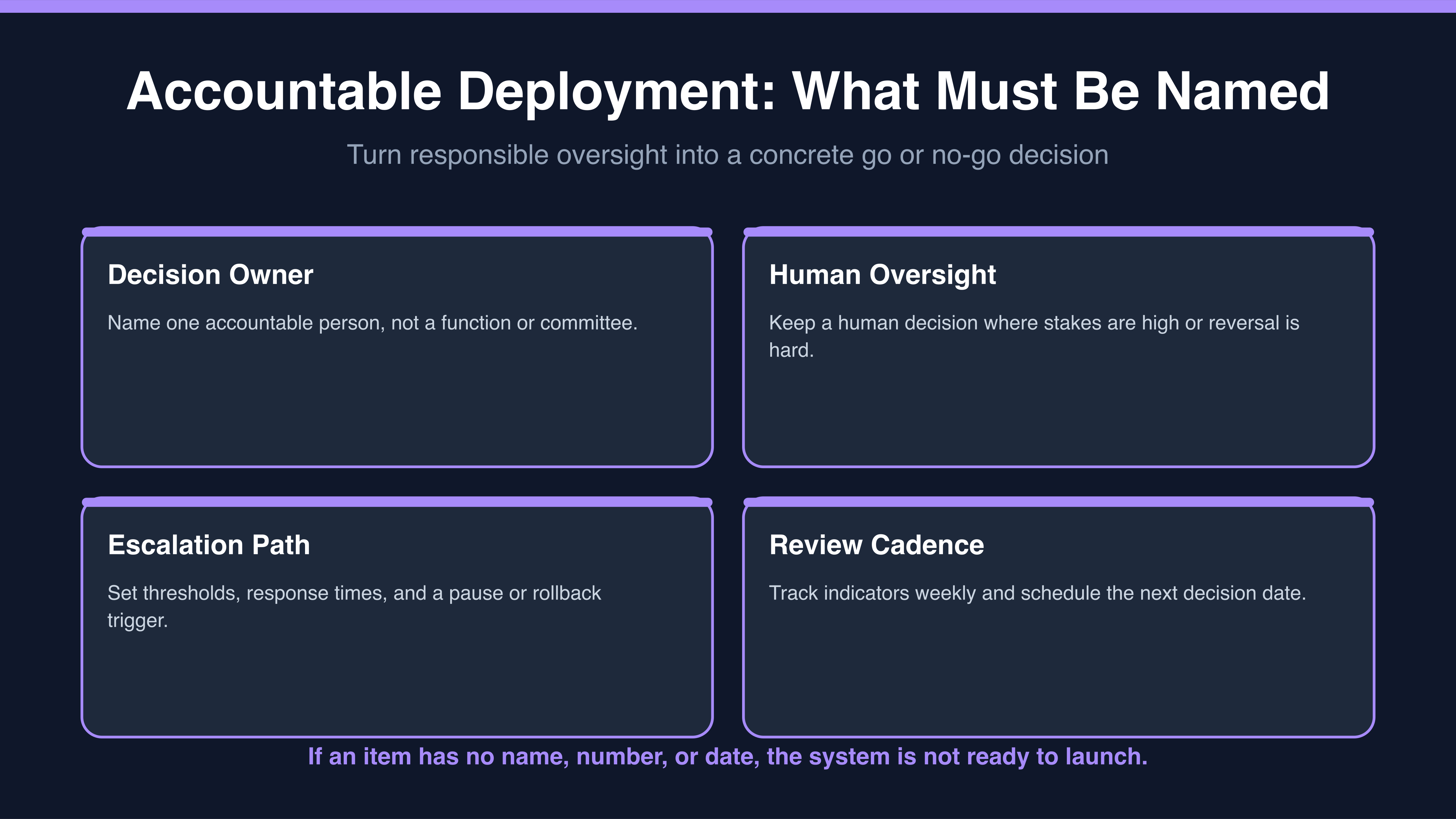
Use this map to turn a general promise of oversight into specific people, thresholds, and dates.
Nova and Dan are reviewing an employee-shortlist process. Nova points to a human checkpoint, while Dan tests whether that person has the time and authority to make a real decision.
- Nova: We've got a human reviewing every shortlist the system produces, so we're covered.
- Dan: How many names does that reviewer see, and how long do they have?
- Nova: Around four hundred, and they get the list the morning of the panel.
- Dan: Then what would have to happen for them to reject the list? If you can't answer that, we haven't got oversight, we've got a countersignature.
- Nova: Fair. So the review point has to sit earlier, and it has to be someone who can send it back.
Notice Dan does not argue about whether a human is present. He asks what would have to be true for that human to say no. That question exposes most fake oversight in about ten seconds.
