Questioning Correlation Before Policy
Questioning Correlation Before It Becomes Policy 🧠
You've spent this course tightening what goes into a decision: which inputs belong, which ones only exist in hindsight, and how much weight a confidence score can carry. This final lesson is about what happens after the system produces a finding, when somebody stands up in a meeting and turns that finding into a policy.
In this lesson, you will learn to:
- Separate a pattern that helps you anticipate an outcome from a cause you can act on.
- Look for alternative explanations before accepting a causal claim.
- Reframe a recommendation around what is known, uncertain, and still untested.
Separating Pattern From Cause 🔎
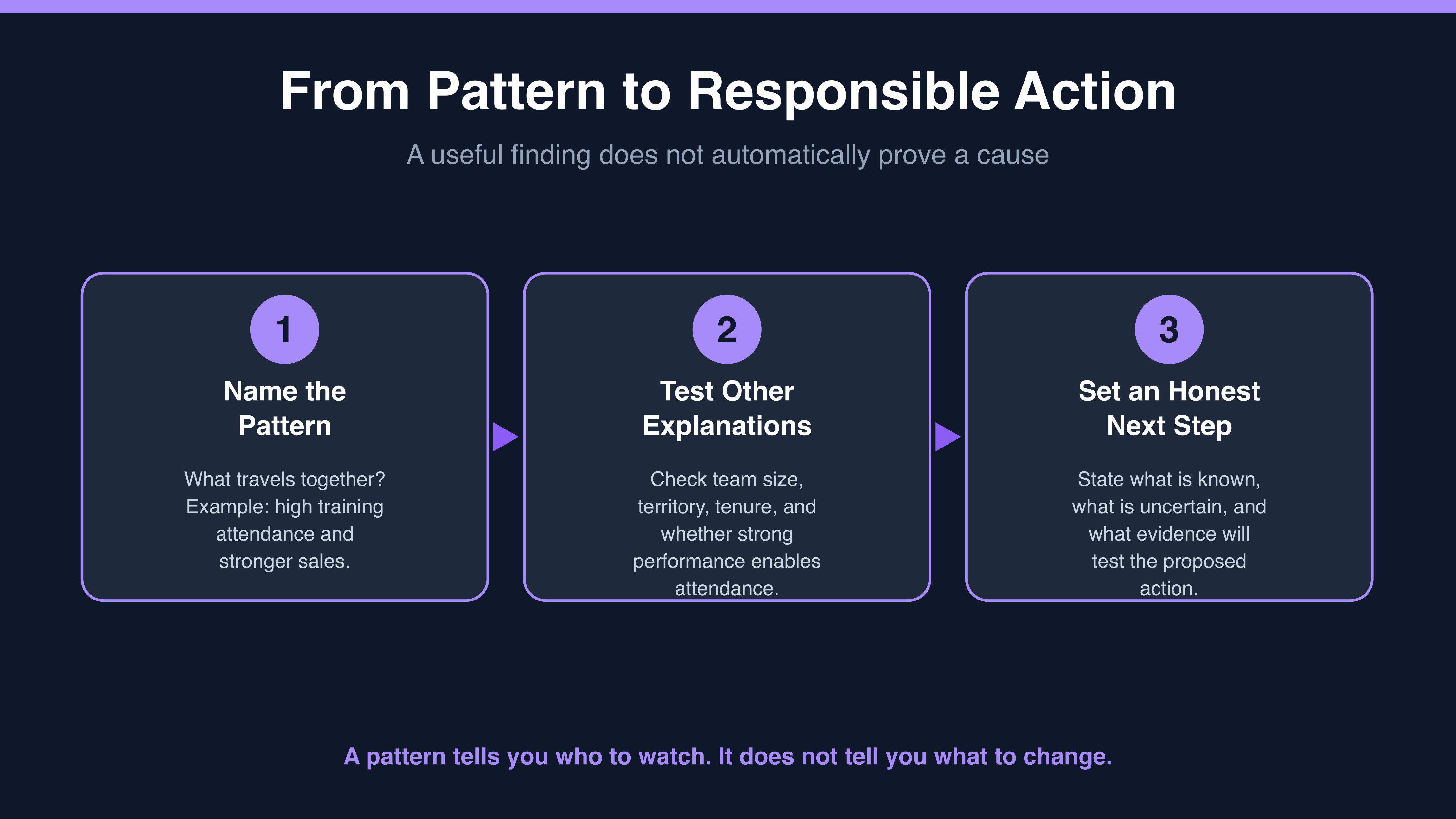
Here's the move to practise. When someone shows you a finding, ask yourself a single question before you say anything: does this help me guess, or does it tell me what to change?
Those are two different things. A pattern that anticipates an outcome tells you that knowing one thing helps you predict another. Teams with high training attendance sell more, so if you know a team's attendance, you can make a better guess about its sales. That is genuinely useful. You can prioritise attention, forecast better, and spot outliers.
A cause you can act on is a much bigger claim. It says that if you reach in and change the first thing, the second thing will move. Send a low-attendance team to training, and their sales will rise. Nothing in the pattern establishes that. The data showed you which teams travel together, not what happens when you push one of them.
The reason this matters is money and credibility. Anticipating costs you nothing if you're wrong about the mechanism. Acting does. A mandatory training rollout funded on a pattern will either work for reasons nobody understands, or fail expensively while everyone insists the data was clear.
Here is how that distinction sounds when Marcus, an analyst, shares a finding with Jessica, the manager reviewing the recommendation:
- Marcus: The analysis is solid. Customers who use the mobile app renew at 91%, non-app users at 62%. So we push the app to everyone.
- Jessica: The 91% is real. But ask it a different way: if I take a customer who has never opened the app and install it for them, does their renewal move?
- Marcus: Presumably, that's the whole point.
- Jessica: That's the part the data never tested. It's just as likely that customers who were already engaged went and downloaded the app. In that case we'd be pushing the app at people it does nothing for.
- Marcus: So the number's fine, the recommendation isn't.
- Jessica: Exactly. The number tells you who to watch. It doesn't tell you what to change.
Notice what Jessica did not do. She never questioned the analysis or the analysts. She questioned the sentence that got built on top of it.