Division as Inverse Multiplication
Introduction
Welcome to Dividing Signed Integers, the third course in our learning path! In the previous courses, we built a solid understanding of how signed multiplication works and why its sign rules make sense. Now we turn to the other side of the coin: division. This first lesson lays the foundation for everything that follows by exploring what division truly means and how it connects back to multiplication.
By the end of this lesson, you will be able to read any division statement as a question about multiplication and use that insight to both find and verify quotients.
Thinking of Division as a Question
Before we write any formulas, let's build some intuition. Imagine you bake 24 cookies and want to share them equally among 6 friends. You naturally ask: "How many cookies does each person get?" You're really searching for a number that, when multiplied by 6, gives 24.
That simple idea is the heart of division. Every time we divide, we are asking a multiplication question in disguise. Understanding this connection will make division feel less like a separate operation and more like a natural extension of what we already know.
The Missing-Factor Meaning of Division
Here is the key idea stated precisely. When we write
we mean that is the number that satisfies
In other words, division asks for a missing factor. The dividend is the product we already know, the divisor is one of the factors, and the quotient is the factor we are looking for.
The diagram below shows how the same relationship can be read in both directions:
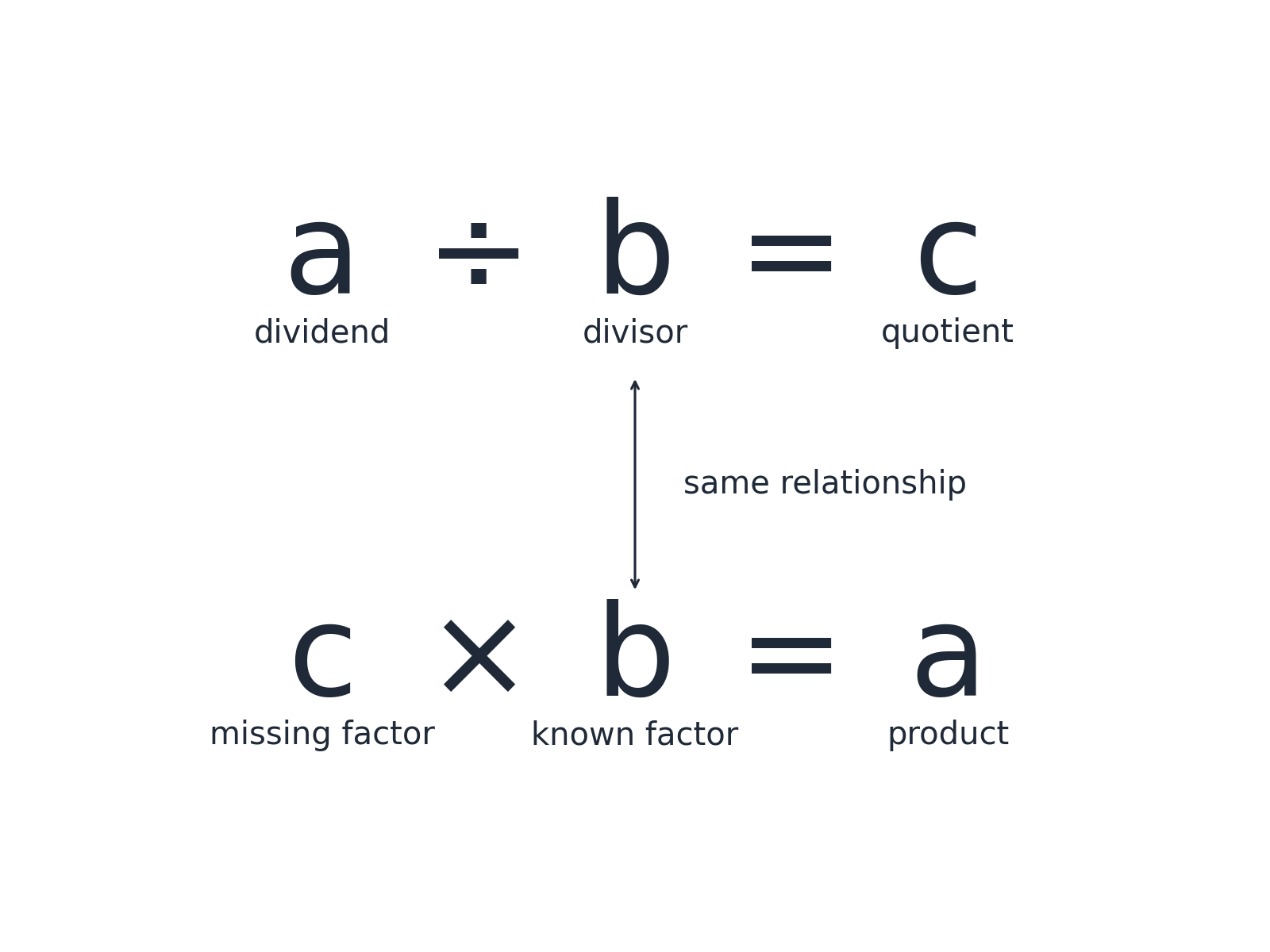
Let's see a concrete example. Consider . We need to find a number such that
Because , the missing factor is , so .
Here is a quick reference showing how the parts line up across several examples:
| Division statement | Missing-factor question | Answer |
|---|---|---|
Notice that each row simply rearranges the same three numbers. No new facts are needed — you just read a multiplication fact in a different direction.
