Placing Negative Signs
Introduction
Welcome to Dividing Rational Numbers! In earlier courses you built a solid toolkit for multiplying signed numbers and dividing signed integers. Now we take those skills further and apply them to fractions and other rational numbers.
This is the first lesson in the course, and we are starting with a small but powerful idea: a single negative sign in a fraction can sit in more than one place without changing the fraction's value. Getting comfortable with this equivalence will make every operation we tackle later — especially dividing signed fractions — feel more natural and much less intimidating.
A Fraction Is a Division
Before we explore sign placement, let's recall one key fact. A fraction is really just a division problem written in a compact form. For example, means , which equals .
Because fractions and division are so closely linked, all the sign rules you developed for dividing integers carry over to fractions directly. That connection is exactly what makes the next idea work.
Three Places for One Negative Sign
Suppose we want the opposite of . We could write the negative sign in any of three positions:
- In front of the whole fraction:
- In the numerator:
- In the denominator:
All three are equal. We can state this as a single rule:
No matter which position the negative sign occupies, the fraction represents the same rational number.
Why the Three Forms Are Equal
The sign rules for division tell us that a positive divided by a negative is negative, and a negative divided by a positive is also negative. Let's see this in action with .
- : the opposite of , which is .
- : this means . One negative sign gives a negative result, so it equals .
- : this means . Again one negative sign, so it equals .
All three expressions land on the exact same value.
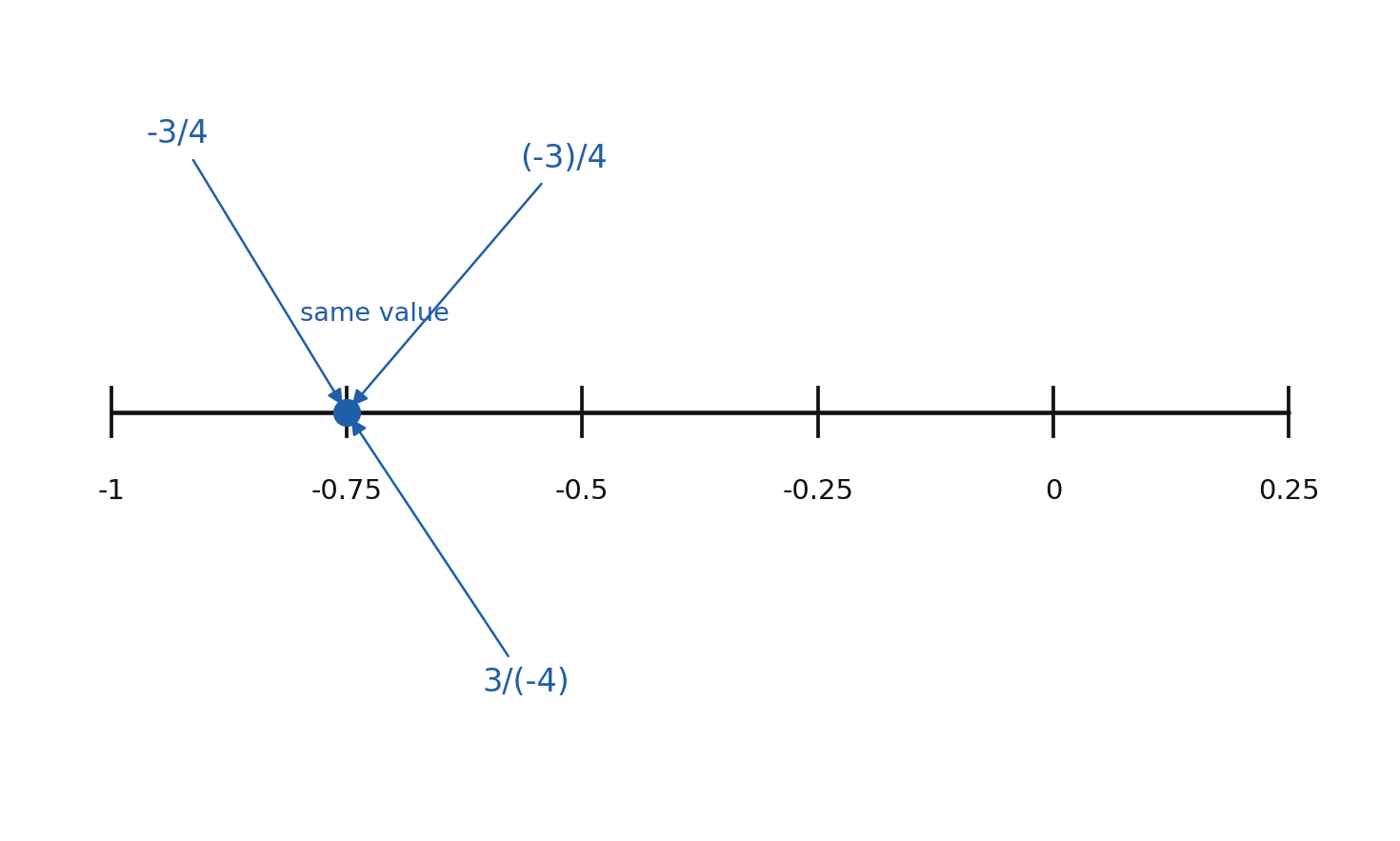
This will always happen because division with exactly one negative sign produces a negative quotient, provided that the numerator is not zero and the denominator is non-zero.
