Adapting Your Leadership Style
📣 Welcome to the Course
Welcome to Diagnose Before You Lead! If you manage people, you've probably noticed something uncomfortable: the exact same approach that works beautifully with one person falls flat with another. That's not a flaw in you or them. It's a signal that leadership is not one fixed move you get right once, but a read you take on each person and each task. In this course you'll learn to make that read deliberately, weighing both what a person can do and how committed they are, so you stop leaning on a favorite style and start giving each person what the work in front of them actually calls for.
In this first lesson, you will learn to:
- Distinguish adaptive leadership from applying one favorite style to everyone.
- Spot the two most common style-situation mismatches: abandoning a novice and micromanaging an expert.
- Diagnose which mismatch is causing a slip and design a corrective shift from what you actually observe.
🎯 Leading the Task in Front of You, Not Your Habit
Most managers lead from a default, a go-to setting they slip into without deciding to. Maybe you're a natural stepping-back type: you hand work over, trust people, and stay out of the way. Maybe you're a hands-on type: you like to set the plan, check the details, and stay close. Others default to being the cheerleader who supplies plenty of energy but little structure, or the firefighter who jumps in and takes the work back the moment it wobbles. These defaults usually come from what worked for us earlier in our careers, how we ourselves were managed, or simply what feels comfortable, which is exactly why we stop noticing them. The problem is when you apply that one default to every person and every task, no matter what they need.
Adaptive leadership simply means adjusting two dials for each situation: how much direction you give (telling someone what to do, how, and by when) and how much support you give (encouraging, listening, and drawing out their own thinking). A brand-new hire on an unfamiliar task usually needs more direction. A proven expert on work they've done many times usually needs less. Same manager, different dials, because the situation is different.
Here's the shift in mindset: you're not leading a person in general, you're leading a person on a specific task, right now. Someone can be highly capable at one thing and genuinely green at another. So the question is never "What's my style?" It's "What does this task, for this person, need from me today?"
Let's see that trap in action. Chris, Dan's manager, stops by to check in on how Dan's team is handling a new round of client reports, and Dan catches the moment his one default stopped fitting:
- Chris: How's the team doing with the new client reports?
- Dan: Ash is flying. I gave them the whole analysis and barely checked in. They're sharp, so I got out of their way.
- Chris: Nice. And the new hire you put on the same kind of task?
- Dan: Same playbook. Handed it over, told him to run with it. Except he's gone quiet on me.
- Dan: Honestly, I think he's drowning. I thought I was empowering him, and I did the opposite.
Notice that Dan wasn't careless. He applied a genuinely good instinct, get out of the way, to someone who needed the opposite. That's the trap: your default feels like leadership, so you don't notice when it stops fitting.
🔍 Spotting the Two Mismatches Behind a Slipping Result
When work slips, the reflex is to look at the person: they need to try harder, care more, step up. Resist that. More often, the result is slipping because your style and the situation don't match. Two mismatches cause most of the trouble, and they're mirror images of each other.
The first is abandoning a novice. You hand someone new a task with little more than "here's the template, figure it out." You think you're granting freedom. What they experience is being dropped in deep water without knowing how to swim. Deadlines slip, quality wobbles, and they often hide the struggle because they don't want to look incapable. The performance problem is real, but the cause is too little direction, not too little effort.
The second is micromanaging an expert. You take someone who genuinely knows the work and rewrite their output line by line, second-guess their calls, and hover over every step. You think you're protecting quality. What they learn is that you don't trust them. They stop bringing their best thinking, wait for your edits instead of owning the outcome, and slowly disengage. Again, a real performance problem, and again the cause sits with your style, not their ability.
The diagnostic move is to pause and ask two questions before you assign blame:
- What did this person actually have to work with, and was it enough for their level on this task?
- What is this person learning about how much I trust them?
When you answer honestly, you can usually name which mismatch is driving the slip.
🛠️ Designing the Corrective Shift
Once you've named the mismatch, correcting it is refreshingly concrete. You're not overhauling your personality; you're running the same three-step move every time, Diagnose → Shift → Signal, then watching to see if the adjustment lands.
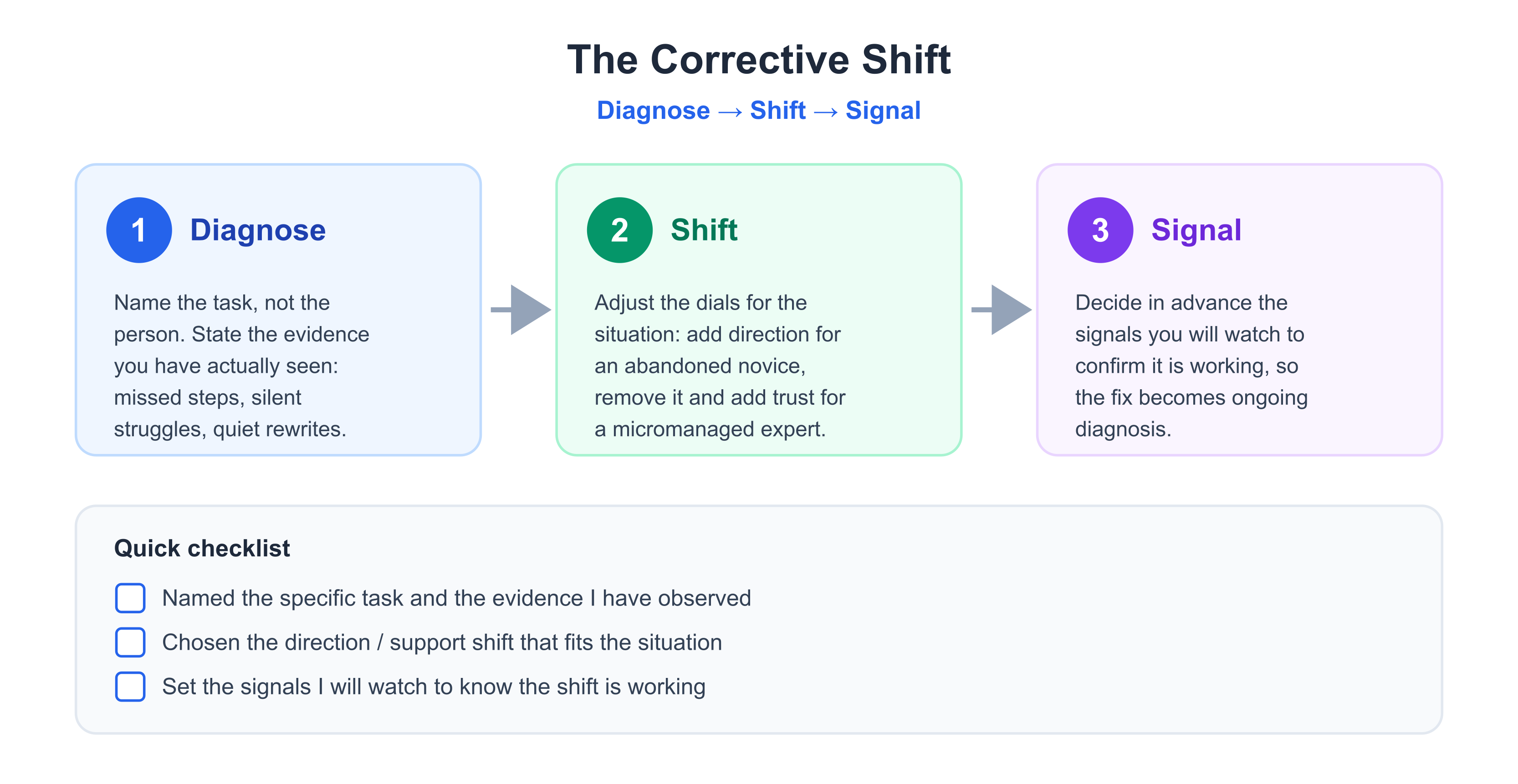
- Diagnose the task, not the person. Name the task precisely, not "Kendall needs help" but "Kendall is doing this reconciliation process for the first time," then state the evidence you've actually observed: the missed steps, the questions never asked, the rewrites you've been quietly doing. Evidence keeps the correction tied to the work rather than to a personality judgment.
- Choose the shift. For the abandoned novice, add direction: walk through the steps, define what "good" looks like, set checkpoints, and make it safe to ask questions. For the micromanaged expert, remove direction and add trust: stop rewriting, hand back ownership of the decisions, and ask what they need from you instead of telling them what to do.
- Set the signals you'll watch. Decide in advance how you'll know it's working. For the novice, watch whether they can restate the steps and hit the next checkpoint without a scramble. For the expert, watch whether they start volunteering ideas again and deliver clean work without your edits. Naming these signals up front is what turns a one-time fix into ongoing diagnosis rather than a set-it-and-forget-it correction.
When a result slips, look first at the fit between your style and the situation, not at the person's willpower. Next, you'll put this into practice: first sorting real management scenarios into the two mismatches, abandoning a novice or micromanaging an expert, then diagnosing a live case out loud and turning it into a corrective plan you can actually use.
