Understanding Data Mesh Principles
Welcome to the Course 🎉
Most data mesh conversations you'll be pulled into will arrive disguised as platform conversations. Someone will show you an architecture diagram and ask whether you support the mesh, and your real job will be to ask who decides what, who is accountable when a published dataset is wrong, and who pays for the capability that makes any of it possible. Here, data mesh is treated as what it actually is: a redistribution of decision rights and accountability, not a technology purchase.
In this lesson, you will learn to:
- Explain the four data mesh principles and how each depends on the others.
- Analyze how the principles redistribute decision rights among domain, platform, analytics, and governance teams.
- Challenge a technology-only reading of data mesh using operating-model evidence.
This first lesson establishes the four principles and, more importantly, what they demand of the people around you.
The Four Principles and Their Mutual Dependence 🧩
Data mesh rests on four mutually reinforcing principles. First, domain-oriented decentralized ownership: responsibility for data sits near the business knowledge that gives it meaning, rather than in a central team translating on everyone's behalf. Second, data as a product: what a domain publishes is treated with consumer value and reliability as first-class concerns, not as an exhaust stream someone else can salvage.
Third, a self-serve data platform: the repeated friction of producing and consuming data is reduced so domains are not each rebuilding the same plumbing. Fourth, federated computational governance: shared rules agreed with distributed participation, with the computational part meaning that an already-agreed rule can be expressed and applied consistently through the platform.
What makes these principles rather than a checklist is that each one fails without the others. Decentralized ownership without data-as-a-product thinking produces a set of private silos with better branding. Data as a product without a self-serve platform means every domain pays a capability tax it cannot afford, and only the best-resourced domain succeeds. A self-serve platform without ownership produces a well-built empty stadium. And all three without federated governance produce fast, well-made, mutually incomparable data that no regulator or enterprise metric can reconcile.
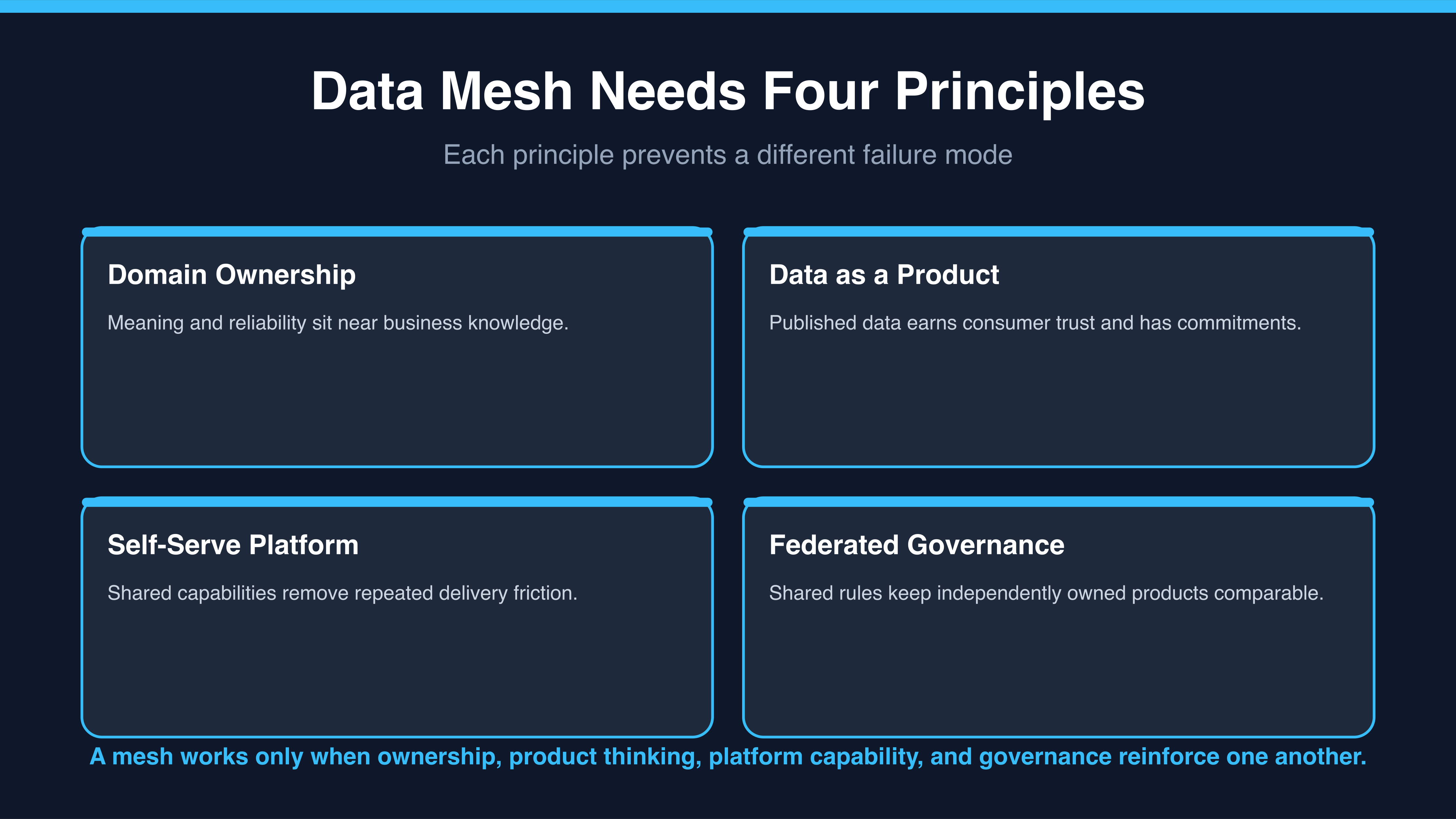
The four principles are mutually reinforcing: omitting one creates a predictable operating-model gap.
How Decision Rights Get Redistributed ⚖️
The most useful way to read any mesh proposal is to ask which specific rights move and which stay put. Four rights are usually in play:
- who defines a data asset's meaning;
- who accepts accountability for its reliability;
- who decides publication and access; and
- who sets and enforces standards.
Under the principles, meaning and reliability move toward domains, publication and access move toward domains within shared rules, and standards move to a federated body rather than a single central team.
The failure mode is not a right moving to the wrong place. It is a right moving nowhere at all.
In an architecture-review discussion, Jessica, a domain representative, tests a proposal with Natalie, an analytics lead focused on accountability.
- Jessica: The proposal says domains are "empowered to publish." That sounds like ownership to me.
- Natalie: Empowered to publish, yes. But when the churn figure is wrong on a Monday morning, who is on the hook?
- Jessica: Analytics would probably fix it, like today.
- Natalie: So the right to define meaning moved to the domain, but the accountability for reliability stayed with analytics. That is the gap I would flag in the review.
- Jessica: And nobody has written that down anywhere.
Notice that Natalie doesn't argue about the platform at all. She traces one right at a time and finds the one that was never assigned.
Challenging a Technology-Only Reading 🔍
A proposal that funds a self-serve platform and nothing else has delivered exactly one of four principles, and the weakest one on its own. The evidence you use to make that case is operating-model evidence, not architectural critique: which named party accepts reliability accountability, what happens when two domains disagree on a definition, and who funds the domain data roles that ownership presumes. If those three questions have no answers, the initiative is a migration wearing a mesh label.
The single idea to carry from this lesson is that data mesh is legible only as a map of decision rights. Two quick checks come next to test whether you can match each principle to the problem it solves, followed by a written assessment where you'll build the before-and-after decision-rights comparison an architecture forum could actually act on.
