Setting Up Comparisons
Introduction
Welcome to Comparing Two Populations, the final course in this learning path! Over the previous courses, you built a solid toolkit: choosing trustworthy samples, summarizing data with measures of center and spread, and drawing conclusions about a single population. Now we are going to put that toolkit to work in a new way — by comparing two populations side by side.
In this first lesson, we will learn how to set up a two-population comparison correctly before any numbers are crunched. That means pinning down exactly which two groups we are comparing, what single numerical measure we are looking at in both, and whether our two samples are actually suitable for a fair comparison. Getting this setup right is the foundation for everything else in the course.
Why Compare Two Populations?
Many of the most interesting questions in everyday life are not about one group alone but about how two groups differ. A school principal might ask whether students at School A read faster than students at School B. A nutritionist might wonder whether Brand X cereal has more sugar per serving than Brand Y. A city planner might compare commute times in two neighborhoods.
In each case, we are not just summarizing one group. We are placing two groups next to each other and asking, "Is there a real difference?" Before we can answer that, though, we need to be very precise about what we are comparing and how. A sloppy setup can lead to misleading conclusions, no matter how carefully the numbers are calculated afterward.
Identifying the Two Populations
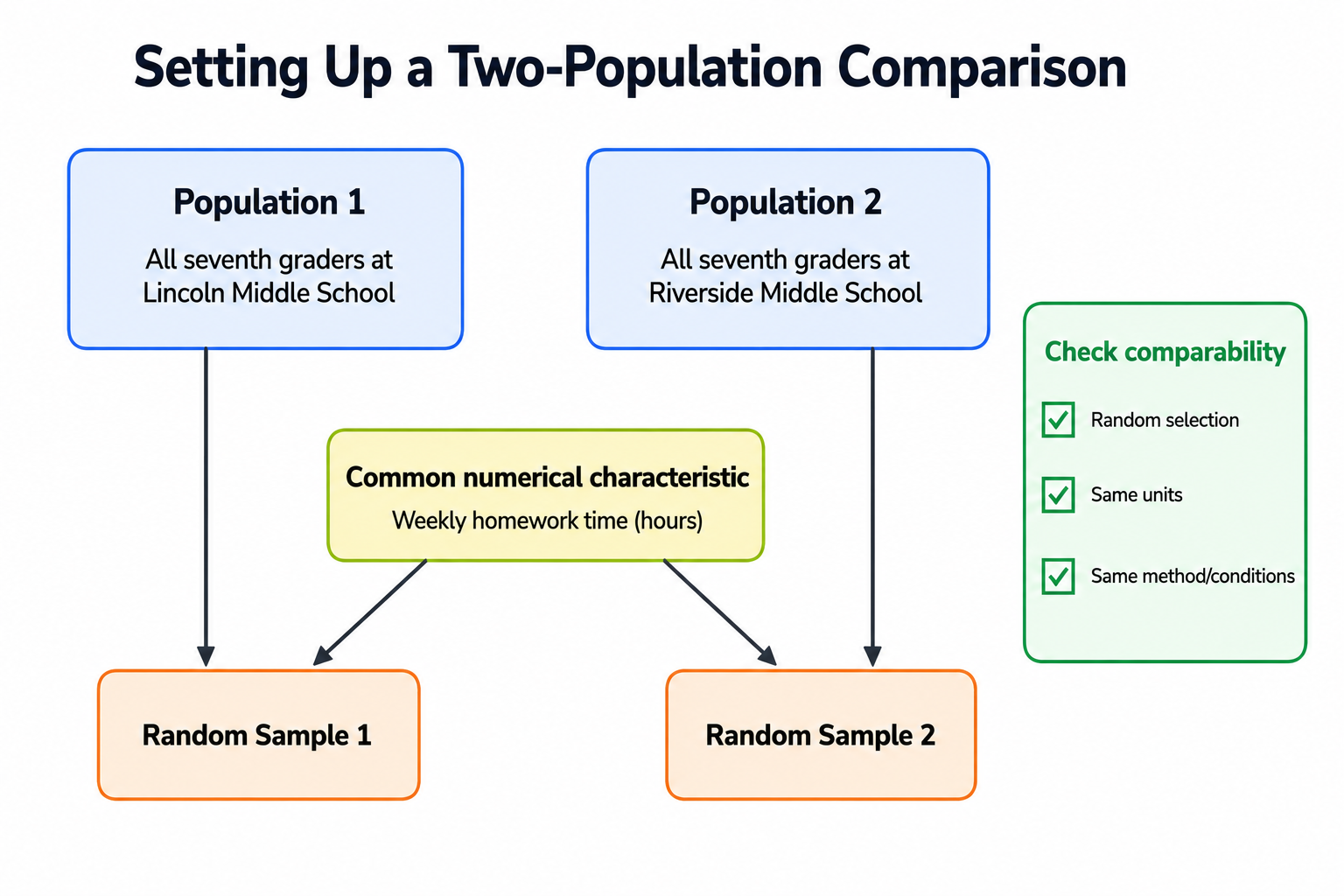
As you may recall from earlier courses, a population is the entire group we want to learn about. In a two-population comparison, we need to clearly name both populations. Consider this question: "Do seventh graders at Lincoln Middle School spend more time on homework than seventh graders at Riverside Middle School?" Here the two populations are:
- Population 1: All seventh graders at Lincoln Middle School
- Population 2: All seventh graders at Riverside Middle School
Being specific matters. If we said "students" instead of "seventh graders at Lincoln Middle School," it would be unclear which students we mean. A clean comparison starts with two clearly defined, distinct groups.